HD claims logo without B (2)
0%
Loading ...

Motorcycle Accident Claims Scotland

element

As Featured In:

circle-element

Check Out Our Awesome Reviews Below:

If you were injured in a motorcycle accident in Scotland because another road user was negligent, you may be entitled to claim compensation. Riders are among the most vulnerable road users on Scottish roads, and even one road traffic collision can leave you dealing with life-changing injuries, pain, disruption, and serious uncertainty about what comes next. According to Transport Scotland, motorcyclists account for 18% of all road fatalities in Scotland, despite representing less than 1% of total road traffic.

At HD Claims, our role is to manage the legal strategy of your motorcycle accident claim from start to finish.

We're Here To Help

Contact Us Today

We work alongside a team of specialist motorcycle accident solicitors who are best suited to your specific case, so your representation is tailored to your needs. We oversee the process, keep you fully informed, and give clear step-by-step support while you focus on your medical treatment and rehabilitation.

If you want clear advice about your eligibility for motorcycle accident compensation in Scotland, contact us today.

Speak to our compensation experts

It doesn't cost you anything to know where you stand.

Fill out the form, and we'll get back to you within one hour.

Need to speak to us sooner?

Call us on 0141 280 1112

Request a FREE call

Terms and conditions

What to Do Immediately After a Motorcycle Accident in Scotland

Before anything else, protect your health. Move out of traffic if you can do so safely, call for emergency help if anyone is badly hurt, and accept hospital assessment if it is offered. After a motorcycle crash, pain may not feel severe straight away, but it can become worse once the initial shock wears off. Some concussion symptoms may also take up to 48 hours to appear.

Securing the Scene and Reporting to Police Scotland

Start with the basics. If you are able, switch off the bike, get to a safer position, and check whether anyone else needs urgent help. If there is a serious injury, danger on the road, or you need an immediate response, contact Police Scotland on 999. If the matter is not urgent, you can report it using Police Scotland’s online form.

Then exchange details with the other driver or road user if that is possible. Take their name, address, registration, and insurer details, and make a note of the make and model of every vehicle involved.

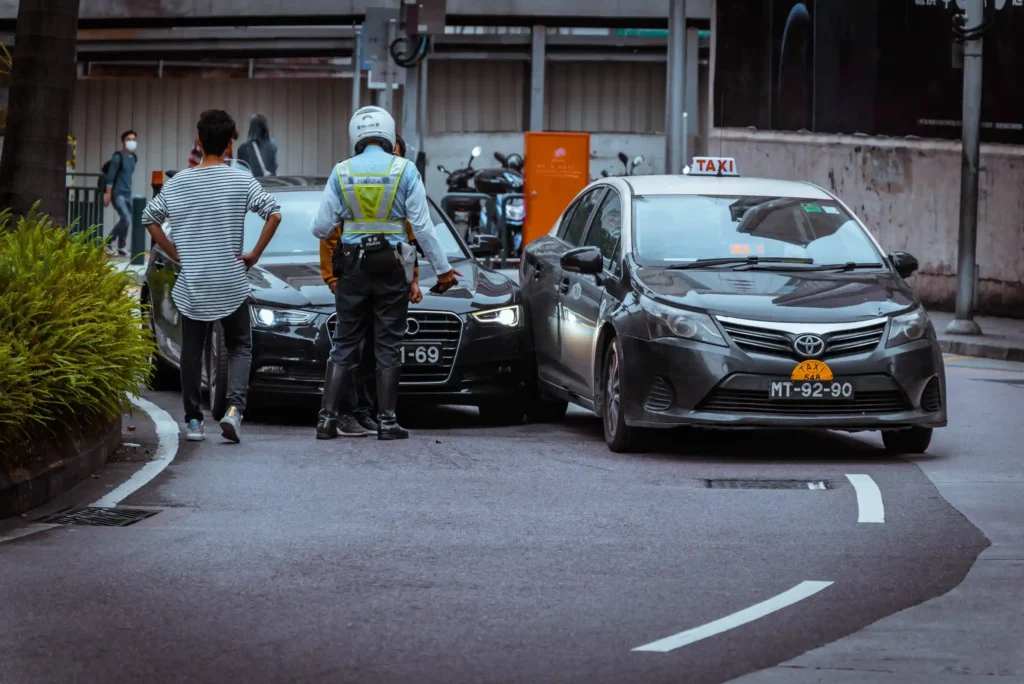
Motorcycle-Accident-Compensation-Claim-Guide

If those details are not exchanged at the scene, the collision should be reported to the police as soon as possible and, in any case, within 24 hours.

If officers come to the scene, ask for the accident reference number before you leave. That police report reference can help tie together the timeline of the crash, the parties involved, and the first account of what happened.

Gathering Essential Evidence for Your Claim

Try to gather and keep:

Do not rush to repair the motorcycle or throw away damaged gear. Those items can help show the force of impact, the angle of the collision, and the extent of the damage. The same applies to receipts for medication, taxis, parking, and private treatment.

You should also notify your insurance company as soon as you can, but make sure your account is clear, accurate, and factual. If you are not certain who was at fault, do not guess. A careful record made early on is far more helpful than a rushed explanation.

If you already have the first pieces of evidence, we can review them in a free and confidential case assessment and tell you whether they are likely to support a personal injury claim.

Common Causes of Motorbike Accidents on Scottish Roads

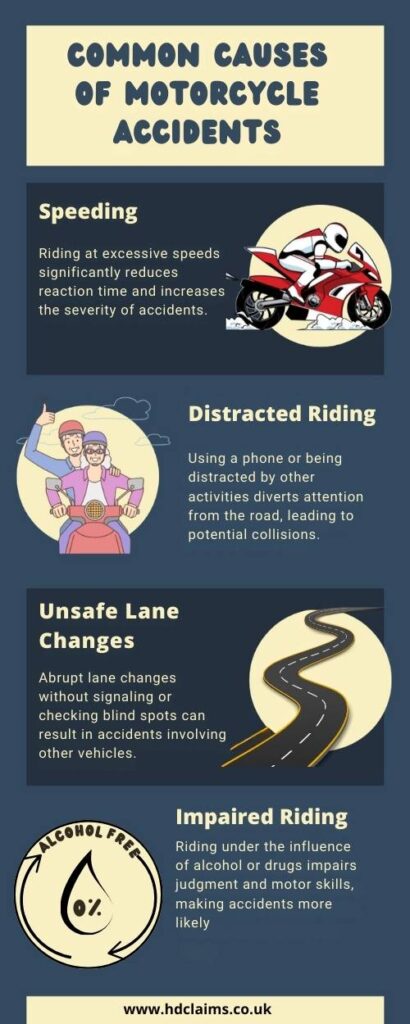
According to 2023 figures from Transport Scotland, loss of control was the most commonly recorded factor for motorcycles, while “failed to look properly” was the most frequently recorded factor overall. Both are common causes of serious bike crashes on Scottish roads.

info-graphic-motor-cycle-accident-claim-scotland
Satisfied Clients
0 K+
Dedicated Experts
0 +
Client Rating
0
Compensation Recovered
£ 0 + Million

Junction Collisions and Pulling Out Without Looking

Many motorbike crashes happen at junctions, especially at busy junctions and roundabouts such as the A720 near Sheriffhall, where poor observation, rushed decisions, and late turns can put riders at real risk.

When a car pulls out in front of a rider, the driver is often at fault. Road users must make proper observations before moving off or turning, and that duty applies just as much when a motorcycle is approaching as it does with any other vehicle.

Blind Spots, Lane Changes, and Filtering

Blind spot collisions and unsafe lane changes are also a common cause of motorcycle accidents. If a driver changes lane without properly checking their mirrors and blind spots, then moves across the path of a bike already there, fault will usually rest with that driver.

Filtering also needs to be assessed carefully on its own facts. A rider is not automatically to blame for passing slow-moving or stationary traffic. Drivers are expected to watch for motorcycles moving through queues, while riders must filter with care, especially near junctions, gaps in traffic, and vehicles that may turn suddenly.

Road Surface Hazards and Single-Bike Crashes

Some accidents involving motorcycles are caused by the road itself rather than another vehicle. Major roads such as the A90 between Aberdeen and Dundee, or longer rural stretches of the A9 between Perth and Inverness, can present hazards such as potholes, loose gravel, standing water, or diesel spills that throw a rider off line.

These cases often depend on who was responsible for inspection, maintenance, or hazard control at that location.

SMIDSY accidents

You may hear riders describe a crash as a SMIDSY accident, short for “Sorry Mate I Didn’t See You.” It usually points to the same failure: the driver did not look properly, misjudged the bike’s speed, or simply did not notice it in time.

If your crash happened because a driver pulled out, changed lanes, opened a door into your path, or forced you off line while overtaking, there may be a strong basis for a claim. We can review the circumstances and tell you whether the evidence suggests the other party was at fault.

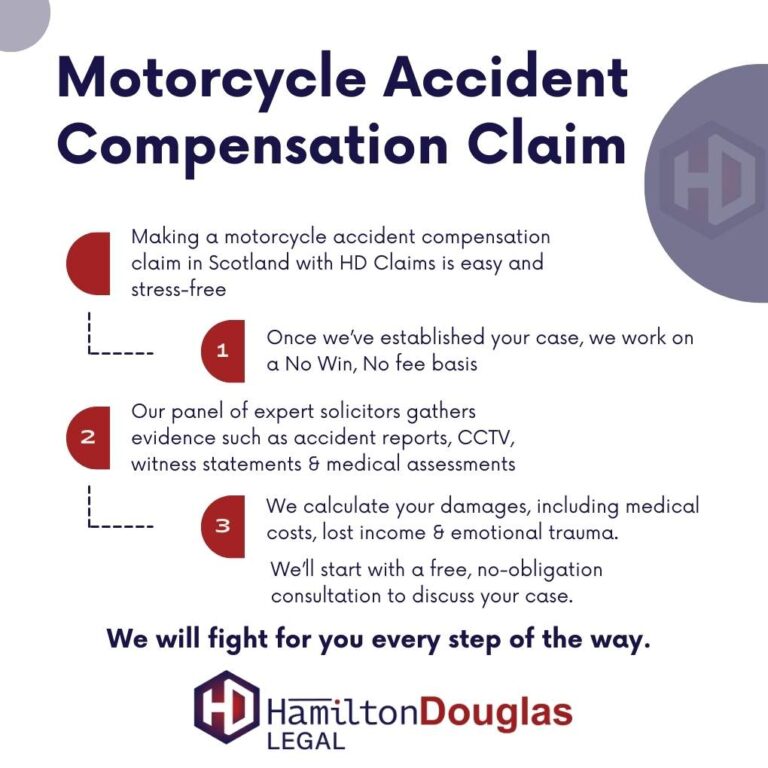
Making A Personal Injury Claim In Scotland

Our panel of experienced personal injury lawyers excel in handling cases against well-funded insurance companies.

Our specialised injury lawyers will assist you with your claim, keep you informed throughout the whole process, and provide you with legal advice that is easy to understand.

01

Get In Touch.

Tell us your story, we're here to listen and provide you with an initial assessment based on your circumstances.

02

We’ll Prepare Your Claim.

We'll be by your side to take care of the legal process. We'll keep you informed of every step of the way.

03

Receive Compensation.

If your claim is successful, we'll ensure that you get your compensation as soon as possible.

efthymios-xylangouras

"A Student’s Journey from Trauma to Triumph: Efthymios’s Fight for Justice After a Devastating Car Accident"

When Efthymios was injured in a car accident, he was left with severe facial injuries. He didn’t know how he would manage his recovery and studies.

“When I got in contact with HD Legal, they made me feel supported. They were incredibly understanding and fought hard for me, ensuring I received the compensation I deserved.”

Read Efthymios’s story >

margaret-forbes

"Cracked Pavement, Broken Ankle: How HD Legal Helped Margaret Find Justice and Peace of Mind"

When Margaret tripped on a neglected crack in the pavement in Glasgow, she shattered her ankle and was forced to take months off work, unsure how she would manage.

“HD Legal were a lifeline for me. They took care of everything—from gathering crucial evidence to battling the council—and gave me the peace of mind I needed to focus on my recovery.”

Read Margaret’s story >

douglas-macgregor

"Blown Away: HD Legal Fights for Douglas After Faulty Washing Machine Explosion"

When Douglas’s new washing machine exploded, it caused a fire that damaged his kitchen and left him with painful burns.

“HD Legal fought relentlessly for me when it seemed like no one else would. They were thorough, professional, and supported me every step of the way, helping me recover both physically and financially.”

Read Douglas’s story >

smiling-women

"From Misdiagnosis to Recovery: How HD Legal Fought for Eilidh’s Justice and Secured the Care She Needed"

When Eilidh’s severe abdominal pain was repeatedly misdiagnosed, her condition worsened, leading to the need for urgent surgery.

“HD Legal stood by me when I felt lost. They were thorough, professional, and fought tirelessly to get me the care and compensation I needed to heal.”

Read Eilidh’s story >

smiling-man

"Falling from Heights, Rising with Justice: How HD Legal Secured Compensation for Alistair After a Workplace Accident Involving Faulty Scaffolding"

Alistair Campbell’s fall from faulty scaffolding left him with serious injuries and months of recovery.

“HD Legal’s panel of solicitors fought for me, ensuring I received the support needed to move forward.”

Read Alistair’s story >

Meet The Team

Maisie-MacLeod.

Maisie MacLeod

Senior Claims Manager

ella-campbell

Ella Campbell

Head of Serious Injury

Freya Douglas

Freya Douglas

Long-Term Illness Specialist

Severe Injuries Suffered by Motorcyclists and Pillion Passengers

Yes, we handle cases involving severe and life-changing injuries. In 2025, there were 581 reported motorcycle casualties in Scotland. Of those, 58% were seriously injured, and 34 were killed.

Why Motorcycle Injuries Are Often So Severe

Riders and pillion passengers have very little physical protection in a collision. Once a bike is struck, the rider may take the force of the impact directly or hit the road at speed, which is why injuries in motorcycle crashes are often far more serious than those in car accidents.

The type of injury usually depends on how the crash happened. A rider thrown over the handlebars may suffer chest trauma, facial injury, or a serious head or brain injury from a crash. A rider trapped under the bike or hit side-on may be left with pelvic damage, crush injuries, or a leg or lower limb injury after a road collision.

Common Physical Injuries

Motorcycle crashes regularly cause:

These injuries can affect far more than pain levels. They may stop someone from walking properly, driving, lifting, climbing stairs, or returning to manual work for months, and sometimes permanently.

Head Trauma and Psychological Harm

Even where early symptoms seem manageable, head injuries need close attention. Concussion can affect memory, concentration, balance, sleep, and confidence long after the crash itself.

Psychological trauma is also common after a serious bike collision. Some riders and passengers experience flashbacks, panic in traffic, disturbed sleep, or a lasting fear of riding again. These effects can make recovery more difficult and can also make it much harder to return to work.

Rehabilitation and Long-Term Support

Severe trauma often requires long-term rehabilitation. That may include physiotherapy, pain management, orthopaedic care, prosthetic treatment, counselling, occupational therapy, or support with mobility and daily living.

Where those needs were caused by the crash, a claim may include the cost of treatment and rehabilitation. If you are dealing with a brain injury, spinal trauma, serious orthopaedic damage, or lasting psychological harm, we can assess what treatment, support, and financial recovery your case may be able to include.

How Much Compensation Will I Get for a Motorcycle Injury in Scotland?

The value of a motorcycle injury claim in Scotland depends on two things: how seriously you were hurt and how much the crash has cost you, both financially and personally. In Scotland, the injury itself is assessed separately from the financial losses that flow from it, which is why two riders with a similar diagnosis can still receive very different settlements.

Understanding Solatium and Financial Loss

Under Scots law, solatium covers pain, suffering, and the impact the injury has had on your daily life. Patrimonial loss covers the financial side of the claim, such as loss of earnings, treatment costs, travel expenses, damaged riding gear, and motorcycle replacement or repair if the bike is beyond economic repair.

The Judicial College Guidelines can be used as a reference point when valuing an injury, but they are only part of the picture. Medical evidence, recovery time, work impact, and future needs often matter more in a case.

That becomes clear when you look at how bike crashes affect people differently. A rider who suffered a whiplash or neck injury in the accident may recover in a few months, or may be left with ongoing pain that affects sleep, driving, concentration, and work. Another rider may need surgery, private physiotherapy, and long-term support. The same diagnosis on paper does not always mean the same outcome in life.

A proper valuation also considers future costs. If you need physiotherapy, counselling, surgery, prosthetic care, or other rehabilitation costs, those future needs should be assessed rather than left out. If you want a realistic idea of what your claim may be worth, we can review your injury, your financial losses, and the evidence already available, then give you a tailored assessment of your likely motorcycle accident compensation in Scotland.

Claiming Through the Motor Insurers' Bureau (MIB) for Hit-and-Run or Uninsured Drivers

Yes, you can still claim if the driver drove off or had no insurance. The Motor Insurers’ Bureau handles claims involving an untraced driver or an uninsured motorist under the Uninsured Drivers’ Agreement and the Untraced Drivers’ Agreement.

For hit-and-run cases, reporting the crash to the police quickly is essential. According to MIB, an accident involving an untraced driver must be reported to the police within 14 days, even if the claim itself is made later.

Early evidence can make a real difference in these claims. Helmet camera footage, CCTV, witness details, debris from the scene, and medical records can all help show what happened. If you are not sure whether your case should go through MIB or a standard insurer route, we can look at the facts and tell you the best next step.

What Are the Time Limits (Time Bar) for Scottish Motorcycle Claims?

In Scotland, you generally have three years to start a motorcycle injury claim in court. For most motorcycle injury claims in Scotland with value under £25,000, the case will usually begin under the compulsory Scottish Personal Injury Pre-Action Protocol. This is a formal process that gives both sides the chance to exchange information, review the evidence, and explore settlement before court action is raised.

If the insurer does not make a fair offer during that process, the claim can then move into formal court proceedings. Depending on the value and complexity of the case, that may mean the All-Scotland Sheriff Personal Injury Court, another sheriff court, or, in more complex or higher-value matters, the Court of Session. That three-year limitation period is often called the triennium, and if court action is not raised in time, the claim can become time-barred under the Prescription and Limitation Act.

For most riders, the clock starts on the date of the crash. In some cases, the date can run from when you first became aware that the injury was significant and linked to the accident, but it is risky to assume that extra time will apply. The safest approach is to treat the deadline as three years from the accident and act early.

Deadlines matter because a strong case needs time to be prepared properly. CCTV footage may only be kept for a short time, witnesses can become harder to trace as weeks and months pass, and medical evidence is rarely available straight away. Leaving things until the last few months can make the process more difficult than it needs to be.

If your deadline is getting close, it is worth getting advice now. We can check the dates, look at whether your case is in danger of becoming time-barred, and explain the next steps clearly.

Can I Claim if the Accident Was Partly My Fault? (Contributory Negligence)

Yes, you may still be able to claim even if you were partly responsible for what happened. Contributory negligence does not automatically stop a case. It usually means the compensation may be reduced to reflect your share of the blame.

The real question is how responsibility is divided. A driver may still be mainly at fault for pulling out, changing lanes without checking properly, or turning across your path, even where there is an argument that you were travelling a little too fast or could have reacted differently.

That is where split liability can apply. For example, a court might decide that the other driver was mostly at fault, but that the rider also contributed in a smaller way. The result is reduced compensation, not the loss of the whole claim.

These cases are fact-sensitive. Small details such as road position, speed, visibility, helmet camera footage, and witness evidence can make a real difference to how blame is divided. If an insurer is trying to put part of the crash on you, your solicitor can assess whether that is actually supported by the evidence.


DEDICATED CLAIMS ADVISORS

Our dedicated claims advisors are always available to offer free legal advice.

100% NO WIN NO FEE CLAIMS

All our claims are processed on a No Win No Fee basis; you pay nothing if you lose.

appear-logo-in-mobile

MILLIONS SECURED IN DAMAGES

To date, we have secured millions in damages.

THOUSANDS OF SATISFIED CLIENTS

To date, we have helped thousands of clients recover compensation and continue to do so.

Why Choose HD Claims for Your Scottish Motorcycle Accident Case?

A motorcycle case in Scotland is not just another road traffic claim. It is dealt with under Scots law, Scottish time limits, Scottish valuation principles, and Scottish court procedure, within a legal system that includes institutions such as the Court of Session and the Law Society of Scotland.

Our role is to manage the legal strategy of your claim from start to finish. We work alongside specialist road accident compensation solicitors in Scotland whose experience fits the case, keep you updated, and make sure the claim stays focused on what matters: proving fault, valuing the damages properly, and protecting your position while you recover.

If your injury involved a bicycle rather than a motorbike, see our guide to cycling accident claims in Scotland.

No Win No Fee Motorcycle Claims Explained

In Scotland, No Win No Fee arrangements work through a formal system known as success fee agreements. The Civil Litigation (Expenses and Group Proceedings) (Scotland) Act 2018, together with the 2020 regulations, recognises these agreements as a form of no win, no fee funding and places limits on the success fees that can be charged in personal injury cases.

That gives you a clearer route to claiming at no upfront cost in Scotland. According to the Scottish Government policy note on the 2020 regulations, claimants typically pay nothing up front under these arrangements, and the regulations cap personal injury success fees at up to 20% of the first £100,000 of damages, 10% of the next £400,000, and 2.5% over £500,000.

If you want a Scotland-based team to take control of the legal strategy, explain the funding clearly, and move the case forward without delay, we can assess your case now and tell you where you stand.

FAQs

Can I make a claim if I was a pillion passenger?

Yes, in most cases you can. A pillion passenger is usually treated as an innocent party, so the claim can often be made against the rider’s insurer if the rider was at fault, or against another driver’s insurer if they caused the crash.

Usually, no. Most motorcycle injury claims settle without you having to attend a court hearing. Court only tends to become necessary where fault is denied, or the other side refuses to make a fair offer.

It can affect the value of the claim, but it does not usually prevent you from claiming altogether. For example, if a helmet was not fastened properly or other missing gear made the injuries worse, there may be a reduction in compensation to reflect that.

If you want straightforward advice about your case, we can look at the facts, explain where liability is likely to lie, and tell you what the next step should be.

We’re Here To Help When You Need Us Most.

Call us on 0141 2801112, or leave us a message below to request a call back and one of our team will be in touch as soon as we can.

Terms and conditions