- Obligation-Free Consultation
- No Win, No Fee
- Award-Winning Lawyers
As Featured In:
Check Out Our Awesome Reviews Below:
EXCELLENT
Based on 99 reviews
Posted on Google![]()
Daniel MorosanuTrustindex verifies that the original source of the review is Google.
I cannot thank the team at HD Claims enough for their help with my personal injury claim. From day one, their injury lawyers were incredibly professional, explaining the no win no fee process clearly without complex jargon. They took away all the stress of dealing with the insurance companies and secured the accident compensation I was entitled to. If you are looking for reliable personal injury solicitors who truly look out for your best interests, I highly recommend their services.Posted on Google![]()
Gigel stoicaTrustindex verifies that the original source of the review is Google.
HD Claims made my personal injury claim simple and stress-free. The team was professional, responsive, and kept me updated throughout the process. I would recommend them to anyone needing help with an accident compensation claimPosted on Google![]()
Muhammed AhmedTrustindex verifies that the original source of the review is Google.
I was involved in a car accident where my car was written off and my passengers were seriously injured. I contacted HD Claims and received an excellent service from start to finish. They were very understanding and took the time to explain the whole process clearly. In the end, I received a very favourable settlement. I would most definitely recommend this firm to anyone in a similar situation.Posted on Google![]()
Sarah TaylorTrustindex verifies that the original source of the review is Google.
Excellent service from HD Claims! They completely managed my personal injury claim from start to finish and allocated me a fantastic specialist solicitor. The whole process was handled on a 'no win no fee' basis, making it entirely stress-free. Their communication was top-notch, and I am very happy with the final settlement I received. I highly recommend their team to anyone looking for reliable legal support.Posted on Google![]()
Nico SullivanTrustindex verifies that the original source of the review is Google.
HD Claims were brilliant after my accident. They handled everything smoothly and kept me informed the whole time. If you need personal injury lawyers with car accident experience, they’re a great choice.Posted on Google![]()
faiq zebTrustindex verifies that the original source of the review is Google.
I've used HD Claims for a few car accidents I've suffered over the years as a taxi driver. Always received a great experience and compensation - Asif Khan GlasgowPosted on Google![]()
picui bossTrustindex verifies that the original source of the review is Google.
Hey my name is Andrei and I’m with John white my self and they are They are the best 100% in all Scotland you should try with them. They’re the best service and they provide with everything. What you want to know about and I give them out 10 out of 10.Posted on Google![]()
GAMERS ONLYTrustindex verifies that the original source of the review is Google.
Was a very good service 👏Posted on Google![]()
Sunny InboxTrustindex verifies that the original source of the review is Google.
I had a great experience with HD Claims. The injury lawyers were professional, responsive, and explained everything clearly. They handled my case with care and confidence, making the whole process stress-free. Highly recommended for injury claims.Posted on Google![]()
John SmithTrustindex verifies that the original source of the review is Google.
My insurance company recommended a firm that charged 30% and had poor reviews. I went with Hamilton Douglas instead, who charged far less and were completely transparent. They were professional, communicative, and secured me an excellent settlement. Do your research and pick them.Verified by TrustindexTrustindex verified badge is the Universal Symbol of Trust. Only the greatest companies can get the verified badge who has a review score above 4.5, based on customer reviews over the past 12 months. Read more
If you suffered a leg injury in Scotland because another person or organisation was negligent, you may be entitled to claim compensation. Leg injury compensation claims in Scotland can follow a road collision, an accident at work or a fall on unsafe property.
A leg injury can quickly change how you live. Driving, climbing stairs or getting through a full shift may become difficult. If the injury is severe, you may need help at home and face a long period of rehabilitation.
According to Public Health Scotland unintentional injury statistics, unintentional injuries led to 56,294 emergency hospital admissions in 2023/24. This represented around one in ten emergency admissions in Scotland.
Speak with HD Claims for a free, confidential assessment. We will listen to what happened, check whether you have grounds to claim and explain what you can do next.
Speak to our compensation experts
It doesn't cost you anything to know where you stand.
Fill out the form, and we'll get back to you within one hour.
Need to speak to us sooner?
Call us on 0141 280 1112
- Over £3+ Million in Settlements
- No Win, No Fee
- Supporting Scots Since 2001
- 10 Offices Around Scotland
Request a FREE call
How to Make a Leg Injury Claim in Scotland
Your health comes first. Once you are safe and have received treatment, a few early steps can make the claim easier to investigate.
Get medical help
Go to A&E, contact NHS 24 or speak to your GP, depending on how badly you are hurt. Tell the medical professional about every symptom, even if one area feels more painful than another.
Medical records will help link the injury to the accident. They can also show how your symptoms changed and whether you needed further treatment.
Report what happened
At work, ask for the accident to be entered in the accident book. If you fell in a shop or another public place, report it to the manager and request a copy of the accident record.
Road collisions should be reported to the police when the law requires it. You should also tell your insurer, even if you believe another driver was entirely responsible.
Save what you can
Photographs taken shortly after the accident can be very useful. Try to capture the wider scene, the problem that caused the accident and any visible injuries.
Keep dashcam footage and ask nearby businesses to preserve relevant CCTV. Write down witness details before people leave, as it can be difficult to trace them later.
Keep a record of the effect on your life.
Save payslips, receipts and invoices connected with the injury. These may include taxi fares to hospital, prescription charges, physiotherapy fees or the cost of crutches.
It can also help to keep a brief diary. A note explaining that you needed help getting dressed or could not complete a normal shift often gives useful context that medical records alone cannot provide.
Get early legal advice.
Early legal advice can identify who may be responsible and whether an insurer should be contacted. It also reduces the risk of losing CCTV, maintenance records or other evidence that may only be kept for a short time.
Build and value the claim.
The responsible party or insurer will receive formal notice of the claim and investigate what happened. You may then attend an independent medical assessment so that a qualified expert can report on your injury and likely recovery.
Once the medical picture is clear enough, your financial losses can be calculated, and settlement discussions can begin. Court proceedings may be considered if responsibility remains disputed or a fair agreement cannot be reached.
Starting a personal injury claim does not mean you must accept the first offer or appear in court. We can review your circumstances confidentially and explain whether the available evidence supports taking the case further.
Common Causes of Leg Injuries
The same injury can happen in very different ways. A broken ankle can be caused by a motorcycle collision, a fall from scaffolding or a trip over a raised paving slab.
Road Traffic Accidents and Pothole Claims
A driver may be responsible when reckless overtaking, speeding or a failure to check the road causes a collision. Pedestrians, cyclists and motorcyclists can also suffer serious leg injuries because they have little protection from the impact.
Provisional Transport Scotland road casualty statistics for 2025 recorded 5,535 casualties, including 1,906 people who were seriously injured.
A motorcycle accident can lead to several injuries at once. Damage to the knee, lower leg and ankle may require more than one operation, followed by months of physiotherapy.
Claiming for a pothole injury isn’t always straightforward. Just because a road defect exists doesn’t automatically mean the council is at fault. While the Roads (Scotland) Act 1984 requires local authorities to maintain public roads, the success of your claim depends heavily on the specific history of that pothole.
To build a strong case, your solicitor will look at the council’s inspection records to see when the road was last checked and if anyone had already reported the issue. You can greatly help your case by taking clear photographs that show the depth of the pothole, exactly where it is on the road, and how difficult it was for you to safely avoid it.
Try to collect this evidence quickly and only when it is safe to do so. Road defects can change after bad weather or disappear once repairs begin.
Accidents at Work and Construction Sites
Employers must take reasonable steps to provide a safe place and system of work. This includes dealing with obvious dangers, giving suitable training and providing equipment that is fit for the job.
On a construction site, a worker may break or crush a leg after falling from an unprotected edge. Forklift accidents, falling materials and unsafe access routes can cause similar harm in factories, warehouses and other workplaces.
According to the HSE workplace health and safety statistics for Scotland, an estimated 40,000 workers sustain non-fatal workplace injuries each year. Those injuries account for around 300,000 lost working days annually.
Tell your employer about the accident as soon as you can and make sure it is recorded in the accident book accurately. If it leaves out an important detail, such as a missing guardrail or defective machine, ask for the record to be corrected.
Other useful evidence may include photographs, risk assessments and training records. In some cases, there may also be a Health and Safety Executive investigation or report.
Making a claim does not mean seeking payment directly from a manager or colleague. Employers normally hold liability insurance to deal with valid workplace claims.
Slips, Trips, and Falls in Public Places
Falling in a supermarket or shopping centre does not by itself prove that anyone was negligent. You need evidence of a defect that the occupier knew about, or should reasonably have discovered and dealt with.
The Occupiers’ Liability (Scotland) Act 1960 requires an occupier to take reasonable care for people entering the premises. A claim might arise from an unmarked spillage, a broken step or a stairwell with poor lighting.
Photograph the danger before it is cleaned or repaired if you can do so safely. Report the accident, note whether warning signs were present and collect the details of anyone who saw you fall or noticed the problem beforehand.
Cleaning records and CCTV can help establish how long a supermarket spillage was present. For a pavement trip causing an ankle or leg fracture, photographs showing the height or depth of the defect are often more useful than a close-up image with no sense of scale.
Depending on where your fall happened, the responsible party could be a local council, a private property owner, or a maintenance contractor. Ultimately, a successful claim hinges on establishing who had legal control and responsibility over the danger, rather than who simply happened to be nearby at the time of the accident.

Making A Personal Injury Claim In Scotland
Our panel of experienced personal injury lawyers excel in handling cases against well-funded insurance companies.
Our specialised injury lawyers will assist you with your claim, keep you informed throughout the whole process, and provide you with legal advice that is easy to understand.
01
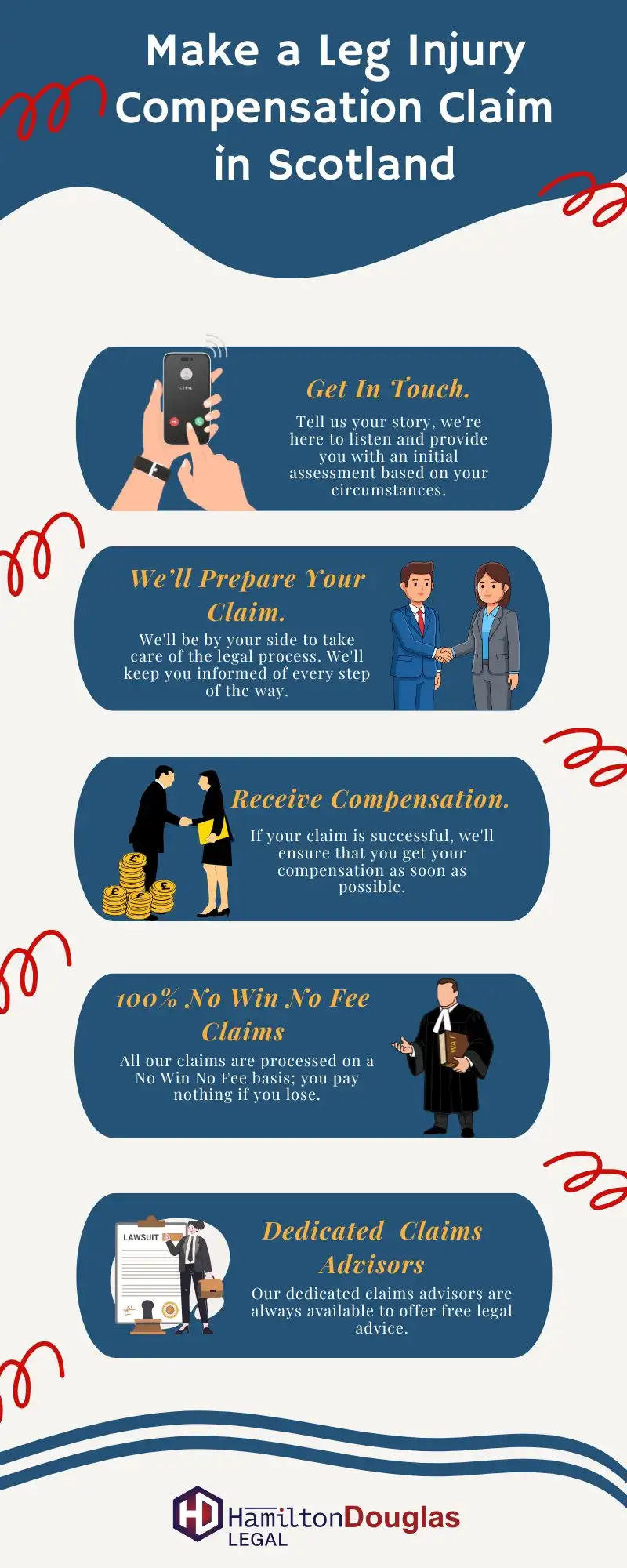
Get In Touch.
Tell us your story, we're here to listen and provide you with an initial assessment based on your circumstances.
02
We’ll Prepare Your Claim.
We'll be by your side to take care of the legal process. We'll keep you informed of every step of the way.
03
Receive Compensation.
If your claim is successful, we'll ensure that you get your compensation as soon as possible.
"A Student’s Journey from Trauma to Triumph: Efthymios’s Fight for Justice After a Devastating Car Accident"
When Efthymios was injured in a car accident, he was left with severe facial injuries. He didn’t know how he would manage his recovery and studies.
“When I got in contact with HD Legal, they made me feel supported. They were incredibly understanding and fought hard for me, ensuring I received the compensation I deserved.”
"Cracked Pavement, Broken Ankle: How HD Legal Helped Margaret Find Justice and Peace of Mind"
When Margaret tripped on a neglected crack in the pavement in Glasgow, she shattered her ankle and was forced to take months off work, unsure how she would manage.
“HD Legal were a lifeline for me. They took care of everything—from gathering crucial evidence to battling the council—and gave me the peace of mind I needed to focus on my recovery.”
"Blown Away: HD Legal Fights for Douglas After Faulty Washing Machine Explosion"
When Douglas’s new washing machine exploded, it caused a fire that damaged his kitchen and left him with painful burns.
“HD Legal fought relentlessly for me when it seemed like no one else would. They were thorough, professional, and supported me every step of the way, helping me recover both physically and financially.”
"From Misdiagnosis to Recovery: How HD Legal Fought for Eilidh’s Justice and Secured the Care She Needed"
When Eilidh’s severe abdominal pain was repeatedly misdiagnosed, her condition worsened, leading to the need for urgent surgery.
“HD Legal stood by me when I felt lost. They were thorough, professional, and fought tirelessly to get me the care and compensation I needed to heal.”
"Falling from Heights, Rising with Justice: How HD Legal Secured Compensation for Alistair After a Workplace Accident Involving Faulty Scaffolding"
Alistair Campbell’s fall from faulty scaffolding left him with serious injuries and months of recovery.
“HD Legal’s panel of solicitors fought for me, ensuring I received the support needed to move forward.”
Types of Leg Injuries We Handle
Some people recover after a few weeks in a support boot. Others face surgery, time away from work and a lasting change in how far or comfortably they can walk.
Claims can involve the femur, tibia, fibula, kneecap, ankle or foot. We also see injuries to the muscles, ligaments, tendons and nerves around these areas.
An accident may injure more than one part of the body. Someone knocked off a bicycle, for example, may suffer an arm injury or upper-limb damage as well as a fractured leg, and both injuries can be included in the same claim.
Fractures, Breaks, and Amputations
A broken bone or fracture from a fall or accident may heal with a cast or protective boot. A displaced or compound fracture can require pins, plates or screws and may take much longer to recover from.
Fractures of the femur, tibia or fibula can make it impossible to put weight on the leg for some time. If the break affects a joint, the person may continue to experience stiffness, weakness or pain after the bone has healed.
Doctors also watch for complications such as infection, deep vein thrombosis and compartment syndrome. These complications can change the course of treatment and may affect the value of the claim.
A traumatic amputation brings lifelong costs as well as a major personal adjustment. A claim may need to provide for prosthetic limbs, future replacements, specialist rehabilitation and changes to the home or car.
Our page about amputation claims in Scotland explains these cases in more detail.
Soft Tissue, Ligament, and Nerve Damage
Soft tissue injuries should never be dismissed simply because no bone was broken. A ‘normal’ X-ray doesn’t rule out a serious leg injury, as X-rays primarily show bone. Damage to your ligaments, tendons, cartilage, or nerves often requires entirely different types of investigation.
The daily impact of these injuries can be severe. For instance, ACL and MCL tears can leave your knee highly unstable, while meniscus damage might cause painful locking or swelling. Similarly, an Achilles tendon injury can make everyday tasks like walking and climbing stairs incredibly difficult.
To properly assess these issues, your solicitor will use your GP and hospital records as evidence of your initial symptoms and early treatment. From there, an MRI scan may be required to reveal more serious structural damage, or nerve tests might be necessary if you’re experiencing numbness, weakness, or altered sensation.
When it comes to valuing your claim, an independent medical expert will review all this evidence. They will consider whether you require surgery, how long your recovery will likely take, and exactly what the symptoms stop you from doing. Factors like continuing pain, limitations on your ability to work, and the risk of developing osteoarthritis in the future will all play a major role in the outcome.
How Much Compensation Can I Claim for a Leg Injury in Scotland?
People understandably want to know the value of their claim. There is no single payment for a broken leg, torn knee ligament or amputation because the effect differs from one person to another.
Two people may suffer similar fractures but face very different recoveries. One may return to desk-based work within a few months, while the other can no longer continue in a job that involves climbing, lifting or standing all day.
The calculation looks at your pain and recovery alongside the money you have lost or are likely to lose. Medical treatment, care needs and the effect on your independence can all influence the final amount.
Scottish courts may refer to earlier Scottish awards and the Judicial College Guidelines when considering pain, suffering and loss of amenity. These are reference points rather than a fixed price list.
You can use our tool to estimate your leg injury compensation amount. It can provide an initial guide, but a full assessment is needed when the claim includes future earnings, care or long-term rehabilitation.
Understanding Solatium and Patrimonial Loss
Scottish claims use two terms that may be unfamiliar: solatium and patrimonial loss.
Solatium is the part of the award for your pain, suffering and loss of amenity. Loss of amenity means the effect the injury has on ordinary life, such as being unable to walk the dog, play sport or enjoy time with your children as you did before.
Patrimonial loss covers the financial effect. Depending on your circumstances, this could include lost wages, treatment costs, travel expenses and help provided by relatives.
In cases of severe injury, this can also extend to the cost of mobility equipment, prosthetics, or necessary modifications to your home. Because these expenses often stretch years into the future, they must be carefully calculated and supported by strong evidence to ensure your claim isn’t settled before the true, long-term costs are fully understood.
Keep receipts where possible, but do not assume you cannot claim an expense simply because you no longer have the receipt. Bank statements, invoices or other records may still help prove what you paid.
Compensation for Loss of Earnings and Private Rehabilitation
If the injury kept you away from work, your claim can include the income you have already lost. Payslips and employer records usually show the difference between your normal wages and what you received during your absence.
Self-employed claimants may need accounts, tax returns and evidence of cancelled work. Fluctuating income can make the calculation less straightforward, so several years of records may be needed.
Future wage loss becomes relevant when you cannot return to the same role or must work fewer hours. For example, a construction worker with lasting knee damage may be able to work again but no longer manage ladders or prolonged kneeling. The claim may then consider reduced earning capacity, retraining and pension loss.
Reasonable private medical treatment and physiotherapy costs can also be included. For a severe injury, rehabilitation may involve specialist orthopaedic care, mobility aids or help adapting the home.
Family care should be recorded even when no money changes hands. If a partner has been helping with washing, dressing, shopping or transport, that support may form part of a care and assistance claim.
An interim payment may sometimes be requested after responsibility has been accepted. It can help with treatment costs or household bills while doctors are still assessing the long-term outcome.
DEDICATED CLAIMS ADVISORS
Our dedicated claims advisors are always available to offer free legal advice.
100% NO WIN NO FEE CLAIMS
All our claims are processed on a No Win No Fee basis; you pay nothing if you lose.
MILLIONS SECURED IN DAMAGES
To date, we have secured millions in damages.
THOUSANDS OF SATISFIED CLIENTS
To date, we have helped thousands of clients recover compensation and continue to do so.
Time Limits for Leg Injury Claims in Scotland
You usually have three years to start a personal injury court action in Scotland. This time limit, known as the triennium, is set out in the Prescription and Limitation (Scotland) Act 1973.
The three-year period normally begins on the date of the accident. It may start later if you did not know, and could not reasonably have known, that you had suffered an injury connected with another party’s actions.
Different rules apply to children, and a person’s legal capacity can also affect the deadline. The court has a limited power to allow some late claims to proceed, but you should not rely on this.
These rules depend on the circumstances of each case, so seek legal advice rather than assuming you have extra time. Contacting an insurer or starting negotiations does not normally stop the clock. Court proceedings must still be started within the relevant time limit.
Contact us as soon as possible, especially if your accident happened some time ago. We need time to investigate your claim and identify the correct party before starting court proceedings to protect your position.
Why Choose HD Claims for Your Leg Injury Case?
Recovering from a leg injury can take up enough of your time without having to chase insurers or work through legal paperwork alone.
Our role is to manage the legal strategy from start to finish. We work alongside specialist personal injury solicitors suited to the circumstances of your case, so your representation reflects the injury and the support you may need.
We gather the relevant records, arrange medical evidence and keep you updated as the claim moves forward. You can focus on treatment while we deal with the day-to-day progress of the case.
Where responsibility has been accepted, the solicitor handling the claim may be able to request an interim payment. This can help pay for rehabilitation or ease pressure on household finances before the final settlement.
Speak with HD Claims for a free assessment. We will explain the evidence we need, the likely next steps and how the claim can be funded before you decide whether to continue.
No Win No Fee Leg Injury Claims Explained
If you are eligible, a No Win No Fee agreement can allow you to start a claim without paying your solicitor’s professional fees upfront.
If your claim succeeds, a success fee may be deducted from your compensation. If it is unsuccessful, you will normally not have to pay that fee. However, you may still be responsible for other costs, depending on the agreement and any insurance cover in place.
Before any work begins, the written agreement will clearly set out the success fee percentage and any other deductions from your compensation. It would also set out who pays for medical reports, court fees and other expenses.
After the Event (ATE) insurance may help cover certain expenses or liability for the other side’s legal costs. Cover depends on the policy’s terms and conditions, including any exclusions, which should be explained before you sign.
We will explain the funding terms, any insurance cover and any costs you could still have to pay, and answer your questions before you commit.
Frequently Asked Questions About Leg Injury Claims
What happens if I was partly at fault for my leg injury?
You may still receive compensation if another party was mainly responsible. Your payment can be reduced to reflect your own share of the blame.
This is known as contributory negligence or split liability. For example, a claim valued at £50,000 would be reduced to £40,000 if the claimant were found 20% responsible.
The percentage must be based on the evidence and what is fair under the Law Reform (Contributory Negligence) Act 1945. Do not agree to split liability before police records, photographs and witness accounts have been properly considered.
Will I need to attend a medical assessment for a broken leg claim?
Usually, yes. An independent medical assessment provides a clear report on the injury, treatment and expected recovery.
The medical expert does not replace your NHS doctor or take over your care. Their report helps the insurer or court understand how the fracture has affected you and whether you are likely to have lasting symptoms.
Tell the medical expert which symptoms have improved and which still affect your daily life. Further medical reports may be needed if you also have nerve damage, psychological trauma or long-term problems that affect your ability to work.
Will my leg injury claim have to go to a Scottish court?
Probably not. Many claims settle through negotiations with the responsible party’s insurer.
Court proceedings may be needed if responsibility is denied or the insurer will not offer a reasonable amount. Depending on the case, proceedings may be raised in a local sheriff court, the All-Scotland Sheriff Personal Injury Court or the Court of Session.
- Start your leg injury claim: Arrange a free, confidential assessment to tell us what happened. We will explain whether you may have a claim, what evidence could help and how much time you have to act.
We’re Here To Help When You Need Us Most.
Call us on 0141 2801112, or leave us a message below to request a call back and one of our team will be in touch as soon as we can.