- Obligation-Free Consultation
- No Win, No Fee
- Award-Winning Lawyers
As Featured In:

Check Out Our Awesome Reviews Below:
EXCELLENT Based on 100 reviews Posted on Rana YousafTrustindex verifies that the original source of the review is Google. HD Claims provided excellent support. Their personal injury solicitors was professional, knowledgeable, and dedicated to securing the best outcome.Posted on Momina TariqTrustindex verifies that the original source of the review is Google. Very professional and supportive team. They handled my case smoothly and kept me informed at every step. If you need trustworthy personal injury solicitors, I definitely recommend them. Great experience with HD Claims.Posted on faiq zebTrustindex verifies that the original source of the review is Google. I've used HD Claims for a few car accidents I've suffered over the years as a taxi driver. Always received a great experience and compensation - Asif Khan GlasgowPosted on picui bossTrustindex verifies that the original source of the review is Google. Hey my name is Andrei and I’m with John white my self and they are They are the best 100% in all Scotland you should try with them. They’re the best service and they provide with everything. What you want to know about and I give them out 10 out of 10.Posted on GAMERS ONLYTrustindex verifies that the original source of the review is Google. Was a very good service 👏Posted on Sofia DouglasTrustindex verifies that the original source of the review is Google. I was rear ended whilst sat in traffic lights and suffered severe pain to my lower back, a friend told me about hd claims as he had used them previously, so far so good can't complain, looking forward to the compensation very soon.Posted on Ali AraizTrustindex verifies that the original source of the review is Google. HD Claims provided excellent support and guidance throughout my case. The personal injury lawyer was professional, knowledgeable, and dedicated to securing the best outcome. Highly recommended!Posted on ThornyTrustindex verifies that the original source of the review is Google. A huge thank you to Hd claims for all their hard work and assistance.Posted on Sunny InboxTrustindex verifies that the original source of the review is Google. I had a great experience with HD Claims. The injury lawyers were professional, responsive, and explained everything clearly. They handled my case with care and confidence, making the whole process stress-free. Highly recommended for injury claims.Posted on Crina VieruTrustindex verifies that the original source of the review is Google. I want to thanks the entire team, the results were as expected, very prompt and explicit in absolutely all the details provided, I recommend and I will definitely call again in the future,thanks again and i recommend you with all my heartVerified by TrustindexTrustindex verified badge is the Universal Symbol of Trust. Only the greatest companies can get the verified badge who has a review score above 4.5, based on customer reviews over the past 12 months. Read more
Industrial Injury Claims Scotland: Expert No Win No Fee Solicitors
If you were injured at work in a factory, on an offshore platform, at a construction site, or in another high-risk workplace anywhere in Scotland, you may have the right to make an industrial injury claim. The same may apply if a loved one has developed a work-related condition after long-term exposure to dust, vibration, chemicals, unsafe machinery, or excessive noise.
At HD Claims, we assess your case carefully from the outset and guide it in the right direction. We work with expert personal injury solicitors in Scotland whose experience matches the nature and complexity of your claim, whether it involves a serious workplace accident, hearing loss, or one of the many industrial disease claims Scottish workers face after harmful exposure.
Where your case is suitable, we can connect you with no win no fee personal injury solicitors, so there is no upfront financial risk in getting started. This gives you access to clear legal advice early on, without having to commit before you understand your position.
Many people come to us while dealing with more than just the injury. You may be off work, worried about income, waiting for treatment, or trying to work out whether an accident or disease was caused by employer failings. That is why we focus on practical first steps, such as reviewing how the accident or exposure happened, checking the available medical evidence, and helping you move forward with strong industrial injury compensation claims.
If the facts support your case, the aim is to pursue fair compensation for industrial injury and put you on the right path for personal injury compensation claims in Scotland. Whether the harm happened in one accident or built up over time through unsafe working conditions, HD Claims helps workers and families across Scotland take the next step with clarity and confidence.
What is an Industrial Injury or Disease?
An industrial injury usually happens after a sudden accident at work. It might be a machinery crush, a fall from height, a burn, or another accident that causes immediate harm. In cases like these, people often explore industrial accident claims after the event.
An industrial disease is different. It does not always happen in one moment. It can build up slowly because of unsafe working conditions, repeated exposure, or the same task being done over and over for months or years.
For example, a worker on a noisy site may develop hearing loss over time. Someone exposed to dust, fumes, or asbestos may later develop breathing problems or even mesothelioma. A person using vibrating tools every day may develop hand problems that lead to a white finger claim.
The simplest way to understand the difference is this:
- An industrial injury is usually sudden
- An industrial disease usually develops over time
- Both can happen because the work was not made safe enough
Sometimes the line is not perfectly clear. A worker may suffer one accident, but the full effect may only show later. In other cases, the damage is gradual from the start. That is why every case depends on its own individual circumstances.
A sudden accident is often easier to spot because it may be reported straight away and entered in the accident book. A disease claim can take longer to identify because symptoms may appear years after the harmful exposure began. Either way, if the condition was caused by your job, you may have grounds for an industrial injuries claim.
In simple terms, whether you are claiming industrial injury after one serious accident or because your health was damaged over time, the key question is the same: did your work cause the harm, and could it have been prevented?

Speak to our compensation experts
It doesn't cost you anything to know where you stand.
Fill out the form, and we'll get back to you within one hour.
Need to speak to us sooner?
Call us on 0141 280 1112
- Over £3+ Million in Settlements
- No Win, No Fee
- Supporting Scots Since 2010
- 10 Offices Around Scotland
Request a FREE call
Common Types of Industrial Accidents We Handle
- Factory accidents involving moving machinery, crush injuries, trapped hands, or amputations.
- Falls from scaffolding, ladders, platforms, or other raised work areas.
- Falling tools or materials on construction and engineering sites.
- Burn injuries caused by hot liquids, steam, chemicals, fire, or electrical faults.
- Chemical exposure from fumes, dust, solvents, or toxic substances.
- Hearing damage caused by constant loud noise in factories, workshops, or offshore settings.
- Hand-arm vibration injuries, including vibration white finger, from regular tool use.
- Back, shoulder, and joint injuries caused by lifting, carrying, or repeated strain.
- Slips, trips, and falls in warehouses, loading bays, yards, and work floors.
- Respiratory problems linked to fibres, dust, smoke, or poor ventilation.
In Scotland, some claims are closely linked to local industries. Offshore oil and gas workers may be hurt by heavy equipment, loud noise, or unsafe access routes; we also assist maritime workers with boating accident claims involving vessels in Scottish waters or at port.
Shipbuilding workers may face dust, fumes, metalwork risks, and older hazardous materials. Manufacturing workers often deal with fast machines, repeated tasks, and poor guarding.
Some people know right away that they are hurt. Others do not realise the damage until later. A fall from scaffolding is obvious on the day. Hearing loss or vibration damage may take years to show its full effect.
If your injury happened at work and it could have been prevented, there may be a valid claim. The key issue is how the accident happened, what safety steps were missing, and how the injury has affected your life.
Proving Employer Negligence: Your Right to a Safe Workplace
- a lack of Personal Protective Equipment (PPE) such as gloves, masks, ear protectors, or safety boots
- a failure to conduct risk assessments for dangerous machinery, chemicals, work at height, or confined spaces
- inadequate training on how to use tools, lift safely, handle substances, or follow emergency procedures
- faulty equipment or poor maintenance that leaves machinery unsafe to use
- unsafe working systems that push staff to work too fast, work alone, or take risks to meet targets
- exposure to excessive noise, dust, fumes, airborne fibres, or other hazardous materials without proper controls
- a wider breach of health and safety regulations that puts workers at avoidable risk
In practice, these cases often come down to straightforward safety failures. A factory worker may suffer a crush injury because a machine guard was missing. A scaffolder may fall because the platform was not checked properly. An offshore worker may develop hearing damage after years of exposure to excessive noise without proper hearing protection. A warehouse worker may injure their back after being told to lift heavy stock without training or support.
The Health and Safety Executive (HSE) sets out clear safety standards, but the legal issue in a claim is not just whether something went wrong. It is whether the employer failed to act as a reasonable employer should have acted in the same situation.
That is why evidence matters. Useful evidence may include:
- accident reports
- photographs of the scene or equipment
- witness statements from co-workers
- training records
- maintenance logs
- PPE records
- complaints made before the accident
- medical records showing the injury or illness
In many cases, proving negligence means building a clear picture. What was the danger? What should the employer have done? What did they fail to do? When those answers show that your injury was preventable, there may be strong grounds for a claim.
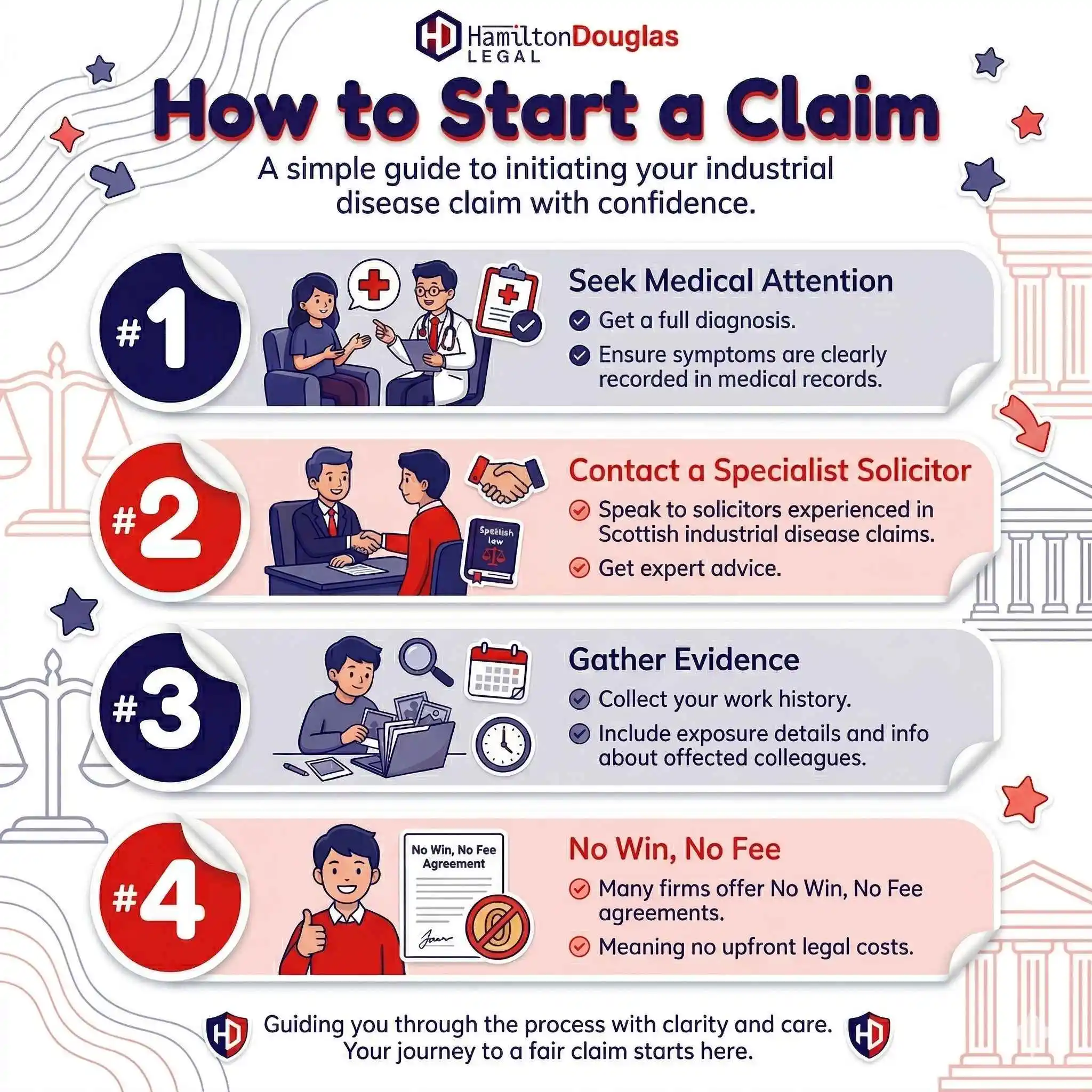
Making An Industrial Injury Claim Against Your Employer
- medical records
- witness statements from colleagues or others who saw what happened
- expert evidence, which may include a medical examination
- any accident reports, training records, or complaints already raised
For example, if you developed breathing problems after years around dust, or suffered burns because proper safety gear was missing, the key issue is whether your employer failed to protect you from a known risk.
Once the evidence is in place, we can value the claim and begin negotiations with the other side. In some cases, that can also include support for treatment such as counselling, physiotherapy, or other practical help while the claim is ongoing.

Making A Personal Injury Claim In Scotland
Our panel of experienced personal injury lawyers excel in handling cases against well-funded insurance companies.
Our specialised injury lawyers will assist you with your claim, keep you informed throughout the whole process, and provide you with legal advice that is easy to understand.
01
Get In Touch.
Tell us your story, we're here to listen and provide you with an initial assessment based on your circumstances.
02
We’ll Prepare Your Claim.
We'll be by your side to take care of the legal process. We'll keep you informed of every step of the way.
03
Receive Compensation.
If your claim is successful, we'll ensure that you get your compensation as soon as possible.

"Former Shipyard Worker Secures Settlement After Asbestos-Related Diagnosis "
“David”, a retired shipyard worker from the west of Scotland, was diagnosed with mesothelioma decades after leaving heavy industry.
“We connected him to a specialist industrial disease solicitor who investigated his employment history, obtained medical evidence, and traced the insurers connected to his former employer. The legal team also gathered witness evidence showing that asbestos exposure had been common in the workplace and that basic safety steps had not been taken.
”

"Factory Engineer Awarded Compensation For Hand-Arm Vibration And Hearing Damage"
“Mark”, a maintenance engineer in central Scotland, spent years using vibrating tools and working in high-noise factory areas.
“He contacted HD Claims and connected him to specialist solicitors. With their help, Mark obtained an independent medical assessment and brought a claim for his pain, ongoing symptoms, lost earnings, and future disadvantage at work.”
Time Limits for Industrial Injury Claims in Scotland
In Scotland, you usually have three years to start an industrial injury claim. That time limit comes from section 17 of the Prescription and Limitation (Scotland) Act 1973. For most accident claims, the clock starts on the date of the injury.
Industrial disease claims are different because symptoms often appear much later. The main rule is the date of knowledge. This is the date you first realised, or could reasonably have known, that your ailment was bad enough to warrant a claim and was related to your job.
For illnesses such as asbestos-related disease or occupational hearing loss, that is often the date a doctor diagnoses the condition or tells you it is work-related, not the date you were exposed.
That is why someone can sometimes claim years, or even decades, after leaving the job or after the employer stopped trading. If the diagnosis is recent, the claim may still be within time.
How Much Compensation For an Industrial Injury?
There is no fixed payout for an industrial injury claim in Scotland. The value depends on the seriousness of the injury or illness, how long the symptoms last, whether there is any lasting disability, and the financial effect the condition has had on your life and work. That is why no careful solicitor should promise a figure at the start.
In Scotland, compensation is usually made up of two main parts.
- Solatium. This is the part that reflects pain, suffering, and the impact the injury has had on your day-to-day life. In practice, this means looking at things such as ongoing pain, disturbed sleep, loss of hearing, breathing problems, restricted movement, or the stress of living with a long-term industrial condition. The valuation is guided by medical evidence, similar cases, and the Judicial College Guidelines.
- Patrimonial loss. This covers financial losses caused by the injury or disease. That can include lost wages, future loss of earnings, pension loss, treatment costs, prescription charges, travel to appointments, care provided by family, and the cost of equipment or support you now need.
A big part of valuing the claim is the medical evidence. You will normally need an independent medical assessment by a suitable specialist, who will review your condition, explain how it was caused, and give a prognosis about recovery or long-term symptoms. That report helps show not only how badly you have been affected now, but what the future may look like as well.
For example, two workers may both have been exposed to the same hazard, but their compensation may differ a great deal. One person with mild noise-related symptoms who keeps working may have a much lower claim than someone whose hearing loss forces them out of a skilled job. The same applies where one back injury settles within months, but another leads to surgery, time off work, and reduced earning ability for years.
This is also why early records matter. Wage slips, travel receipts, treatment costs, and clear medical notes can make a real difference when calculating Patrimonial loss. In serious cases, expert evidence may also be needed to assess future work limits, care needs, or the long-term cost of living with the condition.
DEDICATED CLAIMS ADVISORS
Our dedicated claims advisors are always available to offer free legal advice.
100% NO WIN NO FEE CLAIMS
All our claims are processed on a No Win No Fee basis; you pay nothing if you lose.

MILLIONS SECURED IN DAMAGES
To date, we have secured millions in damages.
THOUSANDS OF SATISFIED CLIENTS
To date, we have helped thousands of clients recover compensation and continue to do so.
Meet The Team

Maisie MacLeod
Senior Claims Manager

Ella Campbell
Head of Serious Injury

Freya Douglas
Long-Term Illness Specialist
No Win No Fee Industrial Injury Compensation Claims
A Conditional Fee Agreement (CFA) in Scotland is the legal agreement behind a no win no fee claim. In simple terms, your solicitor agrees to act without asking you to fund the case upfront. If the claim does not succeed, you usually do not pay your solicitor’s fee under the agreement. If the claim succeeds, a pre-agreed success fee may be deducted from your damages. In Scottish personal injury cases, that fee is capped by law and includes VAT. The cap is up to 20% of the first £100,000 of damages, 10% of the next £400,000, and 2.5% of damages over £500,000.
You should still be told clearly, in writing, what will be deducted and when. Any solicitor we connect you to will explain whether the success fee applies to the whole award or only part of it, and whether any unrecovered outlays could affect the final amount you receive.
After the Event (ATE) insurance is separate from the CFA. It is a policy taken out after the accident or diagnosis to protect against certain case costs, such as adverse expenses or disbursements like medical report fees and court outlays.
In Scotland, personal injury claims also benefit from qualified one-way cost shifting, which generally limits the risk of paying the other side’s expenses unless there has been fraud, abuse of process, or manifestly unreasonable conduct. That extra protection can make taking the next step feel far less risky.
Frequently Asked Questions (FAQs)
Can I claim if my employer has gone out of business?
Yes, you may still be able to claim. In many cases, the claim can be made against the employer’s insurers, even if the business has closed or no longer trades. This is especially important in industrial disease cases, where symptoms may appear years after the exposure happened.
What if I were partly at fault?
You may still have a valid claim. If you were partly responsible, compensation can sometimes be reduced rather than refused altogether. The key question is whether your employer also failed to take reasonable steps to keep you safe.
How long does a Scottish industrial claim take?
There is no fixed timescale. A straightforward case may settle in a few months, but more complex claims often take longer, especially where liability is denied, medical evidence is still being gathered, or the long-term effect of the condition is not yet clear. Industrial disease claims can also take longer because they often need detailed expert evidence.
We’re Here To Help When You Need Us Most.
Call us on 0141 2801112, or leave us a message below to request a call back and one of our team will be in touch as soon as we can.