- Obligation-Free Consultation
- No Win, No Fee
- Award-Winning Lawyers
As Featured In:
Check Out Our Awesome Reviews Below:
EXCELLENT Based on 99 reviews Posted on Google Daniel MorosanuTrustindex verifies that the original source of the review is Google. I cannot thank the team at HD Claims enough for their help with my personal injury claim. From day one, their injury lawyers were incredibly professional, explaining the no win no fee process clearly without complex jargon. They took away all the stress of dealing with the insurance companies and secured the accident compensation I was entitled to. If you are looking for reliable personal injury solicitors who truly look out for your best interests, I highly recommend their services.Posted on Google Gigel stoicaTrustindex verifies that the original source of the review is Google. HD Claims made my personal injury claim simple and stress-free. The team was professional, responsive, and kept me updated throughout the process. I would recommend them to anyone needing help with an accident compensation claimPosted on Google Muhammed AhmedTrustindex verifies that the original source of the review is Google. I was involved in a car accident where my car was written off and my passengers were seriously injured. I contacted HD Claims and received an excellent service from start to finish. They were very understanding and took the time to explain the whole process clearly. In the end, I received a very favourable settlement. I would most definitely recommend this firm to anyone in a similar situation.Posted on Google Sarah TaylorTrustindex verifies that the original source of the review is Google. Excellent service from HD Claims! They completely managed my personal injury claim from start to finish and allocated me a fantastic specialist solicitor. The whole process was handled on a 'no win no fee' basis, making it entirely stress-free. Their communication was top-notch, and I am very happy with the final settlement I received. I highly recommend their team to anyone looking for reliable legal support.Posted on Google Nico SullivanTrustindex verifies that the original source of the review is Google. HD Claims were brilliant after my accident. They handled everything smoothly and kept me informed the whole time. If you need personal injury lawyers with car accident experience, they’re a great choice.Posted on Google faiq zebTrustindex verifies that the original source of the review is Google. I've used HD Claims for a few car accidents I've suffered over the years as a taxi driver. Always received a great experience and compensation - Asif Khan GlasgowPosted on Google picui bossTrustindex verifies that the original source of the review is Google. Hey my name is Andrei and I’m with John white my self and they are They are the best 100% in all Scotland you should try with them. They’re the best service and they provide with everything. What you want to know about and I give them out 10 out of 10.Posted on Google GAMERS ONLYTrustindex verifies that the original source of the review is Google. Was a very good service 👏Posted on Google Sunny InboxTrustindex verifies that the original source of the review is Google. I had a great experience with HD Claims. The injury lawyers were professional, responsive, and explained everything clearly. They handled my case with care and confidence, making the whole process stress-free. Highly recommended for injury claims.Posted on Google John SmithTrustindex verifies that the original source of the review is Google. My insurance company recommended a firm that charged 30% and had poor reviews. I went with Hamilton Douglas instead, who charged far less and were completely transparent. They were professional, communicative, and secured me an excellent settlement. Do your research and pick them.Verified by TrustindexTrustindex verified badge is the Universal Symbol of Trust. Only the greatest companies can get the verified badge who has a review score above 4.5, based on customer reviews over the past 12 months. Read more
A swimming pool injury can leave you dealing with pain, anxiety and unexpected costs at the same time. If you were injured in a swimming pool through no fault of your own, you may be entitled to pursue swimming pool accident compensation under Scots law.
In a Scottish civil claim, the injured person is called the pursuer. The organisation alleged to be responsible, such as a council, leisure trust, gym or hotel, is the defender. A claim may be possible where the defender failed to keep the premises reasonably safe, and that failure caused the accident.
15-second summary
- Eligibility: You must show that the defender owed you a duty, failed to take reasonable care and caused your injury.
- Compensation: A settlement may include Solatium for pain and loss of amenity, plus financial losses such as wages, treatment and travel.
- Evidence: Photographs, an Accident Book entry, witness details, CCTV and medical evidence can strengthen the claim.
- Funding: Eligible cases may proceed under a No Win No Fee arrangement, with the terms explained in writing before work begins.
Swimming remains a common activity across Scotland. According to the Scottish Household Survey 2022, 14% of adults reported that they had gone swimming in the four weeks before taking part in the survey, compared with 17% in 2019.
Speak to our compensation experts
It doesn't cost you anything to know where you stand.
Fill out the form, and we'll get back to you within one hour.
Need to speak to us sooner?
Call us on 0141 280 1112
- Over £3+ Million in Settlements
- No Win, No Fee
- Supporting Scots Since 2010
- 10 Offices Around Scotland
Request a FREE call
What Is a Swimming Pool Accident Claim?
A swimming pool injury compensation claim is a claim for compensation made when unsafe conditions or failures by a swimming pool operator cause an injury. It is a type of public liability claim involving premises that should have been kept reasonably safe.
A valid claim can help fund treatment, replace lost income and recognise the physical or psychological effect of the accident. It may arise from accidents in public places at local community pools, private health clubs, school facilities, hotel pools or larger aquatic venues across Scotland, including those found near the Royal Commonwealth Pool in Edinburgh, Tollcross International Swimming Centre in Glasgow and Aberdeen Sports Village Aquatics Centre.
Common Hazards in Scottish Swimming Pools
Swimming facilities contain unavoidable water, but operators still need sensible systems for inspection, cleaning, supervision and repair. According to Scottish Swimming’s facilities strategy, Scotland has 396 public pools, and 56% are more than 30 years old. The age of a pool does not prove negligence by itself; liability depends on whether the operator carried out reasonable inspections, maintenance and repairs.
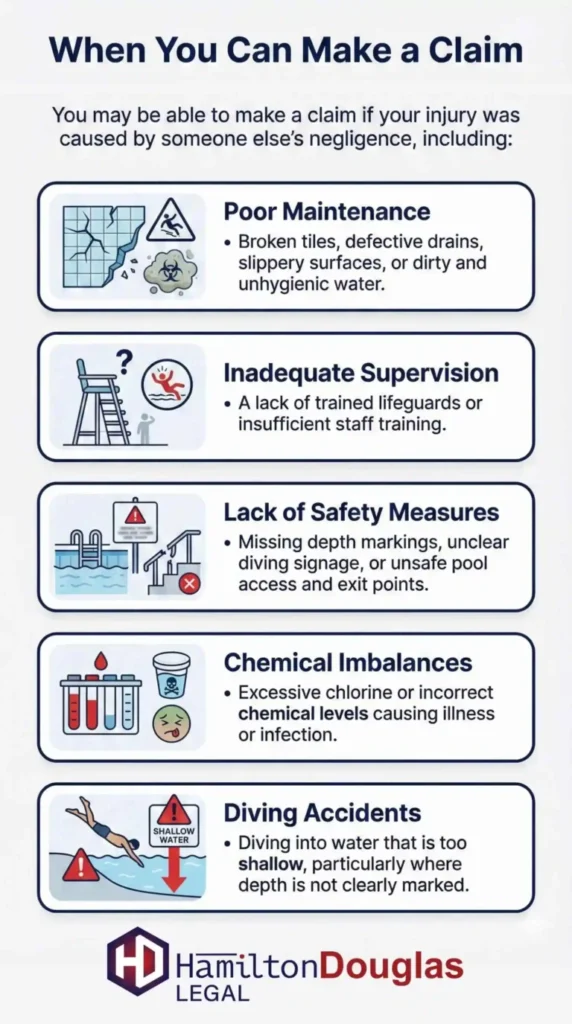
Hazards that may lead to injury include:
- Broken or loose tiles: A cracked underwater tile or razor-sharp edge can cause a deep laceration, tendon damage or permanent scarring.
- Slippery walkways: Standing water, unsuitable flooring, poor drainage or missing warning signs can lead to slipping and falling on a wet leisure centre surface.
- Unsafe chemical dosing: Excessive levels of pool chemicals can cause eye and skin irritation, breathing problems or chemical burns. Mixing chlorine-based products with acids or other incompatible chemicals can also release toxic chlorine gas.
- Missing depth markers: Obscured or deceptive depth markers can expose swimmers to head, neck and spinal injuries when diving.
- Faulty drains and suction systems: Damaged outlet covers or unsecured drain fittings can create a dangerous suction hazard or trap hair, jewellery or limbs.
- Poor supervision: If too few trained lifeguards are present, swimmers in difficulty may not be noticed or helped quickly enough, increasing the risk of a near-drowning accident.
- Contaminated water: Poor cleanliness and failures in water treatment can expose users to waterborne bacteria.
- Inadequate lighting: Poor lighting around the pool area, steps or changing rooms can hide obstacles and increase fall risks.
Typical Injuries Sustained in Swimming Pools
A broken tile may cause a deep cut requiring stitches and later assessment by a plastic surgeon. A fall on wet flooring can result in fractures, a broken toe or foot, concussion, spinal cord damage or a traumatic brain injury.
Diving accidents and suction entrapment can cause life-changing harm. Swimming pool accidents may also lead to chemical burns, breathing problems, infection, severe anxiety or a lasting fear of returning to the water.
The medical evidence should record the diagnosis, treatment, recovery period and any long-term symptoms. These details help assess Solatium, compensation for pain, suffering and loss of amenity.
Am I Eligible to Claim Compensation for a Swimming Pool Injury?
You may have a viable injury compensation claim if all three points below apply:
- The pool operator or occupier owed you a duty of care.
- The defender breached that duty by failing to take reasonable precautions against a foreseeable danger.
- That breach directly caused an injury and resulting loss.
You do not need to know exactly which employee made the mistake before seeking advice. The early assessment focuses on where the accident happened, what the danger was, how long it may have existed and whether the operator had a reasonable opportunity to prevent the harm.
A case is less likely to succeed where there was no unsafe condition, the danger could not reasonably have been identified, or the accident arose entirely from the swimmer’s own conduct. However, being partly responsible does not automatically prevent you from making a claim. If your actions contributed to the accident, any compensation awarded may be reduced to reflect your share of responsibility.
Proving Negligence and the Occupiers’ Liability (Scotland) Act 1960
Under the Occupiers’ Liability (Scotland) Act 1960, swimming pool operators owe visitors a statutory duty of care. They are obliged to take reasonable steps to protect visitors against dangers of which they were aware, or should have been aware. However, an operator is not automatically liable simply because an accident occurred.
Consider a shattered tile reported to management on Monday. If the operator fails to cordon it off, warn swimmers or arrange a repair, and someone is cut on Tuesday, the earlier report and lack of action may support a clear breach of duty.
Proving fault often requires records held by the defender rather than the injured person. We manage the legal strategy while working alongside specialist personal injury solicitors who can seek maintenance logs, cleaning records, chemical-testing results, lifeguard schedules, hourly inspection sheets, accident reports and CCTV footage.
The Occupiers’ Liability Act 1957 often appears on general UK pages, but it applies in England and Wales. Scotland has its own legal system, with distinct legislation, courts and professional bodies such as the Law Society of Scotland. Swimming pool accident claims in Scotland are therefore governed by the Occupiers’ Liability (Scotland) Act 1960 and wider Scots law principles.
Making A Personal Injury Claim
Our panel of experienced personal injury lawyers excel in handling cases against well-funded insurance companies.
Our specialised injury lawyers will assist you with your claim, keep you informed throughout the whole process, and provide you with legal advice that is easy to understand.
01
Get In Touch.
Tell us your story, we're here to listen and provide you with an initial assessment based on your circumstances.
02
We’ll Prepare Your Claim.
We'll be by your side to take care of the legal process. We'll keep you informed of every step of the way.
03
Receive Compensation.
If your claim is successful, we'll ensure that you get your compensation as soon as possible.
"A Student’s Journey from Trauma to Triumph: Efthymios’s Fight for Justice After a Devastating Car Accident"
When Efthymios was injured in a car accident, he was left with severe facial injuries. He didn’t know how he would manage his recovery and studies.
“When I got in contact with HD Legal, they made me feel supported. They were incredibly understanding and fought hard for me, ensuring I received the compensation I deserved.”
"Cracked Pavement, Broken Ankle: How HD Legal Helped Margaret Find Justice and Peace of Mind"
When Margaret tripped on a neglected crack in the pavement in Glasgow, she shattered her ankle and was forced to take months off work, unsure how she would manage.
“HD Legal were a lifeline for me. They took care of everything—from gathering crucial evidence to battling the council—and gave me the peace of mind I needed to focus on my recovery.”
"Blown Away: HD Legal Fights for Douglas After Faulty Washing Machine Explosion"
When Douglas’s new washing machine exploded, it caused a fire that damaged his kitchen and left him with painful burns.
“HD Legal fought relentlessly for me when it seemed like no one else would. They were thorough, professional, and supported me every step of the way, helping me recover both physically and financially.”
"From Misdiagnosis to Recovery: How HD Legal Fought for Eilidh’s Justice and Secured the Care She Needed"
When Eilidh’s severe abdominal pain was repeatedly misdiagnosed, her condition worsened, leading to the need for urgent surgery.
“HD Legal stood by me when I felt lost. They were thorough, professional, and fought tirelessly to get me the care and compensation I needed to heal.”
"Falling from Heights, Rising with Justice: How HD Legal Secured Compensation for Alistair After a Workplace Accident Involving Faulty Scaffolding"
Alistair Campbell’s fall from faulty scaffolding left him with serious injuries and months of recovery.
“HD Legal’s panel of solicitors fought for me, ensuring I received the support needed to move forward.”
Who Is Responsible for My Swimming Pool Accident?
The defender will usually be the organisation which owned the premises, or the relevant part of them.
Depending on the facts, this could be:
- A local authority or council operating a municipal pool.
- A leisure trust managing council facilities.
- A private gym chain, health club or spa.
- A hotel, holiday park or resort.
- A school, university or contractor responsible for the facility.
A claim is not usually brought personally against an individual lifeguard. It is directed at the responsible organisation, and an insurer may handle the response where public liability cover applies.
Responsibility may rest with more than one organisation. For example, a leisure trust may run the swimming pool while an outside contractor is responsible for maintaining the chemical-dosing system. The evidence will help show which organisation controlled the hazard and whether the claim should be brought against one or more defenders.
Special Claim Scenarios: Children and Holiday Accidents
Different legal rules apply when the injured person is a child or the accident happened abroad.
Claiming on Behalf of a Child
A parent or guardian can usually take legal steps for a child injured at a leisure or sports facility, including a public pool, school facility, paddling pool or splash pad. “Litigation friend” is mainly an England and Wales term; Scottish procedure uses its own rules for representing a child’s interests.
Where compensation is payable to a child under 16, the court may direct the Accountant of Court to administer the funds or supervise a parent or guardian to protect the child’s financial interests.
Swimming Pool Accidents Abroad
A Scottish resident hurt in a holiday accident at a hotel or resort pool may still have a route to compensation. Keep the booking documents, report the accident to hotel staff and the tour representative, obtain medical treatment locally and photograph the danger before it changes.
Under the Package Travel and Linked Travel Arrangements Regulations 2018, a UK package organiser is responsible for the performance of travel services included in the package, even where a third-party supplier delivers them. A claim against the organiser may therefore be possible, but jurisdiction and applicable law depend on the booking contract and the facts.
Independent bookings are usually more complex because foreign safety standards and limitation periods may apply. Early advice is important, especially where evidence, witnesses and medical documents are held overseas.
DEDICATED CLAIMS ADVISORS
Our dedicated claims advisors are always available to offer free legal advice.
100% NO WIN NO FEE CLAIMS
All our claims are processed on a No Win No Fee basis; you pay nothing if you lose.
MILLIONS SECURED IN DAMAGES
To date, we have secured millions in damages.
THOUSANDS OF SATISFIED CLIENTS
To date, we have helped thousands of clients recover compensation and continue to do so.
Meet The Team

Maisie MacLeod
Senior Claims Manager

Ella Campbell
Head of Serious Injury

Freya Douglas
Long-Term Illness Specialist
The Claims Process: Evidence and Time Limits
A strong claim starts with preserving evidence before CCTV is overwritten, repairs are completed, or witnesses become difficult to trace.
For many Scottish personal injury claims valued at £25,000 or less, where the accident occurred on or after 28 November 2016, the compulsory Personal Injury Pre-Action Protocol requires both sides to exchange relevant information and investigate liability before court proceedings are raised. Its purpose is to encourage a fair and timely settlement or, where settlement is not possible, clarify which points are still disputed.
If court action becomes necessary, a swimming pool accident claim may be raised in a local sheriff court or the national Sheriff Personal Injury Court. Claims worth more than £100,000 may be raised in either the sheriff court or the Court of Session.
According to Civil Justice Statistics in Scotland 2022–23, 8,474 personal injury cases were initiated in Scotland’s civil courts, with 49% raised in the national Sheriff Personal Injury Court.
Essential Evidence to Support Your Scottish Compensation Claim
Collect what you safely can, but do not delay treatment to gather evidence.
- Accident Book record: Report the accident and ask for a copy or written confirmation of the entry.
- Photographs and video: Capture the broken tile, wet floor, missing marker, defective grate or other hazard from several angles.
- Witness details: Record names, phone numbers and email addresses for swimmers, visitors or staff who saw the accident or hazard.
- Medical evidence: Keep A&E, Minor Injuries Unit and GP medical records, discharge papers, prescriptions and referral letters.
- CCTV: Ask the venue to preserve footage promptly because retention periods may be short.
- Expense log: Keep wage slips, receipts, travel costs and proof of paid care or treatment.
- Personal recovery diary: Note pain levels, sleep problems, missed activities and the effect on work or family life.
An entry in the Accident Book helps prove that the accident was reported, but it does not establish negligence by itself. A claim is supported by evidence showing what the hazard was, whether the operator knew or should have known about it, how it caused the injury and what losses followed.
What Are the Time Limits for Starting a Claim in Scotland?
Under the Prescription and Limitation (Scotland) Act 1973, the usual limit is three years from the accident or, in some cases, the later date when the pursuer became aware of the relevant injury and its connection to the defender’s conduct. Court proceedings normally need to be started before the triennium expires. Simply making a claim or discussing a settlement with an insurer may not pause or extend the deadline.
For a child injured before age 16, the limitation period generally does not run until the child turns 16, which gives them until age 19 to raise proceedings. Scottish courts have limited discretion to allow some late cases, but relying on that discretion is risky.
Medical reports, expert evidence and document recovery can take months. Starting early reduces the risk of the claim becoming time-barred.
How Much Compensation (Solatium) Can I Claim?
The value depends on the injury, prognosis and effect on the pursuer’s daily life. An independent medical report may be obtained from a suitable expert, such as a consultant in emergency medicine, orthopaedic surgeon, neurologist or plastic surgeon.
The expert does not decide compensation. Their report gives an objective diagnosis, recovery outlook and assessment of permanent symptoms, which supports a fair valuation.
Solatium vs. Financial Losses Explained
Solatium compensates pain, suffering and loss of amenity. Loss of amenity covers the activities and independence the injury has taken away, for example, an expert cyclist unable to ride after a serious foot injury.
Patrimonial loss covers measurable financial harm. This may include:
- Past and future loss of earnings.
- Medical expenses, rehabilitation and private physiotherapy.
- Travel costs and other out-of-pocket expenses.
- Paid care, equipment or home adaptations.
- Future loss of income where the injury affects earning capacity.
Our guide to what you may claim after a leisure accident explains these categories in more detail.
Estimated Payouts for Swimming Pool Injuries
Scottish practitioners and courts may refer to reported decisions and the Judicial College Guidelines when assessing Solatium. The Guidelines do not set fixed compensation amounts, but they provide useful reference ranges when valuing an injury. The 18th edition was published in April 2026 with updated figures.
| Injury and Likely Effect | Indicative Solatium Range |
|---|---|
| Minor facial scarring where the lasting effect is limited | £2,260 to £4,670 |
| Less significant facial scarring, such as one scar or several small marks that affect appearance without causing major disfigurement | £5,220 to £18,150 |
| Significant facial scarring where treatment or surgery may reduce the worst effects but some visible damage remains | £12,040 to £39,750 |
| Substantial facial disfigurement with a significant emotional or psychological effect | £23,730 to £63,970 |
| Very severe facial scarring, usually involving serious disfigurement and a severe psychological reaction | £39,340 to £128,590 |
| One noticeable body scar or several superficial scars, including marks on the arms, hands or legs | £3,130 to £10,350 |
| Several noticeable body scars or one disfiguring scar affecting areas such as the arms, hands, legs, chest or back | £10,350 to £30,030 |
These figures cover the injury element only. They do not include patrimonial losses, and they are not a promise of a particular payout. The final swimming pool accident compensation figure depends on medical evidence, recovery, age, scarring, psychological impact, contributory negligence and financial loss.

Start Your No Win No Fee Swimming Pool Accident Claim
Eligible cases may be handled on a No Win No Fee basis through a written success fee agreement governed by the Civil Litigation (Expenses and Group Proceedings) (Scotland) Act 2018 and the related 2020 Regulations.
For personal injury claims, the success fee is capped at 20% of the first £100,000 recovered, including VAT, with lower percentage caps applying to compensation above that amount. If the claim is unsuccessful, the legal service provider receives no success fee.
Before signing a No Win No Fee agreement, you should receive a clear explanation of the success fee, any insurance premium, termination terms and the limited circumstances in which other costs might arise. This allows you to make an informed decision rather than relying on a vague promise that the case is “risk free.”
Why Choose HDClaims for a Scottish Swimming Pool Claim?
Our role is to manage the legal strategy of your claim from start to finish. We work alongside specialist personal injury solicitors suited to your case and oversee evidence gathering, liability enquiries, medical assessment, valuation and negotiations while keeping you fully informed.
A swimming pool accident lawyer working on the case must understand Scots law, the 1960 Act, Scottish limitation rules and the procedures of the Sheriff Personal Injury Court. This local knowledge helps avoid the errors that arise when Scottish claims are treated as though English law applies.
Contact Our Scottish Team for a Free Claim Assessment
If you have suffered an injury at a pool, leisure centre, gym, spa, school or hotel anywhere in Scotland, you can request a free and confidential initial assessment. We assist pursuers across Glasgow, Edinburgh, Aberdeen, Dundee, Inverness and surrounding communities, whether the accident happened at a large aquatic centre or a local neighbourhood pool.
Request a free, confidential assessment by phone, secure callback or live chat. Tell us when and where the accident happened, what caused it and what treatment you received, and we will explain the possible next steps without any obligation to proceed.
FAQs
How long do I have to claim for a swimming pool accident in Scotland?
The usual period is three years from the accident or relevant date of knowledge. For injuries sustained before age 16, the period generally starts at 16 and expires at 19. Seek advice well before the deadline.
Can I claim if the accident happened at a hotel abroad?
Possibly. If the hotel pool was part of a package holiday, you may be able to make a claim against the UK organiser under the Package Travel and Linked Travel Arrangements Regulations 2018. If you booked the hotel independently, foreign law and local time limits may apply, so the booking details and circumstances will need to be reviewed.
How is Solatium calculated for a swimming pool injury?
The valuation considers the injury, pain, treatment, recovery, permanent symptoms and loss of amenity. An independent medical report, comparable decisions and current guideline brackets help assess the appropriate range.
Who is responsible if my child is injured in a public paddling pool?
The responsible operator may be a council, leisure trust, hotel, school or contractor. Liability depends on who controlled the premises and whether reasonable precautions would have prevented the injury.
What evidence helps prove negligence under the Occupiers’ Liability (Scotland) Act 1960?
Useful evidence includes the Accident Book entry, photographs, witness details, CCTV, inspection records, maintenance logs, chemical-testing data and medical documents linking the accident to the injury.
Can I make a No Win No Fee pool accident claim if I was partially at fault?
Yes, you may still be able to claim even if you were partly responsible for the swimming pool accident. However, if your actions contributed to what happened, your compensation may be reduced to reflect your share of responsibility.
We’re Here To Help When You Need Us Most.
Call us on 0141 2801112, or leave us a message below to request a call back and one of our team will be in touch as soon as we can.