HD claims logo without B (2)
0%
Loading ...

Nose Reshaping Claims Scotland

element

As Featured In:

circle-element

Check Out Our Awesome Reviews Below:

When a surgical mistake during a nose job leaves you with breathing issues, unwanted facial changes, or emotional distress, Scots Law gives you a clear path to hold the surgeon accountable. You typically have three years to bring a case forward, and specialist solicitors can take it on a No Win No Fee basis. This means you don’t pay anything upfront to start setting things right.

Making a claim holds the clinic accountable, secures the funds you need for corrective surgery, and acknowledges the damage you’ve experienced.

We're Here To Help

Contact Us Today

At HD Claims, we manage the legal strategy of your rhinoplasty claim from start to finish. We work alongside specialist cosmetic surgery solicitors experienced in your type of claim. Getting legal advice costs you nothing upfront, regardless of your circumstances.

If you’re not sure whether what happened to you counts as negligence, contact us at 01412801112.

Speak to our compensation experts

It doesn't cost you anything to know where you stand.

Fill out the form, and we'll get back to you within one hour.

Need to speak to us sooner?

Call us on 0141 280 1112

Request a FREE call

Terms and conditions

Am I Eligible to Make a Rhinoplasty Negligence Claim in Scotland?

Poor surgical results don’t automatically give rise to a claim. Some complications are accepted risks of any operation, and telling the difference between a known risk and actual negligence is incredibly difficult to do on your own.

Under Scots Law, three things need to be established before a rhinoplasty negligence claim can succeed.

Duty of Care

Every practitioner who performs a nose procedure has a legal duty to protect their patient’s wellbeing. This applies whether you undergo an invasive surgical rhinoplasty or a non-surgical treatment using dermal fillers.

While surgical and non-surgical procedures face different regulations, the fundamental duty of care remains the same. It applies before the procedure, during it, and in the weeks and months of recovery that follow.

Breach of That Duty

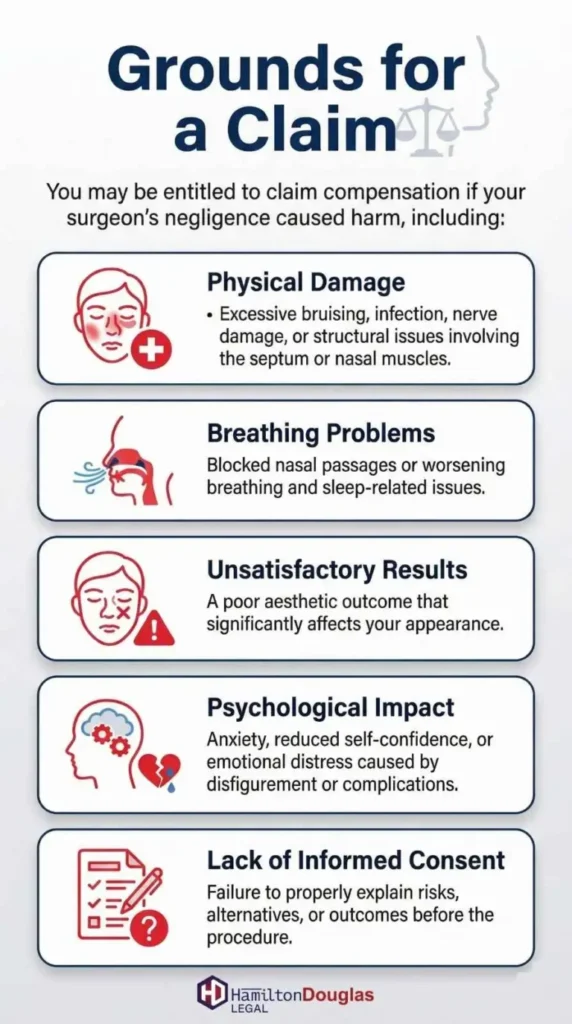
This is where most cases are won or lost. Under Scots Law, a breach usually falls into one of two categories: surgical performance or informed consent. Poor surgical performance is assessed against the Hunter v Hanley standard, where conduct falls below what is expected of any competent practitioner.

Conversely, a failure to inform you about material risks before you consent is assessed under the Montgomery v Lanarkshire [2015] standard.

What does a breach actually look like? It can be something that happened during the operation, but it can also be something that went wrong long before that:

  • Skipping a thorough pre-operative assessment or failing to account for a patient’s full medical history
  • No proper surgical planning for someone with a pre-existing condition like a deviated septum
  • Going ahead with surgery on someone who showed signs of psychological unsuitability for the procedure
  • A technical failure during the operation itself, like removing too much cartilage or damaging surrounding structures
  • Failing to warn the patient about material risks before they gave consent, violating the Montgomery standard


Many patients hesitate to take action because they assume the medical world will just protect its own. That fear is completely understandable, but the data proves otherwise.

According to Public Health Scotland, formal investigations regularly side with the patient. When initial complaints are escalated to a formal investigation, around 28% are officially upheld. Even complex complaints that go straight to formal investigation are upheld 23% of the time.

The system does not automatically side with the surgeon. When you push back with the right legal support, your chances of success are very real.

Causation

The breach has to be the direct cause of the harm you’re now living with. If your surgeon carried out the procedure competently and warned you of the risks, the fact that something went wrong doesn’t automatically mean it was negligence. But if your breathing difficulties, facial changes, or need for corrective surgery are the result of something the surgeon did wrong, that changes things considerably.

Whether you were treated at an NHS hospital or a private cosmetic clinic, medical negligence claims in Scotland follow the same legal threshold. How you paid for your surgery has no bearing on your right to compensation.

However, feeling unhappy with how your nose looks is not, on its own, negligence. But where that dissatisfaction comes alongside real physical harm or evidence that your surgeon made mistakes a competent professional wouldn’t have made, you likely have grounds to pursue a claim.


Satisfied Clients
0 K+
Dedicated Experts
0 +
Client Rating
0
Compensation Recovered
£ 0 + Million

Common Surgical Errors and Signs of a Negligent Rhinoplasty

A lot of patients blame themselves when surgery goes wrong. They wonder if they asked for too much, chose the wrong clinic, or simply weren’t a good candidate. The data tells a different story.

According to the JAMA Facial Plastic Surgery journal, between 5% and 15% of all rhinoplasty procedures require revision rhinoplasty because of functional obstructions or severe aesthetic failures. Botched rhinoplasty is not rare. It is a well-documented problem in cosmetic surgery.

Many victims spend months assuming their symptoms are just slow healing. By the time they realise otherwise, the damage is often harder to correct.

These are the complications that most commonly form the basis of a rhinoplasty negligence claim in Scotland:

Structural and Functional Problems

  • Nose collapse after rhinoplasty: The nasal structures lose their integrity and cave inward. This creates a visible cosmetic deformity and serious breathing difficulties that affect everyday life.
  • Saddle nose deformity: Excessive cartilage removal leaves the nasal bridge sunken. Alongside the cosmetic impact, it often causes severe airway obstruction that doesn’t resolve on its own.
  • Septal perforation: A hole in the nasal septum, usually caused by aggressive tissue removal or poor technique. If this happens, you might experience a constant blocked sensation, painful crusting inside the nose, or even a noticeable whistling sound when you breathe.
  • Alar collapse: The nostril walls weaken and cave inward during normal breathing, often following cartilage grafting failures or over-resection of the alar cartilage.
  • Deviated septum worsened by surgery: A deviated septum might go undetected before the procedure, or the surgery itself might make it worse. In both cases, this failure can lead to long-term airway obstruction and chronic breathing problems.
  • Nasal tip irregularities: Asymmetry or distortion of the nasal tip that stays visible at normal conversational distance. This is rarely just ‘bad luck’ or a normal healing issue. It almost always happens because the surgeon’s technique fell short.

Wound, Nerve, and Tissue Problems

  • Unnecessary scarring from open rhinoplasty cases where incision care or aftercare fell short
  • Tissue necrosis, where skin or surrounding tissue dies due to compromised blood supply during surgery
  • Persistent infections after surgery, which often point to sterility failures or insufficient post-operative monitoring
  • Anosmia, a full or partial loss of sense of smell caused by nerve damage during the procedure
  • Excessive post-operative bleeding (epistaxis) due to vascular injury or poor bleeding control during surgery

What the Standards Actually Say

Both the General Medical Council and the Royal College of Surgeons set out clear guidance for cosmetic surgery practice. An experienced surgeon working to those standards would spot contraindications before operating, manage functional problems through proper pre-surgical evaluation, and follow up properly during recovery. When those steps are skipped or badly handled, and the patient is left dealing with the consequences, there may well be grounds for a claim.

If you suffered facial injury or scarring following a facelift, or you’re dealing with complications from ear surgery negligence and associated hearing difficulties, we handle those claims too.

Making A Personal Injury Claim In Scotland

Our panel of experienced personal injury lawyers excel in handling cases against well-funded insurance companies.

Our specialised injury lawyers will assist you with your claim, keep you informed throughout the whole process, and provide you with legal advice that is easy to understand.

01

Get In Touch.

Tell us your story, we're here to listen and provide you with an initial assessment based on your circumstances.

02

We’ll Prepare Your Claim.

We'll be by your side to take care of the legal process. We'll keep you informed of every step of the way.

03

Receive Compensation.

If your claim is successful, we'll ensure that you get your compensation as soon as possible.

efthymios-xylangouras

"A Student’s Journey from Trauma to Triumph: Efthymios’s Fight for Justice After a Devastating Car Accident"

When Efthymios was injured in a car accident, he was left with severe facial injuries. He didn’t know how he would manage his recovery and studies.

“When I got in contact with HD Legal, they made me feel supported. They were incredibly understanding and fought hard for me, ensuring I received the compensation I deserved.”

Read Efthymios’s story >

margaret-forbes

"Cracked Pavement, Broken Ankle: How HD Legal Helped Margaret Find Justice and Peace of Mind"

When Margaret tripped on a neglected crack in the pavement in Glasgow, she shattered her ankle and was forced to take months off work, unsure how she would manage.

“HD Legal were a lifeline for me. They took care of everything—from gathering crucial evidence to battling the council—and gave me the peace of mind I needed to focus on my recovery.”

Read Margaret’s story >

douglas-macgregor

"Blown Away: HD Legal Fights for Douglas After Faulty Washing Machine Explosion"

When Douglas’s new washing machine exploded, it caused a fire that damaged his kitchen and left him with painful burns.

“HD Legal fought relentlessly for me when it seemed like no one else would. They were thorough, professional, and supported me every step of the way, helping me recover both physically and financially.”

Read Douglas’s story >

smiling-women

"From Misdiagnosis to Recovery: How HD Legal Fought for Eilidh’s Justice and Secured the Care She Needed"

When Eilidh’s severe abdominal pain was repeatedly misdiagnosed, her condition worsened, leading to the need for urgent surgery.

“HD Legal stood by me when I felt lost. They were thorough, professional, and fought tirelessly to get me the care and compensation I needed to heal.”

Read Eilidh’s story >

smiling-man

"Falling from Heights, Rising with Justice: How HD Legal Secured Compensation for Alistair After a Workplace Accident Involving Faulty Scaffolding"

Alistair Campbell’s fall from faulty scaffolding left him with serious injuries and months of recovery.

“HD Legal’s panel of solicitors fought for me, ensuring I received the support needed to move forward.”

Read Alistair’s story >

How Medical Negligence is Proven Under Scots Law

The Hunter v Hanley Standard

The test comes from the 1955 case of Hunter v Hanley. In Scotland, a surgeon is only considered negligent if their conduct was something no professional of ordinary skill would have done when acting with ordinary care. Put plainly: it’s not enough to show that another surgeon might have done things differently. The departure from accepted practice has to be clear and significant.

In rhinoplasty cases, this is where independent expert evidence becomes essential. A specialist consultant with significant rhinoplasty and reconstructive nasal surgery experience reviews what your facial plastic surgeon did and gives a professional opinion on whether it fell below the standard any competent peer would have met. That expert report is the cornerstone of the claim.
What Evidence Goes Into a Rhinoplasty Claim

A solid case draws on several layers of documentation:

  • Medical records and clinical notes. These come from the treating clinic or NHS board and show what was assessed, planned, and done throughout your care.
  • Operative notes: The surgeon’s own account of the procedure, written at the time. These can be revealing, particularly where decisions were made that departed from the standard procedure.
  • Before and after photographs: The visual evidence of the outcome compared to the pre-operative baseline and what was agreed before surgery.
  • Independent expert testimony: A written report from a specialist consultant assessing whether the care you received met the Hunter v Hanley standard.
  • Correspondence and complaint responses: Emails and letters between you and the clinic can sometimes reveal admissions or inconsistencies that strengthen the case.


We help request your records directly from Scottish clinics and NHS boards, instruct the right independent consultants, and build the full picture on your behalf. You don’t have to manage any of this yourself.

How Much Compensation Can You Claim for Rhinoplasty Negligence in Scotland?

There’s no single answer to this, because every claim is different. The amount depends on what happened to you, how badly it has affected your health and daily life, and what it has cost you financially. What we can do is walk you through how compensation is calculated so you have a clear idea of the potential value of your claim.

Rhinoplasty negligence compensation in Scotland falls into two categories: Solatium and Patrimonial Loss. Our free compensation calculator gives you a rough estimate before you speak to anyone.

Solatium: Compensation for Pain, Suffering, and Facial Disfigurement

Solatium covers the personal impact of what happened to you. That means physical pain, restricted breathing, visible changes to your face, and the psychological toll of living with the consequences of someone else’s mistake.

Scottish courts use the Judicial College Guidelines as a reference point.

Several factors push these awards higher:

  • How permanent the damage is: A cosmetic irregularity that fades over time is treated very differently from a structural deformity that’s visible every day for the rest of your life.
  • How old you were when it happened: Younger claimants face a longer period living with the injury, and courts take that into account.
  • Whether your breathing is affected: Things like chronic breathing problems, recurring infections, or losing your sense of smell make every single day a struggle. Because these functional issues take such a heavy toll on your quality of life, your compensation will directly reflect that.
  • The psychological impact: This is often the most overlooked part of a rhinoplasty claim. Emotional trauma, severe depression, social withdrawal, and a loss of confidence in your own appearance are taken seriously in Scottish courts. Chartered clinical psychologists are often brought in to formally assess this harm, and their reports carry real weight with insurers.

Surgeons have a strict duty to protect vulnerable patients. If a clinic fails to screen for Body Dysmorphic Disorder (BDD) before operating, the emotional fallout for the patient can be devastating. Because this failure causes such deep psychological harm, compensation in these cases is usually much higher to reflect the severe toll it takes on your mental health.

Patrimonial Loss: Covering Revision Surgery Costs and Financial Losses

These damages put you back in the financial position you’d have been in if the negligent surgery had never happened.

For most rhinoplasty negligence victims in Scotland, that means recovering:

  • The cost of revision rhinoplasty: Private surgery to repair the damage often costs thousands of pounds, whether the mistakes are cosmetic or affect your breathing. Where an independent expert confirms it’s needed because of the original negligence, it’s fully recoverable.
  • Lost earnings: Pay lost during recovery, at medical appointments, or during corrective procedures is calculated from your payslips and employment records. If your long-term earning capacity is affected, that can be claimed too.
  • Therapy and counselling costs: CBT, psychiatric treatment, and other psychological support directly linked to the harm you suffered are all recoverable.
  • Travel expenses: Mileage, transport, and parking for all relevant appointments go into the claim.
  • Care provided by family or friends: If someone close to you supported you during recovery, a financial value can be placed on that time.


Our team helps pull all of this together using your receipts, invoices, payslips, and expert recommendations. You don’t need to work out what’s claimable and what isn’t.

For more information, visit our guide on what financial losses you can recover.

DEDICATED CLAIMS ADVISORS

Our dedicated claims advisors are always available to offer free legal advice.

100% NO WIN NO FEE CLAIMS

All our claims are processed on a No Win No Fee basis; you pay nothing if you lose.

appear-logo-in-mobile

MILLIONS SECURED IN DAMAGES

To date, we have secured millions in damages.

THOUSANDS OF SATISFIED CLIENTS

To date, we have helped thousands of clients recover compensation and continue to do so.

Rhinoplasty-Compensation-Claim-Grounds

Making a No Win No Fee Rhinoplasty Claim in Scotland

One of the most common reasons people don’t pursue a claim is the fear of legal costs. In Scotland, that concern doesn’t apply, because rhinoplasty negligence claims are funded through a Speculative Fee Agreement (SFA).

You pay nothing to start your claim. If the case doesn’t succeed, you don’t pay a penny in legal fees. This “no financial risk” promise is supported by After The Event (ATE) insurance, which protects you against paying the opponent’s costs if the claim is unsuccessful. If it does succeed, a pre-agreed success fee comes out of your compensation. Scottish law strictly caps how much this success fee can be, so there are no surprises at the end of the process.
You’ll receive a written Speculative Fee Agreement before anything begins, setting out every term clearly. No hidden costs, no ambiguity about what happens in different scenarios.

The Scottish Cosmetic Surgery Claims Process: Step-by-Step

For most people, the biggest barrier isn’t the legal process itself. It’s not knowing what that process actually looks like. Here’s how a rhinoplasty negligence claim typically unfolds in Scotland.

Free Initial Consultation

You tell us what happened. We listen, ask questions about your surgery and its aftermath, and give you an honest view of whether your situation is likely to support a claim under Scots Law. There’s no charge for this, and no pressure to proceed.

Medical Records Retrieval

We formally request your full medical records from the treating clinic or NHS board. This includes pre-operative notes, surgical records, and aftercare documentation. Many claimants find this step daunting. We handle it entirely on your behalf.

Independent Medical Examination

We instruct a medical professional with direct rhinoplasty expertise to review your case. If needed, they’ll examine you in person at a convenient location in Scotland. Their written report forms the foundation of the legal argument, setting out whether the care you received met the Hunter v Hanley standard.

Letter of Claim

Once expert evidence supports your case, a formal Letter of Claim goes to the surgeon’s medical defence organisation or the clinic’s insurers. It sets out what went wrong, the impact on your health and finances, and the compensation being sought.

Negotiation and Settlement

Most rhinoplasty negligence claims in Scotland settle without going anywhere near a courtroom. Your solicitor handles all negotiations and keeps you updated at every stage.

Court Proceedings (Where Required)

When the other side disputes liability and won’t make a fair offer, the case may go to court. Depending on the value of the claim, that typically means the All-Scotland Sheriff Personal Injury Court (ASSPIC) or the Court of Session for higher-value cases.

Pre-action protocols require both sides to exchange evidence before proceedings formally begin, and in many cases this prompts a settlement before any hearing takes place. On the rare occasion that your case does go to court, your solicitor will manage every detail on your behalf.

Frequently Asked Questions About Rhinoplasty Compensation Claims in Scotland

How long do I have to make a rhinoplasty claim in Scotland?

According to the Prescription and Limitation (Scotland) Act 1973, you have three years to start a rhinoplasty compensation claim. That window starts from the date of your surgery, or from the date you first understood that your complications were caused by negligent treatment, whichever is later.

This second rule (the date of knowledge) matters more than most people realise. A lot of patients spend months, sometimes longer, assuming their problems are just a slow recovery. By the time they connect those problems to the surgeon’s conduct, significant time may have passed. The law accounts for this: the three-year clock starts from when you knew, or reasonably should have known, that negligence was the cause.

Usually no. Court is typically the last resort, not the expected outcome. Negotiations happen between the legal teams, and the clinic or surgeon’s insurers usually prefer a settlement to the cost and exposure of a trial. Pre-action protocols, which require both sides to exchange evidence before any formal proceedings begin, often bring things to a resolution at that stage too.

We’re Here To Help When You Need Us Most.

Call us on 0141 2801112, or leave us a message below to request a call back and one of our team will be in touch as soon as we can.

Terms and conditions