


- Obligation-Free Consultation
- No Win, No Fee
- Award-Winning Lawyers
As Featured In:






















Check Out Our Awesome Reviews Below:
EXCELLENT Based on 99 reviews
 Posted on Google
 Daniel MorosanuI cannot thank the team at HD Claims enough for their help with my personal injury claim. From day one, their injury lawyers were incredibly professional, explaining the no win no fee process clearly without complex jargon. They took away all the stress of dealing with the insurance companies and secured the accident compensation I was entitled to. If you are looking for reliable personal injury solicitors who truly look out for your best interests, I highly recommend their services.Posted on Google
 Gigel stoicaHD Claims made my personal injury claim simple and stress-free. The team was professional, responsive, and kept me updated throughout the process. I would recommend them to anyone needing help with an accident compensation claimPosted on Google
 Muhammed AhmedI was involved in a car accident where my car was written off and my passengers were seriously injured. I contacted HD Claims and received an excellent service from start to finish. They were very understanding and took the time to explain the whole process clearly. In the end, I received a very favourable settlement. I would most definitely recommend this firm to anyone in a similar situation.Posted on Google
 Sarah TaylorExcellent service from HD Claims! They completely managed my personal injury claim from start to finish and allocated me a fantastic specialist solicitor. The whole process was handled on a 'no win no fee' basis, making it entirely stress-free. Their communication was top-notch, and I am very happy with the final settlement I received. I highly recommend their team to anyone looking for reliable legal support.Posted on Google
 Nico SullivanHD Claims were brilliant after my accident. They handled everything smoothly and kept me informed the whole time. If you need personal injury lawyers with car accident experience, they’re a great choice.Posted on Google
 faiq zebI've used HD Claims for a few car accidents I've suffered over the years as a taxi driver. Always received a great experience and compensation - Asif Khan GlasgowPosted on Google
 picui bossHey my name is Andrei and I’m with John white my self and they are They are the best 100% in all Scotland you should try with them. They’re the best service and they provide with everything. What you want to know about and I give them out 10 out of 10.Posted on Google
 GAMERS ONLYWas a very good service 👏Posted on Google
 Sunny InboxI had a great experience with HD Claims. The injury lawyers were professional, responsive, and explained everything clearly. They handled my case with care and confidence, making the whole process stress-free. Highly recommended for injury claims.Posted on Google
 John SmithMy insurance company recommended a firm that charged 30% and had poor reviews. I went with Hamilton Douglas instead, who charged far less and were completely transparent. They were professional, communicative, and secured me an excellent settlement. Do your research and pick them.Verified by TrustindexTrustindex verified badge is the Universal Symbol of Trust. Only the greatest companies can get the verified badge who has a review score above 4.5, based on customer reviews over the past 12 months. Read more
Housing disrepair is when something in your rented home is broken, unsafe, or making daily life difficult, and your landlord still has not sorted it out after you reported it.
Living with an unresolved repair can quickly take over your day. A room may become unusable, heating bills may increase significantly, or you may find yourself reporting the same fault without getting a clear answer.
The issue could be damp, black mould, exposed wiring, a broken boiler, leaking pipes, damaged windows, or a leaking roof. These problems can ruin furniture and clothes, or start to affect your health.
You should not have to keep chasing your landlord while a problem in your home gets worse. If they ignore reported repairs or leave serious problems unresolved, you may be able to claim against your landlord for disrepair.
A claim can help push the landlord to complete the repairs. You may also be entitled to housing disrepair compensation if the conditions have caused avoidable stress, financial loss, damage to your belongings or an injury.
At HD Claims, we can help you understand whether you may have grounds for housing disrepair claims in Scotland. We manage the legal strategy of your claim from start to finish, explain each step clearly, and work alongside specialist solicitors suited to the circumstances of the case.
You can use our free claims eligibility checker or speak with our team directly. We will look at what has happened, how long the problem has continued, and what action may be available to you.
Understanding Landlord Responsibilities Under Scots Law
Your landlord cannot avoid essential repairs simply because the tenancy agreement says little about them. Scottish housing law places duties on landlords beyond the written lease, sometimes called implied terms, so both landlords and tenants have a clear baseline for the condition of the home.
The exact rules depend on whether you rent privately, from a council, or through a housing association. In each case, the landlord has legal obligations covering property maintenance, safety and basic living conditions.
Once you report a fault, the landlord should look into it and complete the work within a reasonable time. That does not cover damage you caused beyond normal wear and tear, but everyday use and ageing do not remove the landlord’s responsibility.
Poor maintenance may also lead to an accident. For example, loose flooring, a leaking stairwell, or broken handrails could lead to a public liability claim for an injury caused by unsafe premises if someone gets hurt.
The Repairing Standard & Housing (Scotland) Act 2006
The Repairing Standard sets the minimum condition required for most private rented properties in Scotland. Under the Housing (Scotland) Act 2006, a private landlord must meet this standard when the tenancy starts and continue meeting it while you live there.
Your home should:
- Be water-and airtight.
- Have a sound structure and exterior, including the roof, drains, gutters, and outside pipes.
- Have working and safe water, gas, electricity, sanitation, and heating systems.
- Include safe fixtures and appliances supplied by the landlord.
- Have suitable smoke, heat, and carbon monoxide alarms.
- Provide safe access to relevant shared areas.
The standard also covers features people can easily overlook, such as secure common doors in tenements and safe food preparation space. If rain enters through missing roof tiles, the electrics are unsafe, or the boiler repeatedly fails, the landlord may not be meeting the required standard.
The scale of the problem is significant: in 2024, 48% of all Scottish homes had some disrepair affecting critical elements. These include parts of a building that protect it from the weather, support its stability, or prevent rapid deterioration.
The Tolerable Standard for Scottish Homes
The Tolerable Standard is the minimum condition every home in Scotland should meet, whether it is privately owned, rented from a private landlord, or provided by a council or housing association. It asks whether the property provides the minimum conditions needed to be fit for human habitation.
A home may fall below this standard if it is structurally unstable, affected by rising or penetrating damp, poorly ventilated, or without an adequate water supply. Fire, heat and carbon monoxide detection may also be included in the test.
In 2024, 28% of all Scottish dwellings failed the Tolerable Standard. Most recorded failures involved inadequate fire detection or carbon monoxide alarms: 76% of failing homes lacked satisfactory smoke or heat detection, while 55% lacked satisfactory carbon monoxide protection.
A home can fail the Tolerable Standard for different reasons. Missing alarms may be quicker to fix than serious damp or structural damage, but every failure still needs attention because it can affect your safety.
Speak to our compensation experts
It doesn't cost you anything to know where you stand.
Fill out the form, and we'll get back to you within one hour.
Need to speak to us sooner?
Call us on 0141 280 1112
- Over £3+ Million in Settlements
- No Win, No Fee
- Supporting Scots Since 2001
- 10 Offices Around Scotland
Request a FREE call
Common Issues in Scottish Housing Disrepair Claims
The types of housing disrepair tenants face often overlap. A leaking roof may lead to damp, damaged plaster, unsafe flooring, and mould in more than one room, so you can raise several problems as part of the same complaint or claim.
Keep reporting each new fault, even when it appears connected to an existing one. This creates a clearer record of your housing disrepair issues and shows how the condition of the home has changed over time.
Damp, Mould, and Condensation: The 2026 Regulations
Black mould on a bedroom wall is rarely solved by wiping it away or painting over it. It is important to identify the source: be it penetrating damp from a leaky roof, rising damp from below the building, poor ventilation, or water pouring from broken pipes.
A landlord should not dismiss mould as a lifestyle problem without properly checking what is causing it. If you have reported the damp and the landlord has neglected to investigate or rectify the underlying defect, you may be able to take further action.
From 6 October 2026, the Investigation and Commencement of Repair (Scotland) Regulations 2026 will place clear deadlines on private and social landlords. These rules, often called Awaab’s Law in Scotland.
Will Require Landlords To:
- Investigate reported damp and mould within 10 working days.
- Give the tenant a written summary within 3 working days after the investigation.
- Begin any necessary repairs within 5 working days of completing the investigation.
New damp and mould deadlines will start on 6 October 2026. Existing repair duties still apply, and landlords must deal with reported defects within a reasonable time.
If damp or mould is leaving you coughing, short of breath, or has generally affected your health, speak to your GP. Their medical notes can help show when the problem started and whether the conditions in your home may be affecting your health.
Faulty Heating, Gas, and Boiler Breakdowns
A broken boiler can quickly leave a household without heating or hot water. In private rented homes, the Repairing Standard covers fixed heating and water-heating systems, which should remain in proper working order.
There is no single repair deadline that applies to every boiler fault. Private tenancy rules require work within a reasonable time after the problem is reported, but a complete loss of heating during a Scottish winter calls for a much faster response than a minor fault that does not affect the system.
Landlords, councils, and housing associations must arrange yearly safety checks for the gas appliances and flues they provide. Any dangerous fault found during a check should be dealt with promptly, and the appliance should not be used until it is safe.
A suspected gas leak or carbon monoxide risk is an emergency. Stop using the appliance, open the doors and windows, and call the National Gas Emergency Service on 0800 111 999 instead of waiting for the normal repair or claims process.
Structural Defects, Leaks, and Exterior Damage
Roof leaks, cracked exterior walls, damaged gutters, and broken outside pipes can allow water to spread far beyond the original fault. Under the Repairing Standard, private landlords are responsible for keeping these parts of the building in a reasonable state of repair.
A mark left behind by an old leak may only be cosmetic. However, if water is still coming through the ceiling, plaster is loose, floorboards are starting to rot, or cracks are getting wider, there may be an ongoing problem that needs to be checked.
If water is coming through the ceiling, report it as urgent, move your belongings away, and take photographs only when it is safe. Avoid standing below a bulging ceiling and do not touch lights and sockets near the leak.
In a tenement, responsibility for a roof, staircase, or other shared area may be split between several owners. Your landlord may need to work with them, but shared ownership does not make the danger disappear or justify leaving you without an answer.
You may also have grounds for personal injury claims if a defect causes physical harm. For example, you could suffer a slip or fall due to a landlord’s failure to repair leaking stairs, damaged flooring, or another danger they already knew about.
Am I Eligible for a Housing Disrepair Claim?
If you have reported a leak, mould, broken heating, or another serious problem and your landlord still has not sorted it out, you may have grounds to make a housing disrepair claim. Keep any photos, emails, repair requests, and notes of missed visits, as these can show how long you have been left waiting.
| Tenancy Type | Governing Legal Standard | Escalation Route | Potential Outcomes |
|---|---|---|---|
| Private Renters | The Repairing Standard (Housing (Scotland) Act 2006) | Written notice to landlord → First-tier Tribunal (Housing & Property Chamber) | • Repair Enforcement Orders (RSEO). • Rent Relief Orders (up to 90% rent reduction). • Financial compensation. |
| Council Tenants | The Tolerable Standard & Scottish Secure Tenancy | Internal Council Complaints → Scottish Public Services Ombudsman (SPSO) / Sheriff Court | • Mandatory urgent repairs. • Property transfers/rehousing. • Compensation for belongings or stress. |
| Housing Association | Scottish Housing Quality Standard (SHQS) | Association Complaints Procedure → SPSO / Sheriff Court | • Enforced repair schedules. • Compensation for health impacts and financial losses. |
Important Note: You should continue paying your rent throughout any repair dispute unless ordered otherwise by a court or the First-tier Tribunal. Withholding rent independently can result in rent arrears and lead to eviction proceedings.
Council Tenants and Local Authority Housing
Yes, you can take legal action against your local council when it has failed to meet its responsibilities as your landlord. Council tenants usually hold a Scottish Secure Tenancy, which requires the council to keep the home wind and watertight, reasonably fit to live in, and in a proper state of repair.
Councils may have long repair backlogs, but that does not allow them to leave a serious leak, broken heating system, or unsafe electrical fault unresolved. The Right to Repair scheme also sets clear deadlines for landlords to complete certain small but urgent repairs for Scottish secure tenants.
Start by reporting the fault and using the council’s complaints process if the repair is delayed. If you complete that process and remain unhappy with how the council handled the matter, you may take the complaint to the Scottish Public Services Ombudsman. A separate claim or court action may be needed where you are seeking compensation, so the right next step depends on what happened and what outcome you need.
Housing Association Tenants
Housing associations are usually Registered Social Landlords, and they must meet the standards expected of social landlords in Scotland. Their responsibilities include dealing with necessary repairs within a reasonable period after becoming aware of them.
Report the repair first, then make a formal complaint if the response is poor or the work keeps being delayed. Once you have completed the association’s complaints procedure, you can ask the Scottish Public Services Ombudsman to look at how your complaint was handled.
When landlords fail to act, keep a record of every missed visit, unanswered email, and promise that was not kept. In many disrepair cases, that timeline helps show that the association knew about the problem and had a fair chance to deal with it.
Private Renters and the First-tier Tribunal
Housing disrepair claims against private landlords usually begin with the Repairing Standard. If you have notified your landlord and the home still does not meet that standard, you can apply to the First-tier Tribunal for Scotland’s Housing and Property Chamber.
The Tribunal is the Scottish body that decides whether a private landlord has failed to meet their repair duties. It can inspect the evidence and order the landlord to carry out the necessary work. Applying is free, and you are not normally responsible for the other party’s expenses in Housing and Property Chamber proceedings unless your unreasonable conduct during the case has caused them unnecessary costs.
A Repairing Standard application mainly focuses on getting the property fixed. If your housing disrepair case also involves damaged possessions, illness, or other damages, you may need a different legal route to seek compensation.
The right route depends on who your landlord is and what you want to achieve, whether that is getting the repairs completed, claiming compensation, or both.
The Housing and Property Chamber usually deals with Repairing Standard cases and many disputes involving private tenancies. Claims against a council or housing association, as well as personal injury claims caused by disrepair, may need to be raised in the Sheriff Court.
The Court of Session is generally used only for civil cases that are especially complex or involve a very high value. Most tenants are more likely to deal with the Tribunal or the Sheriff Court.
Contact us at 01412801112; we will review your tenancy type, repair history, and evidence in our free initial consultation and then explain which route fits your circumstances and what compensation you can realistically seek.
Making A Personal Injury Claim In Scotland
Our panel of experienced personal injury lawyers excel in handling cases against well-funded insurance companies.
Our specialised injury lawyers will assist you with your claim, keep you informed throughout the whole process, and provide you with legal advice that is easy to understand.
01
Get In Touch.
Tell us your story, we're here to listen and provide you with an initial assessment based on your circumstances.
02
We’ll Prepare Your Claim.
We'll be by your side to take care of the legal process. We'll keep you informed of every step of the way.
03
Receive Compensation.
If your claim is successful, we'll ensure that you get your compensation as soon as possible.

"A Student’s Journey from Trauma to Triumph: Efthymios’s Fight for Justice After a Devastating Car Accident"
When Efthymios was injured in a car accident, he was left with severe facial injuries. He didn’t know how he would manage his recovery and studies.
“When I got in contact with HD Legal, they made me feel supported. They were incredibly understanding and fought hard for me, ensuring I received the compensation I deserved.”

"Cracked Pavement, Broken Ankle: How HD Legal Helped Margaret Find Justice and Peace of Mind"
When Margaret tripped on a neglected crack in the pavement in Glasgow, she shattered her ankle and was forced to take months off work, unsure how she would manage.
“HD Legal were a lifeline for me. They took care of everything—from gathering crucial evidence to battling the council—and gave me the peace of mind I needed to focus on my recovery.”

"Blown Away: HD Legal Fights for Douglas After Faulty Washing Machine Explosion"
When Douglas’s new washing machine exploded, it caused a fire that damaged his kitchen and left him with painful burns.
“HD Legal fought relentlessly for me when it seemed like no one else would. They were thorough, professional, and supported me every step of the way, helping me recover both physically and financially.”

"From Misdiagnosis to Recovery: How HD Legal Fought for Eilidh’s Justice and Secured the Care She Needed"
When Eilidh’s severe abdominal pain was repeatedly misdiagnosed, her condition worsened, leading to the need for urgent surgery.
“HD Legal stood by me when I felt lost. They were thorough, professional, and fought tirelessly to get me the care and compensation I needed to heal.”

"Falling from Heights, Rising with Justice: How HD Legal Secured Compensation for Alistair After a Workplace Accident Involving Faulty Scaffolding"
Alistair Campbell’s fall from faulty scaffolding left him with serious injuries and months of recovery.
“HD Legal’s panel of solicitors fought for me, ensuring I received the support needed to move forward.”
The Process of Making a Housing Disrepair Claim in Scotland
Knowing how to start a housing disrepair claim can make the situation feel less daunting. The first step is usually to show what went wrong, when you first reported it to your landlord, and what happened after that.
Once we take on your case, we manage the legal strategy from start to finish. We work alongside specialist solicitors suited to your circumstances, keep the paperwork moving, and explain each stage without leaving you to chase updates.
Reporting the Issue and Gathering Evidence
Your landlord needs to know exactly what is wrong before the matter can move forward. Report each problem in writing, even if you have already mentioned it during a phone call or repair visit.
Give your landlord a reasonable opportunity to inspect the property and arrange the repairs. How quickly they should act depends on how serious the problem is. Exposed wiring, a loss of heating during winter, or water coming through the ceiling needs urgent attention, while a minor repair that does not put anyone at risk may reasonably take longer.
Keep whatever helps show the full story:
- Emails, letters, texts, and complaint reference numbers
- Dated photographs or videos showing the problem getting worse
- A simple repair log recording reports, visits, and missed appointments
- Receipts for damaged belongings, extra heating, or temporary accommodation
- Medical records if the conditions have caused health issues
Try not to throw damaged items away before photographing them. A short note explaining when the damage happened can also be useful months later.
Formal Notice and Pre-Action Steps in Scotland
The Pre-Action Protocol for Housing Conditions Claims only applies in England and Wales, not Scotland. In Scotland, the landlord might instead get a letter of repair that explains when the concerns were identified, what action has been taken so far, and what they need to do next.
A specialist solicitor may also ask an independent surveyor to inspect the property or request relevant records from the landlord. The aim is usually to resolve the matter without formal proceedings. However, if the landlord still refuses to act, the claim may need to go to the Tribunal or Sheriff Court.
Applying for a Repairing Standard Enforcement Order
Private renters can apply to the First-tier Tribunal for Scotland’s Housing and Property Chamber if the home does not meet the Repairing Standard. The landlord must first receive clear notice of every repair listed in the application and have a reasonable opportunity to complete the work.
At that point, the Tribunal can step in, check the evidence, and visit the home if it needs a closer look. If it agrees that the repairs have been neglected, it can issue an RSEO telling the landlord exactly what must be fixed.
The landlord will usually get at least 21 days to complete the work. Failing to comply with the order without a reasonable excuse is a criminal offence. The case may be referred for prosecution and could result in a fine.
DEDICATED CLAIMS ADVISORS
Our dedicated claims advisors are always available to offer free legal advice.
100% NO WIN NO FEE CLAIMS
All our claims are processed on a No Win No Fee basis; you pay nothing if you lose.

MILLIONS SECURED IN DAMAGES
To date, we have secured millions in damages.
THOUSANDS OF SATISFIED CLIENTS
To date, we have helped thousands of clients recover compensation and continue to do so.
What Can You Claim For? Compensation and Outcomes
A housing disrepair claim can help get the problems in your home fixed and get compensation for the harm they have caused. The outcome will depend on your tenancy, the landlord’s response, and the evidence showing how the conditions affected you.
We manage both parts of the case together, working alongside specialist solicitors suited to your circumstances. This means the need for urgent repairs is not overlooked while evidence of your losses is being gathered.
Where your situation involves a separate accident or injury, you can also read about injury claims and all types of accidents we cover.
Forcing Repairs and Rent Relief Orders
Getting the home made safe is often the most pressing concern. For private tenants, the First-tier Tribunal can order a landlord to complete specific work when the property falls below the Repairing Standard.
If the landlord ignores the repair order without a reasonable excuse, the Tribunal may issue a Rent Relief Order. This can reduce the rent by up to 90% until the required work is completed.
The rent reduction does not end the tenancy, and it only applies from the date the order is made. It cannot be applied to an earlier period.
The rent does not drop automatically as soon as you report a repair. This step only becomes available after the landlord has failed to follow a Repairing Standard Enforcement Order, and the Tribunal decides that rent relief is appropriate.
Compensation for Damaged Belongings and Health Impacts
Disrepair can cost you money long before a claim begins. Mould may ruin clothing or furniture, a faulty heating system may push up energy bills, or a serious leak may force you to stay somewhere else.
Money claimed for clear expenses is often called “special damages.”
This may include:
- Replacing damaged belongings
- Extra heating or electricity costs
- Temporary accommodation and travel expenses
- Lost earnings or treatment costs linked to an injury
Keep receipts, bank statements, photographs, and proof of payment wherever possible. These records help show what you spent and why.
You may also be able to seek compensation for the wider effect the conditions have had on your life, sometimes called “general damages.” This could reflect the discomfort, stress, loss of enjoyment of your home, or worsening of a health condition caused by the disrepair.
Medical records are especially helpful where damp, mould, unsafe flooring, or another fault has caused an injury or made an existing condition worse. For more information, you can check what you may be able to claim for following an injury, including related expenses and treatment needs.
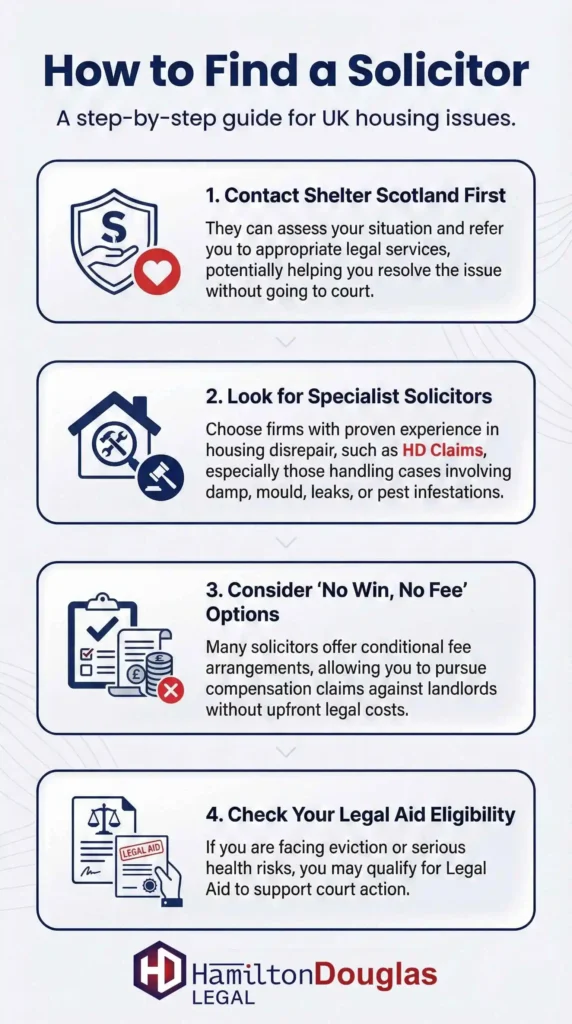
No Win, No Fee Housing Disrepair Solicitors in Scotland
A No Win No Fee arrangement allows you to pursue a housing disrepair claim without paying legal fees upfront. In Scotland, this is usually formalised through a written success fee agreement.
If your claim succeeds, the agreed success fee is normally taken from the compensation you receive. The written agreement should tell you the percentage before the case begins, explain which legal costs it covers, and set out whether you could be responsible for other expenses. Scottish law regulates these agreements and requires their terms to be provided in writing.
If the case does not succeed, you will usually not pay the solicitor’s fee. However, every agreement can differ, so we make sure the funding terms and any possible financial risks are explained clearly before you decide to continue.
Our role is to manage the legal strategy from start to finish. We work alongside specialist housing disrepair solicitors in Scotland suited to your case, handle the communication, and keep you updated throughout.
Read more about why tenants choose HDClaims to manage their case and support them through each stage.
FAQs
Can my Scottish landlord evict me if I claim for disrepair?
No, your landlord cannot lawfully evict you simply because you reported repairs or started a claim.
Under a Private Residential Tenancy, your landlord cannot evict you simply because you reported a repair problem. They must rely on a recognised legal ground and, if you do not agree to leave, apply to the First-tier Tribunal for an eviction order.
The process differs for council and housing association tenants, but those landlords must also follow formal steps and apply to the court. They cannot simply lock you out or force you to leave because you complained.
Seek advice quickly if you receive an eviction notice after your landlord has failed to carry out repairs. The timing may matter, especially if you believe the landlord is using another reason as an excuse to evict you for reporting the problem.
Can I legally stop paying rent if repairs are ignored?
It may be tempting to stop paying rent when your landlord keeps ignoring repairs, but doing so can put you in a difficult position. Unpaid rent can quickly turn into arrears and may give your landlord a reason to start eviction action.
Keep paying the agreed rent unless you have clear written advice, an agreement with your landlord, or a decision from a court or Tribunal telling you otherwise.
There is a safer legal route in some private tenancy cases. If a landlord ignores a Repairing Standard Enforcement Order, the Tribunal may make a Rent Relief Order and reduce the rent by up to 90% until the required work is dealt with.
How long do housing disrepair claims take in Scotland?
There is no fixed timeframe. A landlord who accepts the problem and agrees to repairs or compensation may resolve the case within a few months.
Cases take longer when the landlord disputes responsibility, an inspection is needed, or the matter goes to a Tribunal or court. If the Tribunal makes a repair order, the case may stay open for many months, sometimes into the following year, while it checks that the landlord has completed the required work.
We’re Here To Help When You Need Us Most.
Call us on 0141 2801112, or leave us a message below to request a call back and one of our team will be in touch as soon as we can.