HD claims logo without B (2)
0%
Loading ...

Hairdressing Compensation Claims
in Scotland

As Featured In:

Check Out Our Awesome Reviews Below:

A visit to a hair salon should feel safe, calm, and positive. When a treatment goes wrong because of hairdressing negligence, the result can be much more serious than a bad haircut. Some clients are left with painful chemical burns, scalp damage, a visible bald patch, or lasting hair loss.

Many salon treatments use strong products and hot tools. Hair dye, bleach, peroxide, straighteners, and chemical treatments must be used with proper care. If a hairdresser leaves bleach on too long, mixes products wrongly, skips a patch test, or ignores signs of pain, the harm can be severe.

We're Here To Help

Contact Us Today

Hairdressing is a major industry, and many people visit a salon several times a year. Yet the level of training and experience can vary from one hairdresser to another. That is why a salon’s duty of care is so important.

If you were harmed at a salon, barber, or by a mobile hairdresser in Scotland, you may be able to make a hairdresser compensation claim. This may apply where your injury was caused by poor technique, unsafe products, lack of testing, or substandard treatment, including in some cases a waxing injury or other beauty treatment accident.

HD Claims is here to help you understand if you have grounds for a hairdresser injury claim. We guide you through the initial steps of gathering evidence and then match you with a specialist personal injury solicitor in Scotland who is suited to your specific injury.

Where appropriate, your case may be handled on a No Win No Fee basis, allowing you to seek compensation without upfront legal costs.

Hair salon injuries that could lead to compensation

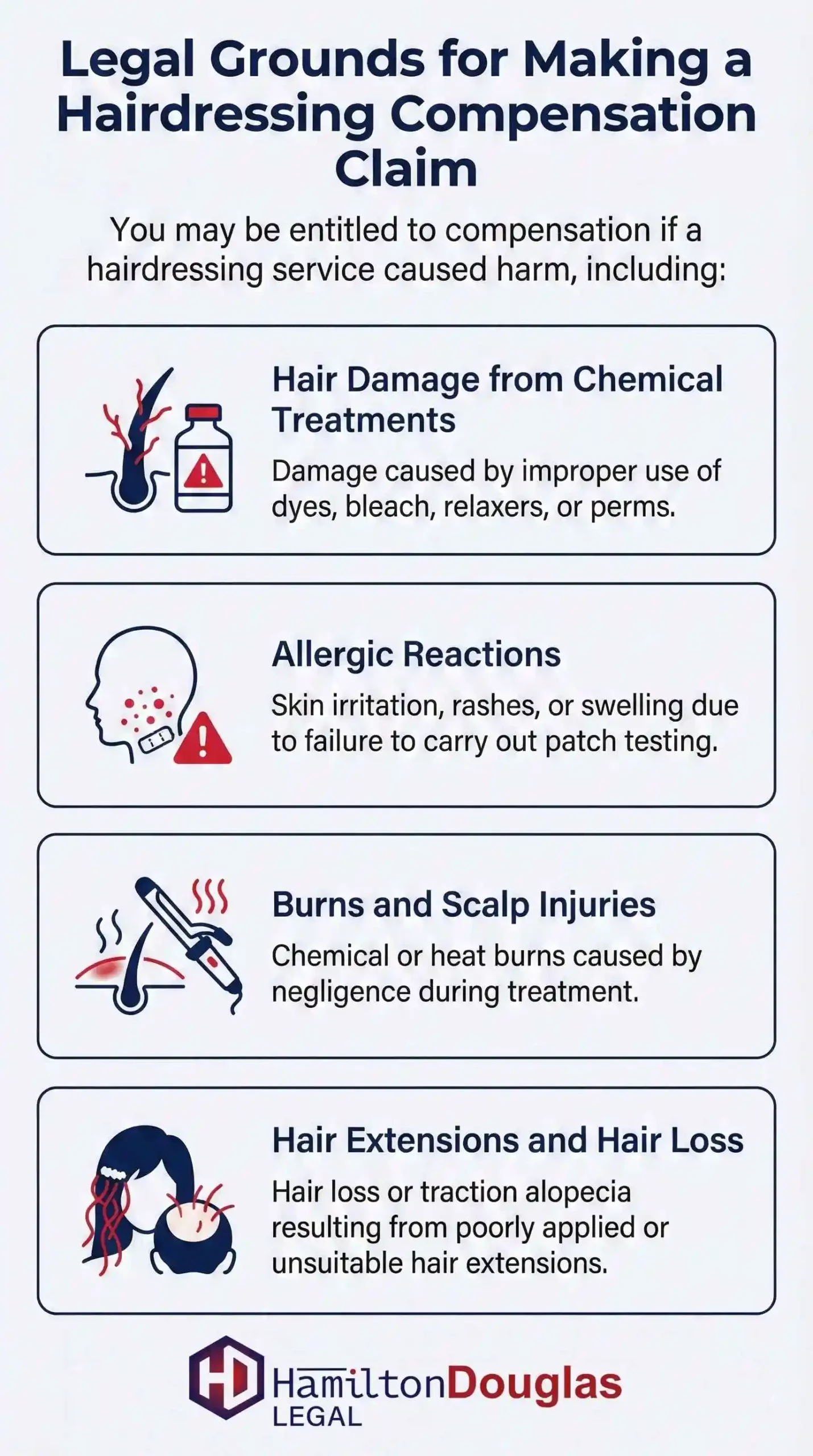
A hairdressing injury can be upsetting because it often happens during something you expected to enjoy. You may have gone in for a colour refresh, highlights, extensions, or even just a trim, and come out in pain, with visible damage, or worried about whether your hair will recover. In some cases, these beauty salon injuries can support personal injury claims if the harm was caused by poor care.

Some of the injuries that may lead to compensation include:

For example, you may tell a stylist that your scalp is burning during a bleaching treatment. If they dismiss your concerns and leave the product on, and you later develop burns or a bald patch, the outcome may be more than just unfortunate. It may be evidence of negligent treatment and could support a claim for hairdresser accident compensation.

Hair dye reactions can also be serious. A patch test is meant to reduce the risk of an allergic reaction, especially where products contain ingredients such as PPD, which is often found in darker dyes. If no patch test was offered, or the salon ignored clear warning signs, it may help show that the treatment was carried out negligently.

Temporary or permanent baldness may also form part of your claim. Hair loss is not “just cosmetic”. It can affect your sleep, mood, confidence, work, relationships, and social life, especially if the damage is visible or happened before a wedding, interview, holiday, or family event.

You do not need to work out on your own whether you can sue a hairdresser. What matters is how the injury happened, whether safer care should have been given, and what proof is available.

It’s a good idea to collect any evidence as soon as possible. This could include photos, medical notes, booking confirmations, receipts, product information, and any messages you’ve sent to the salon. Getting everything together early on can really help your case.

Hairdressing-Compensation-Claim-Grounds-scaled

Speak to our compensation experts

It doesn't cost you anything to know where you stand.

Fill out the form, and we'll get back to you within one hour.

Need to speak to us sooner?

Call us on 0141 280 1112

Request a FREE call

Terms and conditions

Why Skin Patch and Hair Strand Tests Matter

A skin patch test is one of the most important safety steps before hair dye, bleach, tint, toner, or other chemical colour treatment. It is used to check whether your skin may react badly to the product. This is especially important with darker dyes, which may contain PPD, a known cause of severe allergic reactions.

Before a new colour treatment, a patch test should usually be carried out in line with the product instructions, often 24 to 48 hours before the appointment. This gives time for signs of a reaction to appear, such as redness, itching, swelling, burning, or blistering. If a salon skips this step and you suffer contact dermatitis, facial swelling, scalp burns, or another reaction, that may be strong evidence of negligence.

A hair strand test serves a different purpose. It checks how your hair may respond to bleach, dye, relaxers, perms, or chemical straightening products. This can be vital if your hair has been coloured before, is already weak, or has been treated with products that may react badly with new chemicals.

If a stylist fails to carry out a strand test, your hair may become brittle, snap off, stretch, melt, or break close to the scalp. In serious cases, this can leave visible thinning, bald patches, or long-term hair loss. This type of damage may support a claim if the stylist should have tested your hair first or warned you about the risk.

You may have a stronger case if:

It is also worth keeping proof as early as possible. Save photos of your scalp and hair, messages with the salon, appointment records, receipts, and any medical notes from your GP, pharmacist, dermatologist, or hospital. If your claim needs legal support, we can help assess the details and connect you with suitable hairdresser accident solicitors in Scotland.


Satisfied Clients
0 K+
Dedicated Experts
0 +
Client Rating
0
Compensation Recovered
ÂŁ 0 + Million

What evidence do I need for a hairdresser's injury claim?

Good evidence can really help with a hairdresser’s injury claim. It helps show what happened, how serious the damage was, and how the injury has affected your daily life. The best time to collect it is when you experience pain, burning, swelling, hair loss, or scalp damage.

Start by getting medical help. You can contact your NHS GP, attend a minor injuries unit, speak to a pharmacist, or ask for a referral to a dermatologist if the injury is more serious. This matters because medical records might be able to link your chemical burn, allergic reaction, contact dermatitis or hair loss to the salon treatment.

You should also take clear photos and videos. Try to capture the injury in natural light, from more than one angle, and over several days or weeks. Date-stamped photos of scalp burns, bald patches, broken hair, swelling, blisters, or redness can help show how the injury developed.

Keep anything that proves the treatment took place. This may include:

It can also help to write down what happened while it is still fresh in your mind. Include the date, the treatment you booked, who carried it out, what products were used, what you felt during the treatment, and how the salon responded when you raised concerns. Small details can become important later.

If the salon accepts fault, offers a refund, or says something went wrong, keep that message safe. Do not rely on a phone call alone if you can avoid it. A written record is easier to review when your claim is being assessed.

Under the Prescription and Limitation (Scotland) Act 1973, strict time limits apply to personal injury claims in Scotland. In many cases, you have three years from the date of the injury, or from the date you first realised the injury was related to the salon treatment. Because of this, it makes sense to get advice early, when the evidence is still fresh and easy to find.

Making A Personal Injury Claim In Scotland

Our panel of experienced personal injury lawyers excel in handling cases against well-funded insurance companies.

Our specialised injury lawyers will assist you with your claim, keep you informed throughout the whole process, and provide you with legal advice that is easy to understand.

01

Get In Touch.

Tell us your story, we're here to listen and provide you with an initial assessment based on your circumstances.

02

We’ll Prepare Your Claim.

We'll be by your side to take care of the legal process. We'll keep you informed of every step of the way.

03

Receive Compensation.

If your claim is successful, we'll ensure that you get your compensation as soon as possible.

"A Student’s Journey from Trauma to Triumph: Efthymios’s Fight for Justice After a Devastating Car Accident"

When Efthymios was injured in a car accident, he was left with severe facial injuries. He didn’t know how he would manage his recovery and studies.

“When I got in contact with HD Legal, they made me feel supported. They were incredibly understanding and fought hard for me, ensuring I received the compensation I deserved.”

Read Efthymios’s story >

"Cracked Pavement, Broken Ankle: How HD Legal Helped Margaret Find Justice and Peace of Mind"

When Margaret tripped on a neglected crack in the pavement in Glasgow, she shattered her ankle and was forced to take months off work, unsure how she would manage.

“HD Legal were a lifeline for me. They took care of everything—from gathering crucial evidence to battling the council—and gave me the peace of mind I needed to focus on my recovery.”

Read Margaret’s story >

"Blown Away: HD Legal Fights for Douglas After Faulty Washing Machine Explosion"

When Douglas’s new washing machine exploded, it caused a fire that damaged his kitchen and left him with painful burns.

“HD Legal fought relentlessly for me when it seemed like no one else would. They were thorough, professional, and supported me every step of the way, helping me recover both physically and financially.”

Read Douglas’s story >

"From Misdiagnosis to Recovery: How HD Legal Fought for Eilidh’s Justice and Secured the Care She Needed"

When Eilidh’s severe abdominal pain was repeatedly misdiagnosed, her condition worsened, leading to the need for urgent surgery.

“HD Legal stood by me when I felt lost. They were thorough, professional, and fought tirelessly to get me the care and compensation I needed to heal.”

Read Eilidh’s story >

"Falling from Heights, Rising with Justice: How HD Legal Secured Compensation for Alistair After a Workplace Accident Involving Faulty Scaffolding"

Alistair Campbell’s fall from faulty scaffolding left him with serious injuries and months of recovery.

“HD Legal’s panel of solicitors fought for me, ensuring I received the support needed to move forward.”

Read Alistair’s story >

How much compensation for a hairdressing injury in Scotland?

The value of a hairdressing injury claim is determined by the extent of the injury and its impact on your life. In Scotland, compensation can include solatium, which takes account of pain, scarring, hair loss, embarrassment, loss of confidence and psychological trauma. A visible scalp burn or bald patch before a major event may increase the impact.

You may also claim Patrimonial Loss, which covers measurable financial losses such as lost earnings, travel costs, private dermatology treatment, corrective salon work, therapy, prescription costs, or a high-quality human hair wig.

In most cases, you have three years from the date of the injury, or from when you became aware of it, to start a claim. If you are unsure, call 01412801112, and we can help you understand what your case may be worth.

DEDICATED CLAIMS ADVISORS

Our dedicated claims advisors are always available to offer free legal advice.

100% NO WIN NO FEE CLAIMS

All our claims are processed on a No Win No Fee basis; you pay nothing if you lose.

MILLIONS SECURED IN DAMAGES

To date, we have secured millions in damages.

THOUSANDS OF SATISFIED CLIENTS

To date, we have helped thousands of clients recover compensation and continue to do so.

Start Your Hairdresser Injury Compensation Claim

Starting a claim can feel uncomfortable, especially if the salon is local or you know the stylist. If the salon or stylist has public liability insurance, the claim is often dealt with by their insurer rather than paid directly by the individual hairdresser. This is exactly why responsible salons carry insurance.

You do not need to be certain that you have a claim before asking for advice. If you suffered burns, hair loss, a severe reaction, scarring, cuts, or emotional distress after a salon treatment, it is a good idea to speak to someone who can assess what happened. A short conversation can help you understand whether the salon may have failed in its duty of care.

If you want to talk it through, we can look at what happened, explain where you stand, and connect you with the right personal injury solicitor in Scotland. The first chat is free and private, and there is no obligation to do anything after that.

Meet The Team

Maisie-MacLeod.

Maisie MacLeod

Senior Claims Manager

Ella Campbell

Head of Serious Injury

Freya Douglas

Freya Douglas

Long-Term Illness Specialist

FAQs

Is there a time limit for making a hairdressing injury claim in Scotland?

Usually, yes. In Scotland, you will often have three years to start a claim. That is normally counted from the date of the injury, or from the point when you realised the problem was linked to the treatment.

Some cases are different, especially where a child is involved, or someone is not able to deal with a claim on their own. Even so, it is worth looking into it sooner rather than later, while evidence like photos, receipts, messages, and medical notes is still easy to find.

Yes, you may still be able to claim. A waiver does not give a salon or stylist permission to act negligently. If poor care caused your injury, the disclaimer may not stop you from bringing a claim.

For example, you may have signed a consent form before a colour treatment. But if the stylist skipped a patch test, mixed chemicals incorrectly, ignored burning, or left bleach on too long, you may still have a case. What matters is whether the treatment was carried out safely and with reasonable care.

You may still be able to claim. A mobile or self-employed hairdresser still has a duty to carry out treatment with reasonable care and skill. If they did not, and you were injured, there may still be a route to compensation.

Keep any proof that shows who carried out the treatment and where it happened. That could be texts, booking messages, payment records, social media pages, product details, or photos of your injury.

Usually not. Many hairdressing injury claims are resolved without a court hearing, especially where the evidence is clear and liability is accepted.

The case usually only goes to court if fault is denied, your injury is challenged, or the offer on the table is too low. If that happens, your solicitor will talk you through the risks and options before any decision is made.

There is no set timescale. Some claims are fairly straightforward and can be sorted in a few months. A more serious claim involving burns, scarring, hair loss, or psychological distress can take longer.

Most claims involve collecting evidence, getting medical reports, working out the value of the claim, and negotiating with the insurer. If the salon denies fault, or if reports are needed from a dermatologist or trichologist, the process may take more time.

Yes, you may be able to claim. A patch test is a basic safety step before hair dye, bleach, toner, or other chemical colour products are used. If the salon skipped it and you had a reaction, it could indicate negligence.

Allergic reactions can include itching, burning, swelling, blistering, contact dermatitis, facial swelling, or scalp irritation. Try to keep photos, medical notes, product details, booking proof, and any messages with the salon.

Yes, you can in some cases. Damage like hair loss, bald patches, burns, scarring, or hair snapping off can affect much more than how you look. It can affect your confidence, make you avoid people, and leave you dreading work, photos, or big events.

That kind of emotional impact can form part of a claim in Scotland. If it has hit you hard, it helps to have something on record, such as notes from your GP or support from a counsellor, psychologist, or psychiatrist.

We’re Here To Help When You Need Us Most.

Call us on 0141 2801112, or leave us a message below to request a call back and one of our team will be in touch as soon as we can.

Terms and conditions