- Obligation-Free Consultation
- No Win, No Fee
- Award-Winning Lawyers
As Featured In:

Check Out Our Awesome Reviews Below:
EXCELLENT Based on 100 reviews Posted on Google Rana YousafTrustindex verifies that the original source of the review is Google. HD Claims provided excellent support. Their personal injury solicitors was professional, knowledgeable, and dedicated to securing the best outcome.Posted on Google Momina TariqTrustindex verifies that the original source of the review is Google. Very professional and supportive team. They handled my case smoothly and kept me informed at every step. If you need trustworthy personal injury solicitors, I definitely recommend them. Great experience with HD Claims.Posted on Google faiq zebTrustindex verifies that the original source of the review is Google. I've used HD Claims for a few car accidents I've suffered over the years as a taxi driver. Always received a great experience and compensation - Asif Khan GlasgowPosted on Google picui bossTrustindex verifies that the original source of the review is Google. Hey my name is Andrei and I’m with John white my self and they are They are the best 100% in all Scotland you should try with them. They’re the best service and they provide with everything. What you want to know about and I give them out 10 out of 10.Posted on Google GAMERS ONLYTrustindex verifies that the original source of the review is Google. Was a very good service 👏Posted on Google Sofia DouglasTrustindex verifies that the original source of the review is Google. I was rear ended whilst sat in traffic lights and suffered severe pain to my lower back, a friend told me about hd claims as he had used them previously, so far so good can't complain, looking forward to the compensation very soon.Posted on Google Ali AraizTrustindex verifies that the original source of the review is Google. HD Claims provided excellent support and guidance throughout my case. The personal injury lawyer was professional, knowledgeable, and dedicated to securing the best outcome. Highly recommended!Posted on Google ThornyTrustindex verifies that the original source of the review is Google. A huge thank you to Hd claims for all their hard work and assistance.Posted on Google Sunny InboxTrustindex verifies that the original source of the review is Google. I had a great experience with HD Claims. The injury lawyers were professional, responsive, and explained everything clearly. They handled my case with care and confidence, making the whole process stress-free. Highly recommended for injury claims.Posted on Google Crina VieruTrustindex verifies that the original source of the review is Google. I want to thanks the entire team, the results were as expected, very prompt and explicit in absolutely all the details provided, I recommend and I will definitely call again in the future,thanks again and i recommend you with all my heartVerified by TrustindexTrustindex verified badge is the Universal Symbol of Trust. Only the greatest companies can get the verified badge who has a review score above 4.5, based on customer reviews over the past 12 months. Read more
Breast surgery is a deeply personal decision, so when something goes wrong, the impact can be profound. Poor care during or after surgery can leave you with pain, distress, and lasting complications.
If you were harmed in Scotland because of poor treatment, a surgical error, or faulty implants, you may be able to make a breast surgery negligence claim.
At HD Claims, we know how hard it can be to come forward after something like this. Whether your treatment took place in an NHS hospital or a private clinic, we can guide you through the next steps with clear, practical support.
We manage the legal strategy of your case from start to finish and work with experienced Scottish medical negligence solicitors who have prior experience in handling breast surgery and cosmetic negligence claims.
Regulatory Oversight & Your Protection
When navigating a medical negligence claim in Scotland, it is essential to know that the professionals involved are held to rigorous standards of conduct and safety.
- Medical Regulation (Healthcare Improvement Scotland): All private clinics and hospitals in Scotland that provide cosmetic and reconstructive surgery must be registered with Healthcare Improvement Scotland (HIS). As the independent regulator for healthcare, HIS inspects services to ensure they meet essential standards of safety and quality.
- Important Note: Checking whether a clinic is registered with HIS can be helpful, but registration alone does not show whether the care you received met or fell below the proper legal standard.
- Legal Regulation (The Law Society of Scotland): The breast surgery solicitors we connect you with are members of and regulated by The Law Society of Scotland.
When can I claim breast surgery compensation?
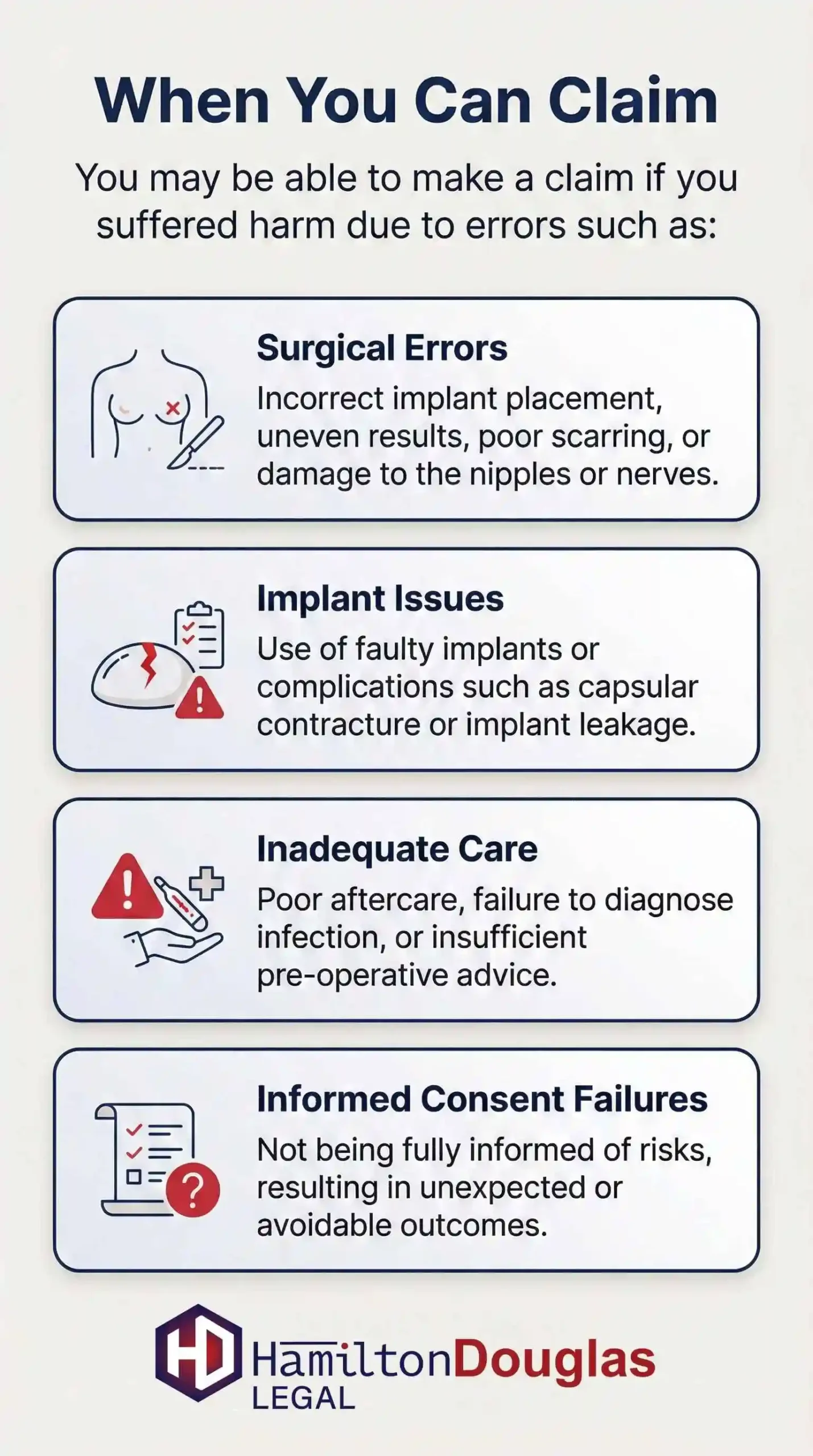
Most breast surgery in Scotland goes well, whether it is carried out for health reasons or cosmetic reasons. However, if your treatment fell below a reasonable standard and resulted in avoidable harm, you may be able to make a medical negligence claim.
To make a claim, you typically need to prove two things. First, that the surgeon, clinic, or other medical professional owed you a duty of care and breached it by giving substandard treatment. Second, that this failure directly caused your injury, such as pain, infection, avoidable scarring, asymmetry, or the need for further treatment.
This is important because a poor result on its own is not always enough. The harm must be linked to the negligent care you received, not simply to a known risk of surgery.
Signing a consent form or waiver does not stop you from seeking compensation. A plastic surgeon still has to meet proper standards before, during, and after surgery, and if they did not do so, you may have grounds to claim.
What are the different types of breast surgery?
Not every breast surgery claim looks the same. The type of operation you had can affect both the problems that developed and the way your case is assessed.
In most cases, breast surgery falls into three main groups: augmentation, reduction, and uplift. Each one has its own purpose, its own risks, and its own warning signs when something has gone wrong.
Breast augmentation is also called breast enlargement surgery or implant surgery. It is used to increase size or change shape, usually with silicone or saline implants.

When problems happen after augmentation, they can be very distressing. Some people are left with pain, infection, problems with implant position (where the implant moves, sits unevenly, or no longer looks properly placed), rippling (visible folds or wrinkles in the implant), loss of nipple sensation, or capsular contracture (where scar tissue tightens around the implant and makes the breast feel hard or uncomfortable).
In these cases, the key questions are often quite specific. Was your suitability for surgery properly assessed? Were the risks explained clearly? Was the implant inserted correctly? Were signs of trouble picked up during aftercare?
Breast reduction is different. It involves removing excess skin, fat, and breast tissue to reduce weight, improve shape, and ease physical discomfort.
If a reduction is carried out negligently, the problems can include uneven breasts, wound breakdown, infection, poor healing, or damage to the nipple. These claims often depend on whether the surgeon planned and performed the procedure with proper care, and whether warning signs were dealt with quickly afterwards.
A breast uplift, sometimes called mastopexy, is designed to raise and reshape the breasts. It usually involves removing loose skin and repositioning the breast and nipple.
If a breast uplift is carried out badly, it can leave you with uneven breasts, heavy scarring, altered sensation, or results that look clearly mishandled rather than simply less than expected. That is why breast surgery claims need to be looked at in light of the exact procedure you had, not treated as if every case is the same.
Speak to our compensation experts
It doesn't cost you anything to know where you stand.
Fill out the form, and we'll get back to you within one hour.
Need to speak to us sooner?
Call us on 0141 280 1112
- Over £3+ Million in Settlements
- No Win, No Fee
- Supporting Scots Since 2010
- 10 Offices Around Scotland
Request a FREE call
Breast Reduction & Implants Claims
You might notice pain, firmness, swelling, rippling, or a change in shape and wonder whether it is something you should just wait out. In many breast augmentation claims, those early signs turn out to be linked to poor surgical technique, poor follow-up care, or faulty implants.
Capsular contracture, implant rupture, and silicone gel bleed can have a serious effect on day-to-day life. They may cause pain, changes in shape, and anxiety about what has gone wrong, as well as the need for further treatment or surgery.
In addition to surgical errors, some implant claims involve defective products. The PIP implant scandal demonstrates how unsafe implants can cause long-term harm, even if the problem is not immediately apparent. That is why implant cases require a thorough investigation of both the procedure and the product used.
Breast reduction cases are different, but they can be just as upsetting. If the surgery is carried out badly, it can lead to fat necrosis, severe asymmetry, infection, or scarring that is far worse than you were led to expect. In these cases, the key question is whether proper care and skill were used at every stage of your treatment.
What is breast uplift surgery, and what are the risks?
Breast uplift surgery, also known as mastopexy, is carried out to raise and reshape the breasts. To do so, the surgeon typically removes loose skin and repositions the nipple. It may appear to be a simple cosmetic procedure, but it is actually a serious operation that requires skill, planning, and careful aftercare.
Some risks can happen even when the surgery is performed properly. These include bruising, haematoma, scarring, delayed healing, and some unevenness while the breasts settle. But a known risk is not the same as negligent treatment.
Problems often become more serious when poor technique is used during skin removal or nipple repositioning. If too much tension is placed on the wound or the blood supply is damaged, this can lead to wound separation, severe infection, permanent loss of nipple sensation, or tissue death. In the most serious cases, part of the nipple or surrounding tissue may not survive.
When a breast uplift goes wrong, the effects can be painful, visible, and deeply upsetting. The harm is not only painful, but often visible too, which can affect how you feel about your body and your confidence day to day.
In many of these claims, the key issue is whether the surgeon took the right steps before and after the operation. That includes checking you were a suitable candidate, explaining the risks properly, and responding quickly if problems developed during recovery. If that did not happen and you were left with avoidable harm, you may be able to make a claim.

How much will I receive in breast surgery compensation?
There is no fixed amount for medical negligence compensation in breast surgery cases. In Scotland, the value of a claim usually depends on two parts: solatium, which covers pain and suffering, and patrimonial loss, which covers financial losses.
Solatium looks at the injury and how it has changed your life. That could mean pain, scarring, loss of feeling, or mental harm like anxiety, depression, or ongoing worry about how you look and how long it will take you to heal.
Patrimonial loss covers the money you have had to spend or the income you have lost because of the negligent treatment. This can include private revision surgery, counselling, medication, travel costs, care costs, and loss of earnings (if you needed time off work).
The final figure will always depend on your own symptoms, treatment needs, and recovery. That is why we look at the full impact of negligence, not just the surgery itself.
How long do I have to make a cosmetic surgery claim?
Under the Prescription and Limitation (Scotland) Act 1973, the standard time limit for a cosmetic surgery claim in Scotland is three years. While this period typically runs from the date of the surgery, it can sometimes begin later if the negligence or injury was not immediately apparent.
If you did not know at the time that negligence had caused the harm, the three-year period can start later. This is often called the date of knowledge.
For example, you might only discover years later that an implant had slowly ruptured or that a complication was linked to negligent treatment rather than a normal surgical risk. In that situation, the clock may run from when you first became aware, or could reasonably have become aware, of that link.
Because these dates can be disputed, it is best to get advice as soon as possible. Waiting too long can put your claim at risk, even if the problem only became clear later.
Making A Personal Injury Claim In Scotland
Our panel of experienced personal injury lawyers excel in handling cases against well-funded insurance companies.
Our specialised injury lawyers will assist you with your claim, keep you informed throughout the whole process, and provide you with legal advice that is easy to understand.
01
Get In Touch.
Tell us your story, we're here to listen and provide you with an initial assessment based on your circumstances.
02
We’ll Prepare Your Claim.
We'll be by your side to take care of the legal process. We'll keep you informed of every step of the way.
03
Receive Compensation.
If your claim is successful, we'll ensure that you get your compensation as soon as possible.

"A Student’s Journey from Trauma to Triumph: Efthymios’s Fight for Justice After a Devastating Car Accident"
When Efthymios was injured in a car accident, he was left with severe facial injuries. He didn’t know how he would manage his recovery and studies.
“When I got in contact with HD Legal, they made me feel supported. They were incredibly understanding and fought hard for me, ensuring I received the compensation I deserved.”

"Cracked Pavement, Broken Ankle: How HD Legal Helped Margaret Find Justice and Peace of Mind"
When Margaret tripped on a neglected crack in the pavement in Glasgow, she shattered her ankle and was forced to take months off work, unsure how she would manage.
“HD Legal were a lifeline for me. They took care of everything—from gathering crucial evidence to battling the council—and gave me the peace of mind I needed to focus on my recovery.”

"Blown Away: HD Legal Fights for Douglas After Faulty Washing Machine Explosion"
When Douglas’s new washing machine exploded, it caused a fire that damaged his kitchen and left him with painful burns.
“HD Legal fought relentlessly for me when it seemed like no one else would. They were thorough, professional, and supported me every step of the way, helping me recover both physically and financially.”

"From Misdiagnosis to Recovery: How HD Legal Fought for Eilidh’s Justice and Secured the Care She Needed"
When Eilidh’s severe abdominal pain was repeatedly misdiagnosed, her condition worsened, leading to the need for urgent surgery.
“HD Legal stood by me when I felt lost. They were thorough, professional, and fought tirelessly to get me the care and compensation I needed to heal.”

"Falling from Heights, Rising with Justice: How HD Legal Secured Compensation for Alistair After a Workplace Accident Involving Faulty Scaffolding"
Alistair Campbell’s fall from faulty scaffolding left him with serious injuries and months of recovery.
“HD Legal’s panel of solicitors fought for me, ensuring I received the support needed to move forward.”
Breast Surgery Negligence Compensation Amounts
Breast surgery negligence compensation amounts are based on the harm you suffered, how serious it was, and how it has affected your life. The value of a claim will usually include general damages for your physical pain and psychological harm, as well as financial losses such as treatment costs, travel costs, and lost income.
The figures below are guideline examples for solatium, which is the part of a Scottish claim that covers pain and suffering. Any patrimonial loss, such as lost earnings or treatment costs, would usually be valued separately.
| Harm | Severity | Guideline Compensation (Solatium) |
|---|---|---|
| Severe Harm & Financial Loss | Multiple severe injuries involving chronic pain, psychological trauma, and substantial financial losses (care, revision surgery, lost earnings). | Up to £500,000+ |
| Financial Loss | financial losses (care, revision surgery, lost earnings). | |
| Breast Injury | Total loss of both breasts. This bracket applies to cases where both breasts are removed or completely lost due to negligence. | £97,840 to £158,560 |
| Breast Injury | Total loss of one breast. This applies to the surgical loss of a single breast. | £45,260 to £60,980 |
| Breast Injury | Significant permanent damage. This includes cases of severe asymmetry, chronic pain (capsular contracture), or a failed reconstruction leaving permanent deformity. | £12,020 to £36,550 |
| Scarring (Non-Facial) | Significant/Noticeable scarring. Permanent, noticeable scarring following procedures such as mastopexy (uplift) or reduction. | £9,560 to £27,740 |
| Scarring (Non-Facial) | Minor/Superficial scarring. A single noticeable scar or several superficial scars with minor cosmetic defects. | £2,890 to £9,560 |
These figures do not include every possible injury or damage. If negligent breast surgery left you with anxiety, depression, distress about your appearance, or the need for private revision surgery, those effects can have a real impact on the overall value of your claim.
DEDICATED CLAIMS ADVISORS
Our dedicated claims advisors are always available to offer free legal advice.
100% NO WIN NO FEE CLAIMS
All our claims are processed on a No Win No Fee basis; you pay nothing if you lose.

MILLIONS SECURED IN DAMAGES
To date, we have secured millions in damages.
THOUSANDS OF SATISFIED CLIENTS
To date, we have helped thousands of clients recover compensation and continue to do so.
Meet The Team

Maisie MacLeod
Senior Claims Manager

Ella Campbell
Head of Serious Injury

Freya Douglas
Long-Term Illness Specialist
FAQs About Breast Surgery Compensation Claims
Can I make a no win, no fee cosmetic surgery claim?
Yes, in many cases you can. In Scotland, this kind of funding is usually explained through a success fee agreement, which should set out clearly what you may have to pay if your claim succeeds. The important point is that the funding terms should be explained clearly at the start, including any success fee, insurance, or deductions that may apply if your claim succeeds.
Am I still eligible to make a breast surgery claim if I signed a waiver?
Possibly, yes. Signing a consent form does not give a surgeon permission to provide negligent treatment, and it does not excuse poor surgical care, poor aftercare, or a failure to warn you properly about material risks. Consent should be a real discussion based on your circumstances, not just a signature on a form.
What evidence do I need to make a breast surgery compensation claim?
The strongest cases usually include medical records, photos of the injury or scarring, letters or emails from the clinic, details of what you were told before surgery, and proof of money you have lost or spent.
You also have the right to ask for copies of your health records, and many claims rely on independent medical evidence and witness statements as part of the claims process. It also helps to gather this early, because the time limit still applies to bringing a claim in Scotland.
What can breast surgery compensation cover?
Compensation is intended to reflect the full extent of the negligent act’s impact on your life. That includes the physical pain and scarring, but also the distress, worry, and loss of confidence that often follow when breast surgery goes wrong.
It may also cover the financial consequences of what happened. This may include the cost of private revision surgery, counselling, medication, travel to appointments, care and support, and income you lost while recovering.
In some cases, it can also include future costs. For example, if you are likely to require additional treatment in the future, or if your recovery has interfered with your ability to work, those losses should be taken seriously.
What is breast uplift surgery, and what are the risks?
Breast uplift surgery, also called mastopexy, is done to lift and reshape the breasts. It usually involves removing loose skin and moving the nipple to a higher position.
Like any operation, it carries some recognised risks. These can include infection, bleeding, scarring, uneven breasts, infection, fat necrosis, and changes in nipple sensation.
Some complications are more serious than others. If the blood supply to the nipple or nearby tissue is damaged, the results can be permanent, which is why good surgical planning and proper aftercare matter so much.
What is breast reduction surgery, and what are the risks?
Breast reduction surgery is used to reduce the size and weight of the breasts. It usually involves removing skin, fat, and glandular tissue, and in many cases, the nipple also has to be repositioned.
The risks can include infection, bleeding, poor healing, heavy scarring, wound breakdown, fat necrosis, uneven shape, and reduced nipple sensation. In more serious cases, there can also be problems with the blood supply to the nipple.
Not every complication means negligence took place. But if the surgery was poorly planned, badly performed, or warning signs were missed afterwards, the harm may have been avoidable.
What happens when I make a cosmetic surgery claim?
When you come to us, the first step is a proper conversation about what happened, how the surgery has affected you, and what support you need now. We then look at the records, photos, and any follow-up treatment, so we can understand whether the care fell below a reasonable standard and whether that failure caused avoidable harm.
If your case is strong, we will connect you with a solicitor who will help put it together step by step. That usually means gathering the right medical evidence, looking closely at how the negligence has affected your health, your confidence, and your finances, and then setting out the claim clearly to the hospital, clinic, or insurer.
Sometimes the other side accepts responsibility early. In other cases, they may deny the facts or offer less than the fair value of the claim. If that happens, court action may be needed, but many cases still settle through negotiation before a final hearing.
If your treatment involves more than one cosmetic procedure, we can also advise on related claims, including liposuction compensation claims, tummy tuck claims, and other cosmetic surgery negligence claims.
What are the different types of breast surgery?
- Breast augmentation is carried out to make the breasts fuller or change their shape, usually with implants.
- Breast reduction is used to make the breasts smaller and lighter by removing excess breast tissue and skin.
- Breast uplift, also called mastopexy, removes loose skin and reshapes the breast.
Each procedure brings different risks, so the legal and medical questions are not always the same. An implant case may focus on rupture, displacement, or poor aftercare, while a reduction or uplift case may focus more on blood supply, wound healing, asymmetry, or scarring.
What is the 45-55 breast rule?
The 45-55 breast rule is an aesthetic idea sometimes used in cosmetic breast surgery. It describes a breast shape where about 45% of the volume sits above the nipple and 55% sits below it, which some research and plastic surgery commentary have described as a natural-looking proportion.
It is important not to treat this as a medical safety rule or a legal test. In a negligence claim, the real question is not whether your result matched a ratio, but whether your care was carried out properly and whether avoidable harm was caused.
What is the average payout for NHS negligence?
There is no single average figure that can tell you what your claim is worth. NHS negligence cases vary hugely, and official data is published at the scheme level rather than in a way that gives a useful average for a breast surgery claim in Scotland. Published figures do exist, but they cover many different types of claims and do not give a reliable guide to what would be a fair value of an individual breast surgery claim.
That is why average payout figures can be misleading. The value of a claim depends on the injury itself, the effect on your life, and the financial losses that follow, such as further treatment, time off work, or ongoing care needs.
We’re Here To Help When You Need Us Most.
Call us on 0141 2801112, or leave us a message below to request a call back and one of our team will be in touch as soon as we can.