


- Obligation-Free Consultation
- No Win, No Fee
- Award-Winning Lawyers
As Featured In:






















Check Out Our Awesome Reviews Below:
EXCELLENT Based on 99 reviews
 Posted on Google
 Daniel MorosanuI cannot thank the team at HD Claims enough for their help with my personal injury claim. From day one, their injury lawyers were incredibly professional, explaining the no win no fee process clearly without complex jargon. They took away all the stress of dealing with the insurance companies and secured the accident compensation I was entitled to. If you are looking for reliable personal injury solicitors who truly look out for your best interests, I highly recommend their services.Posted on Google
 Gigel stoicaHD Claims made my personal injury claim simple and stress-free. The team was professional, responsive, and kept me updated throughout the process. I would recommend them to anyone needing help with an accident compensation claimPosted on Google
 Muhammed AhmedI was involved in a car accident where my car was written off and my passengers were seriously injured. I contacted HD Claims and received an excellent service from start to finish. They were very understanding and took the time to explain the whole process clearly. In the end, I received a very favourable settlement. I would most definitely recommend this firm to anyone in a similar situation.Posted on Google
 Sarah TaylorExcellent service from HD Claims! They completely managed my personal injury claim from start to finish and allocated me a fantastic specialist solicitor. The whole process was handled on a 'no win no fee' basis, making it entirely stress-free. Their communication was top-notch, and I am very happy with the final settlement I received. I highly recommend their team to anyone looking for reliable legal support.Posted on Google
 Nico SullivanHD Claims were brilliant after my accident. They handled everything smoothly and kept me informed the whole time. If you need personal injury lawyers with car accident experience, they’re a great choice.Posted on Google
 faiq zebI've used HD Claims for a few car accidents I've suffered over the years as a taxi driver. Always received a great experience and compensation - Asif Khan GlasgowPosted on Google
 picui bossHey my name is Andrei and I’m with John white my self and they are They are the best 100% in all Scotland you should try with them. They’re the best service and they provide with everything. What you want to know about and I give them out 10 out of 10.Posted on Google
 GAMERS ONLYWas a very good service 👏Posted on Google
 Sunny InboxI had a great experience with HD Claims. The injury lawyers were professional, responsive, and explained everything clearly. They handled my case with care and confidence, making the whole process stress-free. Highly recommended for injury claims.Posted on Google
 John SmithMy insurance company recommended a firm that charged 30% and had poor reviews. I went with Hamilton Douglas instead, who charged far less and were completely transparent. They were professional, communicative, and secured me an excellent settlement. Do your research and pick them.Verified by TrustindexTrustindex verified badge is the Universal Symbol of Trust. Only the greatest companies can get the verified badge who has a review score above 4.5, based on customer reviews over the past 12 months. Read more
If you have suffered a neck injury in Scotland because of someone else’s negligence, you may be able to make a claim. This could happen after a road traffic accident, an accident at work, or a fall in a public place. Some neck injuries are mild and settle with time. Others involve soft tissue damage or problems affecting the cervical spine that can last much longer.
At HD Claims, we help people across Scotland take the next step with confidence. When you have been injured due to another party’s negligence, we make navigating personal injury claims in Scotland simple, providing expert guidance and clear, step-by-step support throughout the process.
That matters because a neck injury can affect far more than your comfort. It can make driving hard, disturb your sleep, limit movement, and leave you struggling at work or at home. In some cases, it can also lead to loss of earnings while you recover.
Neck injuries can range from short-term soft tissue injuries to more serious conditions with a longer recovery time. Some people make a full recovery. Others are left dealing with ongoing pain and suffering, stiffness, and reduced movement for months or longer. We explain who may be able to claim, what causes these injuries, how the Scottish claims process works, what evidence can help, the time limits to know about, the fees involved, and what may affect compensation.
Can I Claim Compensation for My Neck Injury? (Eligibility)
You may be able to claim compensation if five basic points apply to your situation:
- You have suffered a neck injury
- The injury was caused by an accident
- Someone else was wholly or partly to blame
- The claim is still within the Scottish time limit
- There is enough evidence to show what happened and how the injury has affected you
That can cover many different situations. It may involve another driver after a car crash, a neck injury sustained on a bus or public transport, an employer in unsafe lifting or manual handling claims, an occupier who failed to deal with a danger, a business that did not keep visitors safe, or a local authority that failed to maintain a road or pavement properly.
A valid claim is not limited to severe injuries. Even a minor injury may justify a claim if it caused pain, restricted movement, time off work, or treatment costs. It doesn’t matter if it’s a soft tissue injury or not; what’s important is whether the accident was preventable and whether it caused a real impact on your life.
Compensation can also include more than the injury itself. In Scotland, a claim may include solatium for pain and the effect on daily life, as well as patrimonial loss for financial losses. This can include lost earnings, travel expenses, treatment costs, care or support from family, and other accident-related expenses.
You may still be able to claim if:
- Your symptoms did not appear straight away
- You were not taken to the hospital by ambulance
- You thought the injury would settle, but it lasted longer than expected
- You are unsure about the likely value of the claim
- The accident was partly your fault as well as someone else’s
This last point is important. Some people assume they cannot claim if they were partly to blame, but that is not always true. A claim may still be possible where another party also played a part in the accident.
If you are unsure, getting early legal advice can help you understand whether the case is worth taking further.
Our Step-by-Step Process for Neck Injury Claims in Scotland (The Journey)
The process usually starts with a simple first conversation. We ask what happened, when it happened, and how your neck injury has affected you. This helps us carry out a basic case review and see whether you may be able to move forward with a claim in Scotland.
If your claim appears suitable, we work alongside a specialist personal injury solicitor whose experience fits the circumstances of your case. From there, the claim is usually built in clear stages, so it feels more manageable. That often starts with gathering the main facts, checking the circumstances of the accident, and arranging an independent medical assessment.
A typical neck injury claim journey looks like this:
- First contact and basic eligibility screening
- Allocation to a specialist personal injury solicitor suited to your case
- Early evidence gathering
- An independent medical assessment
- Claim intimation to the other side
- Negotiation under the Compulsory Pre-Action Protocol (CPAP)
- Settlement discussions
- if needed, raising proceedings in the Sheriff Court, the National Personal Injury Court, or, in suitable cases, the Court of Session
The Compulsory Pre-Action Protocol (CPAP) is part of the Scottish pre-court claims process. It is designed to encourage an early exchange of information and give the other side a set period to investigate the claim, respond to liability, and consider settlement before court proceedings are raised.
Most of the time, that helps move the case forward without unnecessary delay, although court action may still be needed if fault or the value of the claim is disputed.
Many neck injury claims are resolved without a final court hearing. But it is important to be realistic. If fault is disputed, the medical evidence is challenged, or a fair settlement is not offered, court proceedings may still be necessary.
In simple terms, your role is to explain what happened, attend appointments, and provide any documents or updates requested. Our role is to manage the legal strategy of your claim from start to finish. We work alongside a specialist personal injury solicitor best suited to your case, while keeping you fully informed so you can focus on your treatment and rehabilitation.
Common Causes and Types of Neck Injuries
A neck injury does not always happen in a major crash. It can be caused by a sudden movement, a bad fall, or a moment when proper care was not taken. Some people feel sore for a short time and recover well, while others are left dealing with pain, stiffness, and problems that turn out to be more serious than they first seemed.
What Causes Neck Injuries That Lead to Claims?
A lot of claims begin on the road. A driver brakes too late, looks away for a second, or follows too closely, and the impact throws the neck sharply back and forward. That is why whiplash is the most common type of neck injury after this kind of traffic accident. In more serious crashes, a neck injury may happen alongside a back or spinal injury from a road collision, which can make the recovery and the claim more complex.
Neck injuries can also happen at work. Lifting something heavy without the right support, repeating the same movement all day, or working without proper training can all put the neck under strain.
Some accidents are much simpler than people think. A wet floor that was never marked, a broken step, poor lighting, or badly stacked items can all lead to a fall or sudden jolt. If the accident happened because basic safety was not taken seriously, you may be able to make a claim.
What Types of Neck Injuries Can You Claim For?
Some neck injuries are relatively mild, but that does not mean they are easy to live with. Damage to the muscles, ligaments, and soft tissues can make it painful to turn your head, sleep properly, drive, or sit comfortably for long periods. What sounds minor on paper can still disrupt your life for weeks.
Some neck injuries are more serious from the outset and can take much longer to improve. The pain can spread into the shoulders or upper back, and some people may also experience symptoms affecting the arm, such as tingling, numbness, or weakness.
Then there are the more serious cases, where the injury affects the spine itself or leaves lasting pain and limited movement. These injuries can change how a person works, travels, rests, and manages daily life. Some people need ongoing treatment or physical therapy just to get back to a basic routine.
One thing many people do not realise is that neck pain does not always show up straight away. You may feel shaken after the accident, think you are mostly fine, and only notice the real pain later that evening or the next morning. Because delayed pain is common with neck injuries, it is important not to shrug it off just because you felt alright at first.
Speak to our compensation experts
It doesn't cost you anything to know where you stand.
Fill out the form, and we'll get back to you within one hour.
Need to speak to us sooner?
Call us on 0141 280 1112
- Over £3+ Million in Settlements
- No Win, No Fee
- Supporting Scots Since 2001
- 10 Offices Around Scotland
Request a FREE call
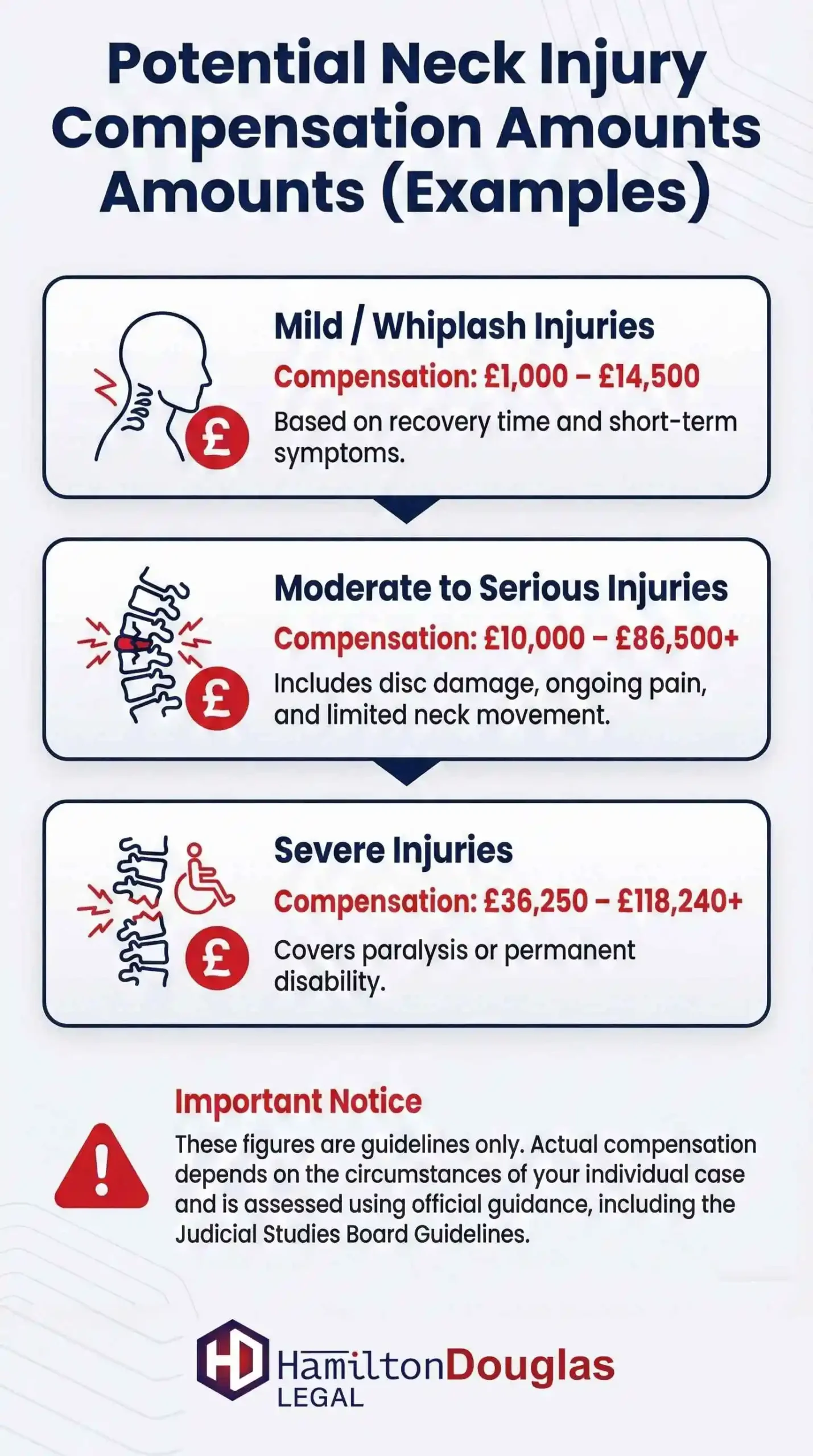
How Much Compensation? Typical Neck Injury Payouts in Scotland
Typical Neck Injury Compensation Payouts
| Injury severity | Typical features | Guideline bracket |
|---|---|---|
| Minor neck injuries | Symptoms resolving within months, or a full recovery expected within up to about 2 years. Example: short to medium-term soft tissue injury with pain, stiffness, and reduced movement. | Up to £9,630 |
| Moderate neck injuries | Longer recovery, ongoing stiffness, reduced movement, disc symptoms, fractures or dislocations short of the most serious category. Example: pain lasting years rather than months, with a real effect on work or normal routine. | £9,630 to £46,970 |
| Severe neck injuries | Permanent disability, serious cervical damage, major fractures or dislocations, or very serious long-term symptoms. Example: major movement loss, chronic pain, severe headaches, or lasting neurological problems. | £55,500 to around £181,020 |
What Changed Under the New Whiplash and Small Claims Rules (Scotland vs. England)?
This is where the position in Scotland is often misunderstood. The 2021 whiplash tariff reforms introduced by the Ministry of Justice apply to England and Wales. The official government guidance says that clearly and explains that the tariff is a fixed compensation system for certain road traffic whiplash claims lasting up to 2 years.
However, Scotland does not use that same fixed tariff approach for these claims. Scottish personal injury claims still sit within a different legal system, and valuation is handled in the more traditional way, using medical evidence and case-specific assessment rather than a simple fixed tariff for qualifying whiplash claims.
Proving Your Injury: The Importance of a Specialist Medical Assessment
Neck injury claims often depend on detail. The other side may accept that an accident happened, but still question how bad the injury was, how long it lasted, or whether the accident really caused all of the symptoms. That is why medical evidence matters so much.
An independent medical assessment is one of the most important parts of the case. If your claim moves forward, a solicitor may arrange for you to be seen by a suitable independent expert. This is not about testing you or trying to challenge your account. It is about making sure the injury is properly recorded by someone qualified to assess it.
The medical report can help show:
- What the injury is
- Whether it fits with the accident
- What symptoms have you had
- How long is recovery likely to take
- Whether treatment may still be needed
- How the injury has affected work and daily life
That can make a big difference in a case involving a neck injury in a car accident, an accident at work, or any other kind of accident. A clear medical picture helps everyone understand what you are dealing with now and what may lie ahead.
The Importance of a Specialist Medical Assessment
The appointment itself is usually straightforward. The expert will ask what happened, when the pain started, how the symptoms changed over time, and what problems you are still having now. They may also ask about your movement, sleep, driving, work, and the everyday activities that have become harder since the injury.
They will usually look at:
- Your account of the accident
- Your symptoms and where the pain travels
- Any relevant medical history
- Treatment you have already had
- Limits on movement and daily function
This matters because neck injuries do not always follow a neat pattern. Some people feel little pain immediately after the accident, then wake up the next day much worse. Others improve for a while, then struggle when they return to work, drive longer distances, or try to get back to their normal routine. Delayed symptoms and changing symptoms can still be discussed and recorded.
The written report usually covers the nature of the injury, how serious it is, how long recovery may take, and whether symptoms are likely to continue. It may also deal with whether more treatment could help and how the injury affects work, hobbies, travel, sleep, care needs, and everyday tasks. In practice, this report often plays a major part in valuing the claim because it gives the case a clear medical foundation.
What Evidence Is Needed for a Successful Case?
A strong case usually needs two kinds of evidence. One helps show how the accident happened. The other shows what injury it caused and how that injury affected your life.
Liability evidence may include:
- Photos of the scene, vehicles, obstacles, or other dangers
- Witness details
- Accident report forms
- Dashcam or CCTV footage
- A police reference, if there is one
Medical and financial loss evidence may include:
- GP or hospital records
- The independent medical report
- Proof of lost earnings
- Receipts for treatment, travel, medication, care, or equipment
- A diary showing pain levels, sleep problems, missed work, and day-to-day difficulties
A simple diary is often more useful than people realise. If you note things like when the pain flares up, when you could not drive, when you missed work, or when you needed help at home, it creates a clearer picture of how the injury has affected your real life. That can be helpful in many types of claims, including car and motorcycle accidents in Scotland, where the effect of a neck injury may be greater than it first appears from the initial medical record.
Making A Personal Injury Claim In Scotland
Our panel of experienced personal injury lawyers excel in handling cases against well-funded insurance companies.
Our specialised injury lawyers will assist you with your claim, keep you informed throughout the whole process, and provide you with legal advice that is easy to understand.
01
Get In Touch.
Tell us your story, we're here to listen and provide you with an initial assessment based on your circumstances.
02
We’ll Prepare Your Claim.
We'll be by your side to take care of the legal process. We'll keep you informed of every step of the way.
03
Receive Compensation.
If your claim is successful, we'll ensure that you get your compensation as soon as possible.

"A Student’s Journey from Trauma to Triumph: Efthymios’s Fight for Justice After a Devastating Car Accident"
When Efthymios was injured in a car accident, he was left with severe facial injuries. He didn’t know how he would manage his recovery and studies.
“When I got in contact with HD Legal, they made me feel supported. They were incredibly understanding and fought hard for me, ensuring I received the compensation I deserved.”

"Cracked Pavement, Broken Ankle: How HD Legal Helped Margaret Find Justice and Peace of Mind"
When Margaret tripped on a neglected crack in the pavement in Glasgow, she shattered her ankle and was forced to take months off work, unsure how she would manage.
“HD Legal were a lifeline for me. They took care of everything—from gathering crucial evidence to battling the council—and gave me the peace of mind I needed to focus on my recovery.”

"Blown Away: HD Legal Fights for Douglas After Faulty Washing Machine Explosion"
When Douglas’s new washing machine exploded, it caused a fire that damaged his kitchen and left him with painful burns.
“HD Legal fought relentlessly for me when it seemed like no one else would. They were thorough, professional, and supported me every step of the way, helping me recover both physically and financially.”

"From Misdiagnosis to Recovery: How HD Legal Fought for Eilidh’s Justice and Secured the Care She Needed"
When Eilidh’s severe abdominal pain was repeatedly misdiagnosed, her condition worsened, leading to the need for urgent surgery.
“HD Legal stood by me when I felt lost. They were thorough, professional, and fought tirelessly to get me the care and compensation I needed to heal.”

"Falling from Heights, Rising with Justice: How HD Legal Secured Compensation for Alistair After a Workplace Accident Involving Faulty Scaffolding"
Alistair Campbell’s fall from faulty scaffolding left him with serious injuries and months of recovery.
“HD Legal’s panel of solicitors fought for me, ensuring I received the support needed to move forward.”
Don’t Wait: The 3-Year Time Limit in Scotland.
There is a deadline for starting a neck injury claim in Scotland, and it matters more than many people realise. In most cases, court action has to be started within three years of the accident. Sometimes the three years run from the date you first became aware that your injury was linked to the accident, rather than the accident date itself.
In legal terms, this is often referred to as prescription and limitation under the Prescription and Limitation (Scotland) Act 1973. It is the legal time limit for taking your case forward. If that deadline passes, you may no longer be able to claim.
However, there are some exceptions. These can apply in cases involving children, adults who lack capacity, or injuries where the cause was not clear straight away. But it is risky to assume an exception applies to your claim without checking.
Even if you are still receiving treatment, do not assume you can wait indefinitely.
Starting earlier usually puts you in a better position. Records are easier to find, witnesses remember more clearly, and it is often simpler to show how the injury has affected you when the case is dealt with sooner.
Fees and Representation
A lot of people hesitate at this stage for two simple reasons. They worry about cost, and they are not sure whether they really need a solicitor. Both concerns are normal, especially when you are already dealing with pain, treatment, time off work, or pressure at home.
If your claim appears suitable, we will work alongside a specialist personal injury solicitor best suited to your case. They can then explain the available funding options clearly, including what they mean in practice and what you may or may not have to pay.
Clear & Transparent: How The No Win No Fee Agreement Works
“No Win No Fee” is a simple way of describing a funding arrangement where, in general, you do not pay your solicitor’s fee if the claim does not succeed. But it is still important to read the terms carefully. It does not mean every possible cost disappears in every case, and the exact wording of the agreement matters.
If the claim succeeds, a success fee may be taken from your damages. The exact percentage, any other deductions, and any insurance or outlay arrangements should be explained to you before you go ahead. That is one reason it is worth slowing down and asking clear questions at the start, rather than signing anything you do not fully understand.
- Note: The solicitor’s funding agreement is separate from our role in overseeing the progress of your claim. The legal funding agreement itself is something you should review directly with the solicitor before you decide to proceed.
Before you agree, ask:
- What percentage is the success fee?
- Are there any other deductions?
- Who pays for medical reports and court outlays?
- What happens if the claim does not succeed?
Should I Use a Solicitor for My Neck Injury Claim?
Some people do try to deal with a claim on their own. That may seem tempting at first, especially if the injury sounds straightforward. But neck injury claims can become more complicated than expected. Fault may be denied. The other side may question whether the accident caused all of your symptoms. Or the first offer may not reflect the real impact the injury has had on your life.
A solicitor can help with the parts of a claim that people often underestimate. That includes getting the right medical evidence, calculating financial losses properly, dealing with negotiations, following Scottish procedure, and raising proceedings if necessary. Court procedure in Scotland can be complex, and even the court service advises people to seek legal advice in ordinary cause cases.
Legal help can be especially useful if your symptoms last longer than expected, you have lost income, fault is disputed, you have more than one injury, or court proceedings may be needed. In that kind of situation, good support can make sure the claim is prepared properly and that you understand your options at each stage.
DEDICATED CLAIMS ADVISORS
Our dedicated claims advisors are always available to offer free legal advice.
100% NO WIN NO FEE CLAIMS
All our claims are processed on a No Win No Fee basis; you pay nothing if you lose.

MILLIONS SECURED IN DAMAGES
To date, we have secured millions in damages.
THOUSANDS OF SATISFIED CLIENTS
To date, we have helped thousands of clients recover compensation and continue to do so.
Starting Your Claim: Next Steps
If you think someone else’s negligence caused your neck injury, the best next step is to deal with it early and keep things simple. You do not need to have every answer before you ask for help. But a few practical steps can make the process much easier.
A good starting point is to:
- Get medical attention.
- Report the accident where relevant.
- Gather any early evidence.
- Keep a note of your symptoms and expenses.
- Contact us for an initial review.
- If your claim appears suitable, we can arrange for it to be handled by a specialist personal injury solicitor best suited to your case.
When you get in touch, it helps to have a few basic details ready. This might include the date of the accident, where and how it happened, the symptoms you have had, any treatment you have received so far, and any photos, witness details, or insurer information you already have. Do not worry if some of this is missing. You can still ask for guidance even if you do not yet have every detail.
After you contact us, our legal team will carry out a confidential, no-obligation assessment of your claim. We will listen to what happened, ask a few key questions, and explain whether your case appears suitable to take forward. If it does, we will work alongside a specialist personal injury solicitor best suited to your case and oversee the process from the outset.
If you are ready to take the next step, call 01412801112 for an initial review. Even if you are still unsure, an early conversation can help you understand where you stand and what to do next.
FAQs
Will I have to go to court?
Usually, no. Many neck injury claims are resolved before there is ever a final hearing, especially when fault is accepted and the medical evidence is fairly clear. Going to court becomes more likely when the other side disputes who caused the accident or argues that the claim is worth less than you say it is.
Even then, raising court proceedings does not mean you are definitely heading for a full trial. Very often, it is just the formal step needed to keep the claim moving. Cases can still settle after that.
Can I claim if the accident was partially my fault?
Yes, sometimes you still can. This is often called contributory negligence, but it just means both sides may share some responsibility for what happened.
If that applies, compensation may be reduced to reflect your share of the blame rather than refused altogether. For example, the other side may accept that they caused the accident but say that something you did also made the injury worse. These cases depend on the facts, so it is usually worth getting the position checked rather than assuming you cannot claim.
What if the other driver was uninsured?
A claim may still be possible. In road traffic cases involving an uninsured or untraced driver, the Motor Insurers’ Bureau (MIB) may be able to deal with the claim instead of a normal insurer.
That is different from an ordinary fault case where the other driver’s insurer handles the case. So if the driver had no insurance, or drove off and cannot be traced, it does not always mean the case ends there.
How Long Will My Neck Injury Claim Take to Settle?
There is no fixed timescale for a neck injury claim. Some cases move quite quickly, while others take longer because the fault is disputed or it is still too soon to know how the injury is likely to progress. The main things that affect timing are whether the fault is admitted, how serious the injury is, how long recovery takes, what the medical evidence says, and whether court action is needed.
It can be risky to settle too early if your prognosis is still unclear. If you accept an offer before the injury has properly settled, or before a doctor can say how long the symptoms are likely to last, you may end up resolving the claim before the full effect of the injury is known.
Who Is Responsible for Paying Neck Injury Compensation?
In most cases, compensation is paid by the insurer of the person or organisation that was at fault. So, after a road traffic accident, it is usually the at-fault driver’s insurer. In other cases, it may be an employer, a business, a public body, or the occupier of a property, depending on where the accident happened and who was responsible for safety there.
If there is no valid insurer in place, that does not always mean the claim ends there. In road traffic cases involving an uninsured or untraced driver, the Motor Insurers’ Bureau may be able to deal with the claim instead.
How Much Is the Settlement for a Neck Injury in the UK?
There is no single UK settlement figure for a neck injury. The amount depends on things like how serious the injury is, how long symptoms last, what the medical evidence says, how much the injury affects your work and daily life, and whether you have financial losses on top of the injury itself. Guideline brackets exist, but they are only a starting point, not a promise.
What Will Reduce the Risk of Neck Injury?
You cannot remove the risk completely, but you can lower it. On the road, a few simple steps can help, such as wearing your seat belt, sitting properly, and making sure the head restraint is adjusted to support the back of your head rather than sitting too low or too far away. That can help reduce the force on the neck in a rear-end collision.
At work, the same idea applies: reduce the strain before it causes harm. Safer manual handling, sensible lifting practices, and proper risk assessment all matter, especially in jobs that involve carrying, pushing, pulling, or repeated physical tasks.
We’re Here To Help When You Need Us Most.
Call us on 0141 2801112, or leave us a message below to request a call back and one of our team will be in touch as soon as we can.