- Obligation-Free Consultation
- No Win, No Fee
- Award-Winning Lawyers
As Featured In:
Check Out Our Awesome Reviews Below:
EXCELLENT Based on 99 reviews Posted on Google Daniel MorosanuTrustindex verifies that the original source of the review is Google. I cannot thank the team at HD Claims enough for their help with my personal injury claim. From day one, their injury lawyers were incredibly professional, explaining the no win no fee process clearly without complex jargon. They took away all the stress of dealing with the insurance companies and secured the accident compensation I was entitled to. If you are looking for reliable personal injury solicitors who truly look out for your best interests, I highly recommend their services.Posted on Google Gigel stoicaTrustindex verifies that the original source of the review is Google. HD Claims made my personal injury claim simple and stress-free. The team was professional, responsive, and kept me updated throughout the process. I would recommend them to anyone needing help with an accident compensation claimPosted on Google Muhammed AhmedTrustindex verifies that the original source of the review is Google. I was involved in a car accident where my car was written off and my passengers were seriously injured. I contacted HD Claims and received an excellent service from start to finish. They were very understanding and took the time to explain the whole process clearly. In the end, I received a very favourable settlement. I would most definitely recommend this firm to anyone in a similar situation.Posted on Google Sarah TaylorTrustindex verifies that the original source of the review is Google. Excellent service from HD Claims! They completely managed my personal injury claim from start to finish and allocated me a fantastic specialist solicitor. The whole process was handled on a 'no win no fee' basis, making it entirely stress-free. Their communication was top-notch, and I am very happy with the final settlement I received. I highly recommend their team to anyone looking for reliable legal support.Posted on Google Nico SullivanTrustindex verifies that the original source of the review is Google. HD Claims were brilliant after my accident. They handled everything smoothly and kept me informed the whole time. If you need personal injury lawyers with car accident experience, they’re a great choice.Posted on Google faiq zebTrustindex verifies that the original source of the review is Google. I've used HD Claims for a few car accidents I've suffered over the years as a taxi driver. Always received a great experience and compensation - Asif Khan GlasgowPosted on Google picui bossTrustindex verifies that the original source of the review is Google. Hey my name is Andrei and I’m with John white my self and they are They are the best 100% in all Scotland you should try with them. They’re the best service and they provide with everything. What you want to know about and I give them out 10 out of 10.Posted on Google GAMERS ONLYTrustindex verifies that the original source of the review is Google. Was a very good service 👏Posted on Google Sunny InboxTrustindex verifies that the original source of the review is Google. I had a great experience with HD Claims. The injury lawyers were professional, responsive, and explained everything clearly. They handled my case with care and confidence, making the whole process stress-free. Highly recommended for injury claims.Posted on Google John SmithTrustindex verifies that the original source of the review is Google. My insurance company recommended a firm that charged 30% and had poor reviews. I went with Hamilton Douglas instead, who charged far less and were completely transparent. They were professional, communicative, and secured me an excellent settlement. Do your research and pick them.Verified by TrustindexTrustindex verified badge is the Universal Symbol of Trust. Only the greatest companies can get the verified badge who has a review score above 4.5, based on customer reviews over the past 12 months. Read more
28% of adults in Great Britain had at least one tattoo, and around one in seven tattooed adults regretted at least one of them. For many, laser removal is a new beginning, but if the process of treatment goes wrong, the physical and emotional ramifications can be hard to live with.
If poor care during laser tattoo removal caused burns, infection, changes in skin colour, permanent scarring, or emotional distress, you may be able to claim compensation. Problems can arise when the wrong laser settings are used, the skin is not properly assessed, or the clinic fails to provide suitable aftercare.
HD Claims manages the legal strategy of your case from start to finish. Whether your treatment took place at a city-centre clinic near Buchanan Street in Glasgow or elsewhere in Scotland, we work alongside cosmetic and beauty treatment negligence specialist solicitors whose experience suits the type and severity of your injury.
Call 0141 280 1112 for a free, no-obligation assessment.
- Medical disclaimer: This page provides general legal information about tattoo removal claims in Scotland. It is not a substitute for medical advice, diagnosis or treatment. If you have burns, severe pain, signs of infection or symptoms that are getting worse, seek advice from a qualified medical professional as soon as possible.
Speak to our compensation experts
It doesn't cost you anything to know where you stand.
Fill out the form, and we'll get back to you within one hour.
Need to speak to us sooner?
Call us on 0141 280 1112
- Over £3+ Million in Settlements
- No Win, No Fee
- Supporting Scots Since 2001
- 10 Offices Around Scotland
Request a FREE call
Claiming for Negligent Laser Tattoo Removal in Scotland
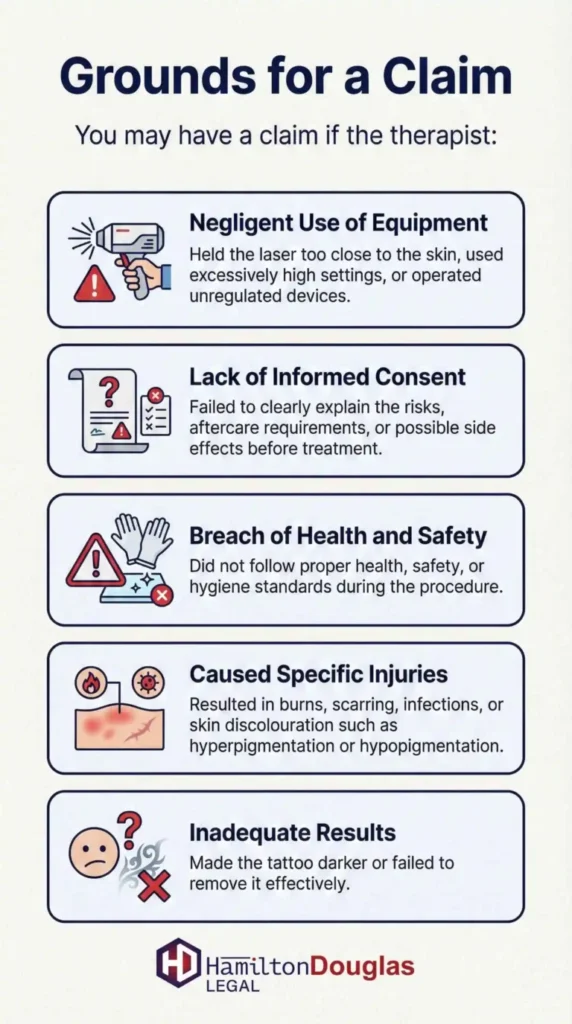
Negligent laser tattoo removal occurs when a clinic or practitioner provides care below the standard expected of a reasonably competent professional, and that failure causes an avoidable injury.
A poor cosmetic result does not automatically amount to negligence. Redness, swelling and some blistering can occur after a properly performed tattoo removal procedure, provided the risks were explained, and suitable care was given.
A claim may arise where laser tattoo removal gone wrong can be traced to a specific failure.
Such As:
- Using unsuitable laser intensity, wavelength, or settings for your skin type and tattoo ink;
- Failing to carry out a test patch or assess relevant skin conditions;
- Treating you without informed consent or a clear warning about material risks;
- Allowing an unqualified practitioner to operate the equipment; or
- Providing inadequate aftercare or failing to respond to signs of infection or burning.
Clinical research reports an overall laser complication rate of 6.2%. The same review reported that people with darker skin were more likely to experience changes in skin colour, with 8% developing lighter patches and 22% developing darker patches.
These figures do not show that every complication was caused by negligence. They do, however, highlight why practitioners must choose laser settings that suit the person’s skin tone and the type of tattoo being treated.
Healthcare Improvement Scotland regulates independent healthcare services that fall within its remit. Registered clinics using Class 4 laser equipment must follow requirements covering staff competence, safe procedures, and health and safety. Treatment at an unregulated laser clinic may still support a claim, although lack of registration alone does not establish a breach of duty.
If you have developed severe pain, burns or lasting scarring, seek medical attention and contact us promptly. Early advice can help preserve treatment records and other evidence needed to assess cosmetic clinical negligence.
Common Injuries Caused by Negligent Laser Tattoo Removal
Some redness, swelling and mild blistering can be expected after laser tattoo removal. You should seek advice if the pain becomes severe, the skin starts to look worse, or the area does not heal as expected.
- Serious burns: A laser set too high, or used on the same area for too long, can badly burn the skin. A burn injury caused by a cosmetic treatment may need hospital or GP treatment and can leave a visible scar.
- Painful or infected blisters: Small blisters can appear after treatment. Get medical help if they become increasingly painful, leak pus or fluid, or if redness begins to spread around the treated area.
- Changes in skin colour: The skin may become darker after treatment or lose pigment and turn noticeably lighter. These marks can last, particularly when the practitioner has used settings that were unsuitable for the person’s skin tone.
- Lasting scars: Burns or infected wounds may leave flat, thick or raised scars. Tattoo scarring claims can take account of where the scar appears, how noticeable it is and whether it causes pain, tightness or sensitivity.
- Emotional distress: Visible damage can affect confidence as well as appearance. You may avoid certain clothes, photographs, or social situations because you feel uncomfortable about the injured area.
If a laser skin treatment has caused injury or scarring, arrange medical care before dealing with the claim. Take clear photographs as the injury changes, and keep any messages or aftercare advice given by the clinic.
Proving Cosmetic Clinical Negligence in Scotland
To prove that a clinic was at fault, you need more than an unwanted result. The evidence must establish that the practitioner failed to meet the requisite level of care and that such failure caused or materially contributed to your damage. In a Scottish civil claim, you must show that it is more likely than not that the practitioner failed to provide proper care and that this caused or contributed to your injury.
If a laser technician used settings that no ordinarily competent practitioner would have chosen, and those settings caused your burns or scarring, the clinic may be liable.
Where the treatment involved professional clinical judgement, Scottish courts may apply the Hunter v Hanley test. It considers whether there was a normal and accepted practice, whether the practitioner departed from it, and whether no ordinarily competent professional acting with ordinary care would have taken the same course. A poor result on its own does not meet this test.
In a laser tattoo removal case, possible failures may include:
- Ignoring the results of a test patch;
- Failing to consider your skin tone, medication, or skin conditions;
- Selecting unsuitable laser settings or frequencies;
- Continuing after your skin showed a serious reaction; or
- Failing to explain important risks before treatment.
An independent expert will often need to review the clinic’s records, photographs, laser settings, and any later medical treatment. Specialist evidence helps establish what a competent practitioner should have done and whether the clinic’s failure caused the damage. Scottish courts recognise that expert input is usually needed where a case involves technical knowledge outside the court’s experience.
The precise legal test can depend on the practitioner’s qualifications and whether the service was provided as clinical treatment.
Making A Personal Injury Claim
Our panel of experienced personal injury lawyers excel in handling cases against well-funded insurance companies.
Our specialised injury lawyers will assist you with your claim, keep you informed throughout the whole process, and provide you with legal advice that is easy to understand.
01
Get In Touch.
Tell us your story, we're here to listen and provide you with an initial assessment based on your circumstances.
02
We’ll Prepare Your Claim.
We'll be by your side to take care of the legal process. We'll keep you informed of every step of the way.
03
Receive Compensation.
If your claim is successful, we'll ensure that you get your compensation as soon as possible.
"A Student’s Journey from Trauma to Triumph: Efthymios’s Fight for Justice After a Devastating Car Accident"
When Efthymios was injured in a car accident, he was left with severe facial injuries. He didn’t know how he would manage his recovery and studies.
“When I got in contact with HD Legal, they made me feel supported. They were incredibly understanding and fought hard for me, ensuring I received the compensation I deserved.”
"Cracked Pavement, Broken Ankle: How HD Legal Helped Margaret Find Justice and Peace of Mind"
When Margaret tripped on a neglected crack in the pavement in Glasgow, she shattered her ankle and was forced to take months off work, unsure how she would manage.
“HD Legal were a lifeline for me. They took care of everything—from gathering crucial evidence to battling the council—and gave me the peace of mind I needed to focus on my recovery.”
"Blown Away: HD Legal Fights for Douglas After Faulty Washing Machine Explosion"
When Douglas’s new washing machine exploded, it caused a fire that damaged his kitchen and left him with painful burns.
“HD Legal fought relentlessly for me when it seemed like no one else would. They were thorough, professional, and supported me every step of the way, helping me recover both physically and financially.”
"From Misdiagnosis to Recovery: How HD Legal Fought for Eilidh’s Justice and Secured the Care She Needed"
When Eilidh’s severe abdominal pain was repeatedly misdiagnosed, her condition worsened, leading to the need for urgent surgery.
“HD Legal stood by me when I felt lost. They were thorough, professional, and fought tirelessly to get me the care and compensation I needed to heal.”
"Falling from Heights, Rising with Justice: How HD Legal Secured Compensation for Alistair After a Workplace Accident Involving Faulty Scaffolding"
Alistair Campbell’s fall from faulty scaffolding left him with serious injuries and months of recovery.
“HD Legal’s panel of solicitors fought for me, ensuring I received the support needed to move forward.”
Gathering Evidence for Your Compensation Claim
Clear photographs, medical records and the clinic’s paperwork can all help support your claim. Keep anything that shows what your skin looked like before treatment, how the injury developed, and what happened at each appointment.
- Take photographs as the injury changes. Photograph the treated area in good light and, where possible, include the date. Do not rely on one image taken after the damage first appeared. Burns, blisters, infection, and scarring can change considerably during recovery.
- Get medical help and keep the records. Notes from your GP, hospital, or dermatologist can confirm the symptoms you reported, the treatment you needed and whether further care may be required. Keep prescriptions, referral letters and appointment details.
- Request the clinic’s full file. Ask for consultation notes, test-patch results, consent forms, aftercare instructions and details of the laser settings used. You have the right to request copies of personal information an organisation holds about you, usually through a subject access request.
Other useful evidence may include:
- Receipts and booking confirmations;
- Emails, messages, or complaints sent to the clinic;
- The practitioner’s name and advertised qualifications;
- Witness statements from anyone who attended with you or saw the injury develop; and
- Proof of lost income, travel costs, or private treatment expenses.
Signing a consent form does not automatically prevent you from bringing a claim. Consent may show that certain risks were explained, but a business cannot use a contract term or notice to exclude liability for personal injury caused by negligence. The clinic is still expected to carry out the treatment with reasonable care and skill.
Do not worry if you do not have every document. Your solicitor can help obtain the relevant records, arrange expert evidence, and build a clear timeline of what happened.
The Claims Process and Scottish Time Limits
In most cases, you have three years to begin a personal injury claim in Scotland. This time limit is often called the Triennium and comes from the Prescription and Limitation (Scotland) Act 1973.
The three years will usually run from the date of the laser tattoo removal procedure. If you did not realise straight away that the treatment had caused a serious injury, the time limit may instead run from your date of knowledge, when you first knew, or could reasonably have known, that the damage was linked to the procedure.
Making a complaint to the clinic does not pause the three-year deadline. Before court action, the evidence will usually be sent to the clinic or its insurer so they can investigate the claim and consider a settlement.
If the case is treated as an ordinary personal injury claim and falls within the relevant financial limit, the Scottish Personal Injury Pre-Action Protocol may apply. A claim treated as clinical negligence may follow a different pre-court process, but the evidence will still normally be shared with the clinic or its insurer before court action is considered.
If the claim cannot be settled, proceedings may need to be raised before the deadline expires. Most personal injury actions are brought in the Sheriff Court, including the specialist All-Scotland Sheriff Personal Injury Court. A high-value claim of more than £100,000 may instead be raised in the Court of Session.
A Scottish court can allow some late claims to continue, but this is entirely at its discretion. If the three-year deadline is close, seek advice promptly rather than relying on the court to make an exception.
Once we take on your claim, the process will normally involve:
- Reviewing what happened and checking the relevant deadline;
- Gathering photographs, clinic notes, and medical records;
- Arranging an independent medical assessment;
- Identifying who was responsible and presenting the claim to them;
- Negotiating an out-of-court settlement where possible; and
- Raising court proceedings if liability or compensation remains disputed.
There is no fixed timescale for tattoo compensation claims. A case may take longer if the clinic denies fault, the injury has not yet settled, or an expert needs time to assess whether the scarring will be permanent. Waiting for a reliable medical opinion can also prevent a claim from being valued before the full impact of the injury is known.
We manage the legal strategy throughout, work alongside specialist personal injury solicitors suited to the case and keep you updated at each stage. If your treatment took place close to three years ago, seek advice now so there is enough time to review the evidence and protect your right to claim.

DEDICATED CLAIMS ADVISORS
Our dedicated claims advisors are always available to offer free legal advice.
100% NO WIN NO FEE CLAIMS
All our claims are processed on a No Win No Fee basis; you pay nothing if you lose.
MILLIONS SECURED IN DAMAGES
To date, we have secured millions in damages.
THOUSANDS OF SATISFIED CLIENTS
To date, we have helped thousands of clients recover compensation and continue to do so.
How Much Compensation (Solatium) Can I Claim?
The amount will depend on what happened to you and how the injury has changed your life. A small mark that fades may lead to a lower award than a visible scar that causes daily pain or makes you feel self-conscious.
In Scotland, the part of your compensation that covers pain, scarring and emotional harm is called solatium. It may reflect the effect the injury has had on your confidence, sleep, relationships or ability to enjoy normal activities.
The following figures offer a broad guide to possible awards for scarring, although the final amount will depend on your medical evidence and how the injury has affected your life.
| Injury and Likely Effect | Indicative Solatium Range |
|---|---|
| Minor facial scarring where the lasting effect is limited | £2,260 to £4,670 |
| Less significant facial scarring, such as one scar or several small marks that affect appearance without causing major disfigurement | £5,220 to £18,150 |
| Significant facial scarring where treatment or surgery may reduce the worst effects but some visible damage remains | £12,040 to £39,750 |
| Substantial facial disfigurement with a significant emotional or psychological effect | £23,730 to £63,970 |
| Very severe facial scarring, usually involving serious disfigurement and a severe psychological reaction | £39,340 to £128,590 |
| One noticeable body scar or several superficial scars, including marks on the arms, hands or legs | £3,130 to £10,350 |
| Several noticeable body scars or one disfiguring scar affecting areas such as the arms, hands, legs, chest or back | £10,350 to £30,030 |
These brackets mainly cover pain, suffering and visible scarring. You may also claim patrimonial loss for missed wages, travel, private skin care, scar treatment, counselling, and other costs linked to the injury.
Someone with scarring on their face or hands may be affected very differently from someone whose scar is usually covered. The same applies where burns remain painful, clothing irritates the area, or the person avoids work and social events because of how the skin looks.
A medical specialist can check how well the area has healed and whether further treatment may help. Your solicitor uses that opinion, along with evidence of your expenses and the effect on your life, to calculate a fair value for laser treatment compensation claims.
You can check how much your beauty claim could be worth or speak to us about what happened.
Start Your No Win No Fee Tattoo Removal Claim Today
Worry about legal costs should not stop you from asking whether you have a claim. Many tattoo removal injury lawyers manage eligible cases on a no win no fee basis, so you do not pay an upfront legal fee to get started.
In Scotland, this is usually set out in a success fee agreement. If your claim succeeds, an agreed fee is deducted from your compensation. If it does not succeed, you will normally have no solicitor’s fee to pay, as long as you follow the terms of the agreement. Scottish rules regulate these arrangements.
Before you agree to proceed, you will receive a clear explanation of:
- The percentage payable if you win;
- Whether any medical, court, or insurance costs could apply; and
- What may happen if you end the agreement early.
We manage the legal strategy from start to finish and work alongside specialist personal injury solicitors suited to your case. Our focus is on building strong evidence, dealing with the clinic or its insurer and seeking the full compensation for your injuries and damages.
To begin, use our online contact form, call 0141 280 1112, or speak to us through live chat.
We can also help where the harm involved a waxing or beauty treatment injury or dermal filler.
FAQs
Can you still owe money in a no win no fee case?
Yes, but only in certain situations. You may have costs to pay if you end the agreement early, fail to follow its terms or provide false information about your claim.
If court proceedings are raised, Qualified One-Way Costs Shifting, known as QOCS, usually protects an injured person from having to pay the other side’s legal expenses when the claim is unsuccessful. This protection comes from section 8 of the Civil Litigation (Expenses and Group Proceedings) (Scotland) Act 2018.
QOCS protection may be lost if the court finds that the claimant acted fraudulently, behaved in a clearly unreasonable way or abused the court process.
Can you sue a tattooist?
Yes, you may be able to claim against a tattoo artist, removal practitioner, or tattoo parlour if poor care caused your injury. This could involve unsafe hygiene, contaminated tattoo ink, or a laser treatment that was carried out badly.
You will need evidence showing what went wrong and how it caused the damage. If your own aftercare played a part, your compensation may be reduced rather than the claim being rejected altogether.
What is the average payout for a personal injury claim in the UK?
There is no meaningful average because every claim is different. The amount will depend on how serious the injury is, how long it lasts and how it affects your work, confidence and daily life.
A small mark that heals quickly will usually be valued differently from permanent facial scarring, ongoing pain or lasting emotional distress.
What is the time limit for medical negligence in Scotland?
You will usually have three years to start a claim. The time normally runs from the date of the injury, or from when you first realised that the treatment may have caused it.
There can be exceptions, but making a complaint to the clinic does not pause the deadline. It is better to seek advice early, while records are still available and there is enough time to investigate what happened.
We’re Here To Help When You Need Us Most.
Call us on 0141 2801112, or leave us a message below to request a call back and one of our team will be in touch as soon as we can.