Manual Handling Claims Scotland

element

As Featured In:

circle-element

Check Out Our Awesome Reviews Below:

Posted on Google Google
Daniel Morosanu profile picture
Daniel Morosanu
Google star 1Google star 2Google star 3Google star 4Google star 5Trustindex verifies that the original source of the review is Google.
I cannot thank the team at HD Claims enough for their help with my personal injury claim. From day one, their injury lawyers were incredibly professional, explaining the no win no fee process clearly without complex jargon. They took away all the stress of dealing with the insurance companies and secured the accident compensation I was entitled to. If you are looking for reliable personal injury solicitors who truly look out for your best interests, I highly recommend their services.
Posted on Google Google
Gigel stoica profile picture
Gigel stoica
Google star 1Google star 2Google star 3Google star 4Google star 5Trustindex verifies that the original source of the review is Google.
HD Claims made my personal injury claim simple and stress-free. The team was professional, responsive, and kept me updated throughout the process. I would recommend them to anyone needing help with an accident compensation claim
Posted on Google Google
Muhammed Ahmed profile picture
Muhammed Ahmed
Google star 1Google star 2Google star 3Google star 4Google star 5Trustindex verifies that the original source of the review is Google.
I was involved in a car accident where my car was written off and my passengers were seriously injured. I contacted HD Claims and received an excellent service from start to finish. They were very understanding and took the time to explain the whole process clearly. In the end, I received a very favourable settlement. I would most definitely recommend this firm to anyone in a similar situation.
Posted on Google Google
Sarah Taylor profile picture
Sarah Taylor
Google star 1Google star 2Google star 3Google star 4Google star 5Trustindex verifies that the original source of the review is Google.
Excellent service from HD Claims! They completely managed my personal injury claim from start to finish and allocated me a fantastic specialist solicitor. The whole process was handled on a 'no win no fee' basis, making it entirely stress-free. Their communication was top-notch, and I am very happy with the final settlement I received. I highly recommend their team to anyone looking for reliable legal support.
Posted on Google Google
Nico Sullivan profile picture
Nico Sullivan
Google star 1Google star 2Google star 3Google star 4Google star 5Trustindex verifies that the original source of the review is Google.
HD Claims were brilliant after my accident. They handled everything smoothly and kept me informed the whole time. If you need personal injury lawyers with car accident experience, they’re a great choice.
Posted on Google Google
faiq zeb profile picture
faiq zeb
Google star 1Google star 2Google star 3Google star 4Google star 5Trustindex verifies that the original source of the review is Google.
I've used HD Claims for a few car accidents I've suffered over the years as a taxi driver. Always received a great experience and compensation - Asif Khan Glasgow
Posted on Google Google
picui boss profile picture
picui boss
Google star 1Google star 2Google star 3Google star 4Google star 5Trustindex verifies that the original source of the review is Google.
Hey my name is Andrei and I’m with John white my self and they are They are the best 100% in all Scotland you should try with them. They’re the best service and they provide with everything. What you want to know about and I give them out 10 out of 10.
Posted on Google Google
GAMERS ONLY profile picture
GAMERS ONLY
Google star 1Google star 2Google star 3Google star 4Google star 5Trustindex verifies that the original source of the review is Google.
Was a very good service 👏
Posted on Google Google
Sunny Inbox profile picture
Sunny Inbox
Google star 1Google star 2Google star 3Google star 4Google star 5Trustindex verifies that the original source of the review is Google.
I had a great experience with HD Claims. The injury lawyers were professional, responsive, and explained everything clearly. They handled my case with care and confidence, making the whole process stress-free. Highly recommended for injury claims.
Posted on Google Google
John Smith profile picture
John Smith
Google star 1Google star 2Google star 3Google star 4Google star 5Trustindex verifies that the original source of the review is Google.
My insurance company recommended a firm that charged 30% and had poor reviews. I went with Hamilton Douglas instead, who charged far less and were completely transparent. They were professional, communicative, and secured me an excellent settlement. Do your research and pick them.
Verified by Trustindex
Trustindex verified badge is the Universal Symbol of Trust. Only the greatest companies can get the verified badge who has a review score above 4.5, based on customer reviews over the past 12 months. Read more

If you were injured at work during a manual handling task, whether lifting, lowering, pushing, or carrying, Scottish law gives you the right to claim compensation. We manage the full legal strategy of your case from start to finish, working alongside specialist personal injury solicitors selected for your specific circumstances, to secure the maximum settlement you are entitled to.

Many workers across Scotland sustain serious injuries each year because their employers failed to provide adequate training, proper equipment, or safe working conditions. Seeking legal advice costs nothing upfront and carries no financial risk when handled on a No Win No Fee basis. We oversee the entire process, keeping you fully informed at every stage while you focus on your treatment and rehabilitation.

We're Here To Help

Contact Us Today

Can I Claim Compensation for a Manual Handling Injury at Work in Scotland?

You can make a manual handling accident compensation claim in Scotland if your employer was at least partly responsible for your injury. Eligibility covers full-time employees, part-time workers, agency staff, and sub-contractors. It is also important to note that you do not need to prove your employer acted deliberately to cause you harm; you simply need to show that their negligence or oversight contributed to the accident.

Workers injured in the workplace through employer negligence have a right to claim under Scottish personal injury law. This applies whether the failure involved a missing risk assessment, absent mechanical aids, or a breach of the Manual Handling Operations Regulations 1992.

The Manual Handling Operations Regulations 1992 require every employer to avoid dangerous manual handling wherever reasonably practicable. Where that is not possible, they must assess the task and actively reduce the risk of injury before work begins.

Failing to do this means they have broken the law, which is the exact reason you are entitled to make a workplace injury claim against them. That obligation applies to every worker under an employer’s direction, regardless of employment status or contract type.

According to the Health and Safety Executive’s Work-related musculoskeletal disorders statistics in Great Britain, 2025 (published November 2025), musculoskeletal disorders (MSDs) account for 27% of all work-related ill health cases across Great Britain. If you are living with a musculoskeletal condition following a workplace handling accident, your situation is widely recognised under health and safety law as a compensable outcome.

How Much Compensation Can I Claim for a Manual Handling Injury?

Compensation for a manual handling injury in Scotland is split into two parts: solatium and patrimonial loss. Solatium covers physical pain, mental suffering, and loss of amenity. Patrimonial loss covers the financial impact of your injury, including lost wages, rehabilitation costs, and care expenses.

Solatium is the Scottish legal term for general damages. Its value is assessed with reference to the Judicial College Guidelines, based on an independent medical examination. The examiner’s report sets out the nature, severity, and expected duration of your injuries, which forms the basis for the compensation figure.

Your compensation is calculated on the specific medical evidence and financial losses that apply to you. Two claims involving the same type of injury can produce very different outcomes depending on severity, prognosis, and the financial impact on your working life.

Patrimonial loss is where financial recovery becomes equally important. Money spent on private physiotherapy, home adaptations, and travel to medical appointments, as well as both past and future loss of earnings, can all be claimed. According to the HSE’s Working days lost, musculoskeletal disorders, 2025 (published November 2025), work-related musculoskeletal conditions account for 7.1 million lost working days each year, with each affected worker missing an average of 14 days.

Those two weeks of lost income, and any time beyond them, are recoverable alongside your solatium as part of a properly structured Scottish claim.

To calculate your manual handling injury claim value, use our compensation calculator or speak with a specialist solicitor for a confidential, case-specific assessment.

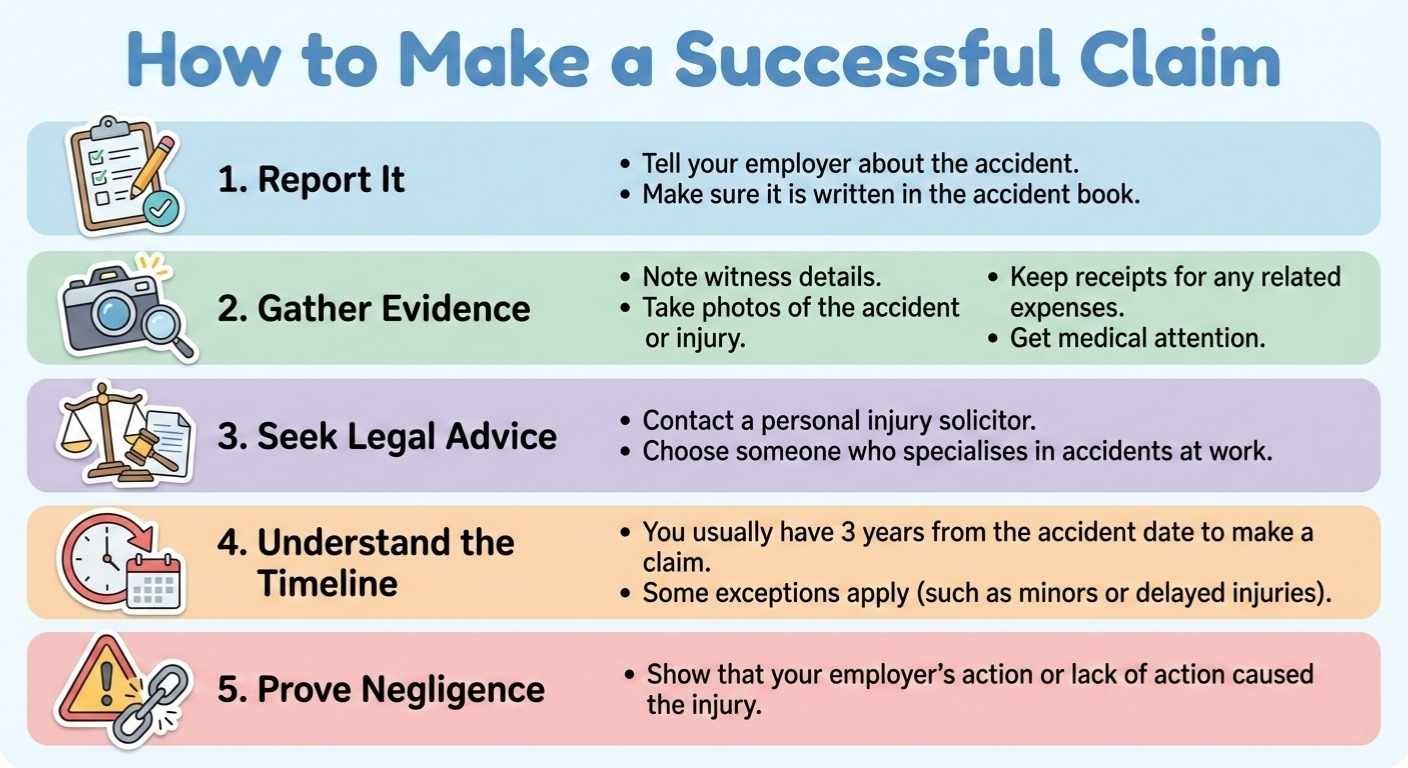
How-to-make-a-successful-Manual-Handling-Injury-Claim

Speak to our compensation experts

It doesn't cost you anything to know where you stand.

Fill out the form, and we'll get back to you within one hour.

Need to speak to us sooner?

Call us on 0141 280 1112

Request a FREE call

Terms and conditions

Average Manual Handling Compensation Payout Examples

For those who have sustained a back or spinal injury from heavy lifting at work, compensation varies considerably depending on the severity of the damage, the prognosis for recovery, and whether surgery was required. The compensation amounts listed below are estimated ranges. They are taken from the Judicial College Guidelines for the Assessment of General Damages (18th Edition, April 2026), a legal reference book widely used by Scottish legal practitioners to help value injury claims. They should be read as approximate reference ranges rather than fixed outcomes; every case is assessed on its individual medical evidence, and final awards are subject to judicial discretion.

Injury TypeApproximate Award Range
Minor soft tissue back injury (full recovery expected within two years)Up to £16,520
Moderate lumbar disc herniation with ongoing symptoms£16,520 – £51,230
Severe spinal damage (permanent disability or surgery required)£51,230 – £212,670+
Abdominal hernia (single surgical repair, full recovery)£3,500 – £9,650 (indicative)
Moderate shoulder or wrist strain (lasting functional impact)£8,550 – £21,000 (indicative)
Chronic repetitive strain condition affecting capacity to work£9,360 – £20,650 (indicative)

If your injury causes a permanent disability, requires ongoing care, or stops you from doing your old job, your compensation will likely be much higher. To prove this, we arrange an independent medical assessment to clearly show the insurer or the court exactly how your life has been affected.

If your injury falls into any of the categories above, contact us promptly. The sooner the evidence-gathering process begins, the stronger your position.

Satisfied Clients
0 K+
Dedicated Experts
0 +
Client Rating
0
Compensation Recovered
£ 0 + Million

Common Causes and Types of Manual Handling Injuries at Work

According to the HSE’s Non-fatal injuries sustained by workers, causes, 2025, handling, lifting, or carrying is the second most common cause of non-fatal injuries to employees, accounting for 17% of all employer-reported accidents. That represents thousands of preventable accidents in Scottish workplaces each year, most traceable to employer oversights that basic equipment, a proper risk assessment, or adequate staffing could have prevented.

Manual handling includes any task requiring a worker to lift, carry, push, pull, lower, or support a load. Not all injuries, including those caused by manual handling, result from a single event. Many build gradually through repetitive tasks, awkward postures, or sustained exposure to loads beyond what one person should reasonably handle.

Common manual handling injuries seen in Scottish workplace claims include:

  • Acute back sprains and muscle tears from single heavy or awkward lifts
  • Slipped or herniated discs from sustained bending and lifting over time
  • Repetitive strain injuries from repeated motions such as packing, overhead stacking, or assembly-line work
  • Abdominal hernias from excessive strain during heavy lifting
  • Strains and sprains to the wrists, knees, and ankles when carrying loads on uneven or slippery ground
  • Tendon and ligament tears from sudden or uncontrolled movements
  • Crush injuries from dropped or unstable loads


An arm or shoulder injury sustained during a manual handling task is especially common in healthcare and retail, where reaching overhead, supporting patients, or handling heavy stock across long shifts is routine.

Construction site injuries caused by lifting or carrying present their own distinct risks: uneven ground, absent lifting aids, and the expectation that workers move loads alone that should require two people.

Manual Handling Claims Across Scotland's Key Industries

Manual handling injuries occur across every sector, but Scotland’s employment geography means certain industries and regions account for a disproportionate share of workplace claims.

In Glasgow and the Clyde Valley, large-scale construction and ongoing infrastructure projects create environments where workers are routinely expected to move heavy materials without adequate lifting aids or sufficient staffing. Construction injury claims from this region make up a significant portion of Scottish workplace personal injury caseloads.

In Lanarkshire, the concentration of major distribution centres and logistics operations means workers frequently carry out repetitive loading, unloading, and order-picking tasks at a pace and volume that exceeds safe manual handling thresholds. Many of the injuries that result are cumulative conditions that develop over months before a single reportable accident occurs.

Across NHS Lothian and Scotland’s wider health boards, patient handling is one of the most physically demanding duties in nursing, care, and portering roles. Injuries sustained while transferring, repositioning, or supporting patients are among the most frequently claimed manual handling injuries in the Scottish healthcare sector.

In Aberdeenshire and nearby farming areas, farm hands and seasonal workers have a very different job than people working indoors. They often have to carry heavy items over rough ground without much equipment to help, and long shifts only make the physical strain worse.

In Aberdeen’s onshore energy and supply chain sector, workers at supply bases are constantly moving heavy loads under tight deadlines. Even in this high pressure environment, employers have the exact same legal responsibility to keep staff safe as they do in any other industry.

If you work in any of these sectors and were injured during a manual handling task, the same statutory obligations applied to your employer. Your employment type, industry, or location does not alter your right to make a claim.


Making A Personal Injury Claim In Scotland

Our panel of experienced personal injury lawyers excel in handling cases against well-funded insurance companies.

Our specialised injury lawyers will assist you with your claim, keep you informed throughout the whole process, and provide you with legal advice that is easy to understand.

01

Get In Touch.

Tell us your story, we're here to listen and provide you with an initial assessment based on your circumstances.

02

We’ll Prepare Your Claim.

We'll be by your side to take care of the legal process. We'll keep you informed of every step of the way.

03

Receive Compensation.

If your claim is successful, we'll ensure that you get your compensation as soon as possible.

efthymios-xylangouras

"A Student’s Journey from Trauma to Triumph: Efthymios’s Fight for Justice After a Devastating Car Accident"

When Efthymios was injured in a car accident, he was left with severe facial injuries. He didn’t know how he would manage his recovery and studies.

“When I got in contact with HD Legal, they made me feel supported. They were incredibly understanding and fought hard for me, ensuring I received the compensation I deserved.”

Read Efthymios’s story >

margaret-forbes

"Cracked Pavement, Broken Ankle: How HD Legal Helped Margaret Find Justice and Peace of Mind"

When Margaret tripped on a neglected crack in the pavement in Glasgow, she shattered her ankle and was forced to take months off work, unsure how she would manage.

“HD Legal were a lifeline for me. They took care of everything—from gathering crucial evidence to battling the council—and gave me the peace of mind I needed to focus on my recovery.”

Read Margaret’s story >

douglas-macgregor

"Blown Away: HD Legal Fights for Douglas After Faulty Washing Machine Explosion"

When Douglas’s new washing machine exploded, it caused a fire that damaged his kitchen and left him with painful burns.

“HD Legal fought relentlessly for me when it seemed like no one else would. They were thorough, professional, and supported me every step of the way, helping me recover both physically and financially.”

Read Douglas’s story >

smiling-women

"From Misdiagnosis to Recovery: How HD Legal Fought for Eilidh’s Justice and Secured the Care She Needed"

When Eilidh’s severe abdominal pain was repeatedly misdiagnosed, her condition worsened, leading to the need for urgent surgery.

“HD Legal stood by me when I felt lost. They were thorough, professional, and fought tirelessly to get me the care and compensation I needed to heal.”

Read Eilidh’s story >

smiling-man

"Falling from Heights, Rising with Justice: How HD Legal Secured Compensation for Alistair After a Workplace Accident Involving Faulty Scaffolding"

Alistair Campbell’s fall from faulty scaffolding left him with serious injuries and months of recovery.

“HD Legal’s panel of solicitors fought for me, ensuring I received the support needed to move forward.”

Read Alistair’s story >

Employer Duties and Proving Negligence Under Scottish Law

Under the Manual Handling Operations Regulations 1992 and the Management of Health and Safety at Work Regulations 1999, every Scottish employer has a statutory duty to protect workers from harm caused by manual handling. This is a legal obligation, not a general guideline, and failing to meet it is what gives rise to a compensation claim.

Employer negligence takes several recognisable forms. The most common is failing to carry out a suitable risk assessment before workers are asked to handle heavy or awkward loads. Employers are also clearly at fault if they fail to provide basic lifting equipment like hoists or trolleys or if they expect one person to struggle with a heavy load that safely requires two people.

The absence of proper training is another consistent factor. If your employer cannot prove they provided manual handling training by showing training logs or induction records, they will have a very hard time defending themselves against your claim. HSE guidance is unambiguous on this point: where dangerous manual handling cannot be eliminated, providing adequate training is a statutory requirement, not a discretionary step.

Building the evidence to support your claim typically involves:

  • The workplace accident book entry, or documentation showing no record was maintained
  • Medical records from the date of injury onward
  • CCTV footage where it exists
  • Witness statements from colleagues
  • Internal training records and risk assessment documentation
  • Any correspondence showing the employer was aware of the hazard before the accident occurred


We handle all the evidence gathering for you. If your employer tries to hide training logs or safety records that they are legally required to share, your solicitor will step in and force them to hand the documents over.

Will I Lose My Job for Making a Work Accident Claim Against My Employer?

No. Making a personal injury claim against your employer does not put your job at risk. Any dismissal, demotion, or act of detriment taken against you for bringing a legitimate workplace injury claim is unlawful under Scottish and UK employment law, and could form the basis of a separate unfair dismissal claim.

Every employer in Scotland is legally required to hold Employers’ Liability Insurance under the Employers’ Liability (Compulsory Insurance) Act 1969. When a claim succeeds, the insurer pays, not the employer’s bank account and not the business’s operational funds.

Claims are processed through the insurance framework precisely to protect businesses from bearing the full financial weight of compensation outcomes, which is exactly why Employers’ Liability Insurance is a legal requirement in the first place.

If your employer’s behaviour changes after you raise a claim, take note of it. Document any shift in how you are managed, spoken to, or scheduled, and raise it with your solicitor without delay. That conduct carries legal weight.

Your right to compensation and your right to keep your job are independent of each other. Exercising one does not put the other at risk.

DEDICATED CLAIMS ADVISORS

Our dedicated claims advisors are always available to offer free legal advice.

100% NO WIN NO FEE CLAIMS

All our claims are processed on a No Win No Fee basis; you pay nothing if you lose.

appear-logo-in-mobile

MILLIONS SECURED IN DAMAGES

To date, we have secured millions in damages.

THOUSANDS OF SATISFIED CLIENTS

To date, we have helped thousands of clients recover compensation and continue to do so.

How Does No Win No Fee Work for Manual Handling Claims in Scotland?

In Scotland, No Win No Fee is formally called a Speculative Fee Agreement. If your claim is unsuccessful, you pay nothing in solicitors’ fees.

Statutory Success Fee Caps

It is important to understand how costs work if your claim succeeds. Under a Speculative Fee Agreement, your solicitor is entitled to charge an uplift, a success fee, on top of their standard fees, in recognition of the financial risk they took in pursuing the claim. The Civil Litigation (Expenses and Group Proceedings) (Scotland) Act 2018 and its accompanying regulations impose statutory caps on success fees in personal injury cases:

  • 20% of the first £100,000 of damages recovered
  • 10% of any damages recovered between £100,001 and £500,000
  • 2.5% of any damages recovered above £500,000


These caps are a statutory protection for claimants and cannot be contracted around.

Qualified One-Way Costs Shifting (QOCS)

A further and significant protection applies to all personal injury claims raised in Scotland on or after 30 June 2021: Qualified One-Way Costs Shifting (QOCS), introduced under the Civil Litigation (Expenses and Group Proceedings) (Scotland) Act 2018. Under QOCS, even if your claim is unsuccessful, the court won’t order you to pay the opponent’s legal expenses, provided you have conducted your claim in an appropriate manner. This protection removes the principal financial risk that previously deterred injured workers from pursuing legitimate claims.

QOCS protection can only be lost in limited circumstances: if the court finds that you have acted fraudulently, behaved in a manifestly unreasonable manner, or abused the court process.

The only other big risk is if your employer offers to settle out of court and you say no. If you take the case to trial and win a smaller amount than they offered you, you might have to pay a share of their lawyer fees. To ensure you still walk away with some compensation, the court will cap those fees so they do not exceed 75% of your total awarded damages.

Your solicitor must also advise you on whether After the Event (ATE) insurance is appropriate to cover any residual cost risk. Before you commit to anything, we explain every aspect of the funding arrangement in clear language, including what happens in the event the claim does not succeed.

All Speculative Fee Agreements in Scotland are regulated under Scots law and overseen by the Law Society of Scotland. There are no surprises, and you will not be asked to sign anything you have not fully understood.

Time Limits for Making a Manual Handling Claim in Scotland

In Scotland, you have three years to make a personal injury claim. This is set under the Prescription and Limitation (Scotland) Act 1973 and is applied strictly: once the deadline passes, the right to claim is lost.

For an injury caused by a single accident, the three years run from the date of the accident. For conditions that develop gradually, such as a long-term musculoskeletal condition caused by months of repetitive lifting, the period starts from the date of knowledge: the date you became aware, or should reasonably have become aware, that your condition was caused by your work.

There are two main exceptions. If you were under 16 at the time of the accident, the three-year period begins on your 16th birthday (meaning you have until your 19th birthday to raise a claim). If the injured person lacks mental capacity, the limitation period is paused until capacity is established or a legal representative is appointed.

If you are close to the three-year deadline, act now. A quick initial assessment secures your legal position before time runs out.

Why Choose HD Claims?

Handling a workplace injury claim in Scotland takes more than just a basic understanding of the law. You need someone who actually knows how the Scottish courts work and exactly what kind of proof is required to win. It is also crucial to know how insurance companies try to fight these claims, especially when an employer flat out refuses to take the blame.

We work alongside a team of specialist manual handling injury solicitors best suited to your specific case, ensuring your representation is tailored to your needs. We oversee the entire process, keeping you fully informed while you focus on your treatment and rehabilitation.

The solicitors we work with have handled claims across every major industry where manual handling injuries occur, from factory accident claims across Scotland to complex construction disputes and patient-handling cases in healthcare.

How the Scottish Court System Works

Scotland has a distinct civil court structure for personal injury claims. The All-Scotland Sheriff Personal Injury Court (ASSPIC), based in Edinburgh and established in 2015, is the specialist court with national jurisdiction over most personal injury cases. It handles claims with a value exceeding £5,000 and has exclusive jurisdiction for cases up to £100,000. It is staffed by sheriffs who specialise in personal injury law, which leads to more consistent and expert case management than a local sheriff court. For workplace injury claims, the ASSPIC has jurisdiction even for values over £1,000 in some circumstances.

For cases above £100,000, or those involving novel or complex points of law, proceedings may be raised concurrently in the Court of Session in Edinburgh, which is Scotland’s supreme civil court. The decision on which court to use is a strategic one, made by the solicitors handling your case based on the value and complexity of your claim.

Frequently Asked Questions About Manual Handling Compensation Claims in Scotland

Can I claim if a manual handling accident aggravated a pre-existing back condition?

Yes. Under Scottish law, an employer takes their claimant as they find them. If a workplace lifting incident worsened or accelerated a pre-existing condition, such as a degenerative disc disorder or a previous back injury, you can claim for that specific deterioration.

An independent medical expert will assess how much the workplace event contributed to your current symptoms, separating the work-related aggravation from the natural progression of the underlying condition. That expert report forms the foundation of your compensation valuation and is one of the most important documents in your case.

A denial of liability does not end your claim. Under the Compulsory Pre-Action Protocol (CPAP), formally introduced under the Act of Sederunt (Sheriff Court Rules Amendment) (Personal Injury Pre-Action Protocol) 2016 and governing personal injury litigation in Scotland, both parties exchange evidence before any formal court proceedings begin. Where an employer disputes responsibility, we work with the solicitors on your case to gather additional evidence, including independent safety reports and expert witness analysis, to challenge that denial directly.

If negotiations do not produce a fair outcome, your solicitor will raise court proceedings on your behalf.

Most personal injury claims in Scotland settle without a court hearing. Solicitors and the employer’s insurer negotiate a settlement in the majority of cases, long before any formal proceedings are needed. Where court action is necessary, it is typically raised in the All-Scotland Sheriff Personal Injury Court (ASSPIC), either to protect the limitation period or when an insurer refuses to offer a fair settlement.

A straightforward claim, where liability is clear and the medical evidence is settled, typically resolves within six to nine months. Where injuries are more serious, liability is contested, or the prognosis is still developing, the timeline can extend to twelve to eighteen months or beyond. These are general estimates and will depend on the particular facts of your case.

Legal Disclaimer

The content on this page is intended for general informational purposes only and does not constitute legal advice. It should not be relied upon as a substitute for specific legal advice tailored to your individual circumstances. No solicitor-client relationship is created by reading this page or contacting us through it.

We’re Here To Help When You Need Us Most.

Call us on 0141 2801112, or leave us a message below to request a call back and one of our team will be in touch as soon as we can.

Terms and conditions