HD claims logo without B (2)
0%
Loading ...

Vibration White Finger Claims Scotland

element

As Featured In:

circle-element

Check Out Our Awesome Reviews Below:

Scottish workers who developed VWF after years of using vibrating machinery at work may be entitled to claim compensation for the harm it has caused. According to the HSE, 220 new cases of Hand-Arm Vibration Syndrome (HAVS) were officially assessed in 2024 alone, but the true number is likely to be far higher because the scheme relies on self-reporting and does not cover self-employed workers.

For many people, the damage builds up after years of exposure to vibration from vibrating hand tools at work. The symptoms often develop gradually, which is why workers do not always realise at first that the condition is linked to their job. These cases often fall within vibration-related industrial injury claims.

We're Here To Help

Contact Us Today

If you are looking into vibration white finger claims, you need clear answers on whether your condition is work-related and what evidence will support your case. You also need legal advice that reflects the medical reality of HAVS and the way Scottish industrial disease cases are pursued.

At HD Claims, we work alongside a team of specialist personal injury solicitors best suited to your specific white finger claim, ensuring your representation is tailored to your needs. If your symptoms began after years of working with vibrating machinery, speak with our specialist team at 01412801112 for a free, no-obligation initial consultation.

Speak to our compensation experts

It doesn't cost you anything to know where you stand.

Fill out the form, and we'll get back to you within one hour.

Need to speak to us sooner?

Call us on 0141 280 1112

Request a FREE call

Terms and conditions

What is Vibration White Finger (VWF) and HAVS?

Vibration White Finger is an industrial injury caused by repeated use of hand-held vibrating power tools over time. It affects circulation in the fingers by damaging small blood vessels and can also involve nerve damage. In medical terms, it is the vascular part of Hand-Arm Vibration Syndrome, and it is often described as secondary Raynaud’s phenomenon.

Hand-Arm Vibration Syndrome (HAVS) is the wider diagnosis. It covers the full range of harm linked to prolonged vibration exposure, including blanching in the fingers, numbness, tingling, reduced feeling, and in some cases loss of grip or hand strength. VWF is one part of that broader condition.

Many people first notice the problem when their hands get cold or wet. A finger may turn white and numb, then become painful as the blood flow returns. Others notice a pins-and-needles sensation, weaker grip, or difficulty with small everyday tasks after years of using tools such as pneumatic drills, breakers, grinders, or saws.

This kind of damage usually builds up gradually rather than appearing all at once. What may start as an occasional symptom can turn into a long-term condition that affects work, daily tasks, and comfort in cold weather.

High-Risk Industries and Tools for Hand-Arm Vibration

The vibrating tools most often linked to VWF and HAVS include pneumatic drills, road breakers, concrete breakers, angle grinders, disc cutters, hammer drills, chipping hammers, chainsaws, brush cutters, powered sanders, concrete pokers and needle guns. Workers can also be exposed when they hold materials against vibrating machinery as part of the job. According to the HSE, regular use of hand-held or hand-guided power tools is a recognised source of hand-arm vibration injury.

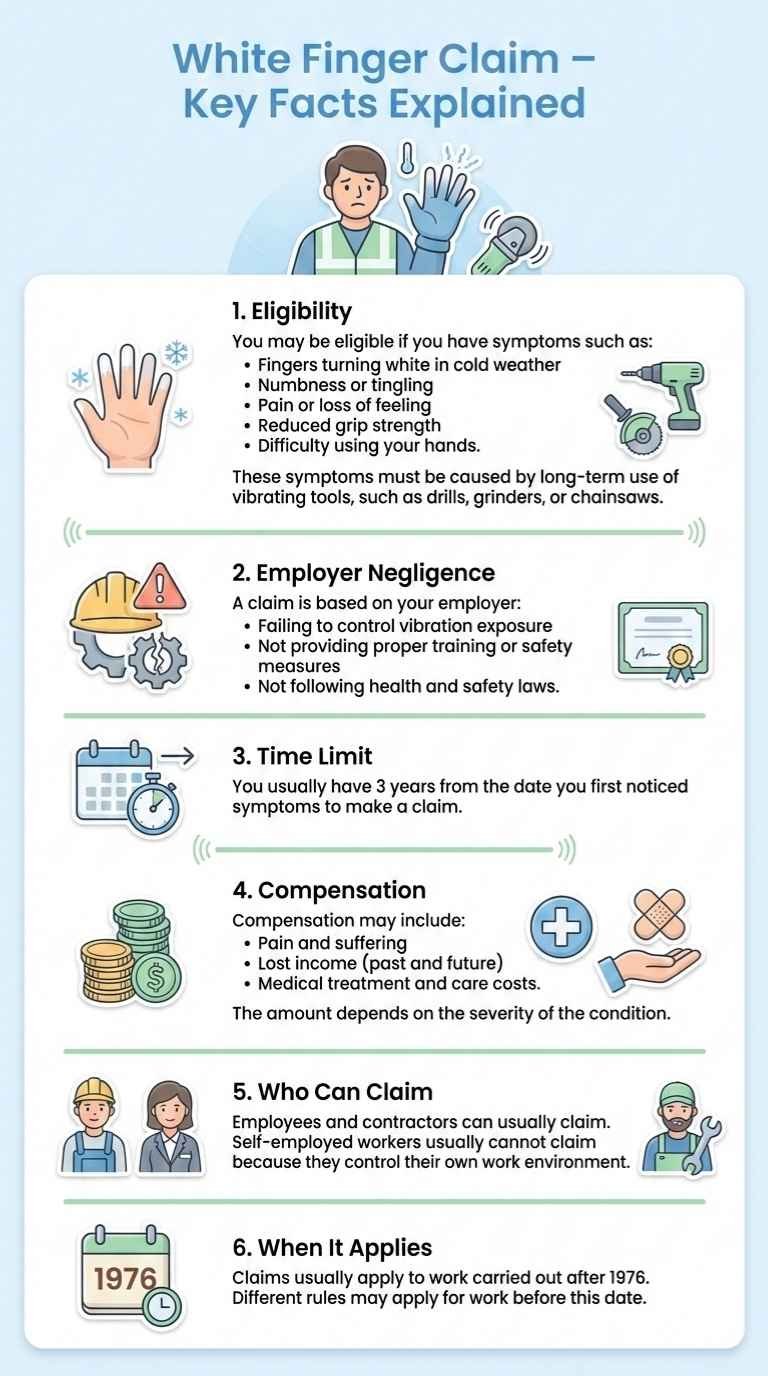
White-Finger-Claims-key-Facts

These cases are seen across building sites in Glasgow and Edinburgh, shipyards on the Clyde, forestry work in the Highlands, and heavy engineering across the Central Belt, where regular tool use is part of everyday work. The link to the job is often clearest where someone has spent years using the same equipment for long periods, especially where exposure was not properly monitored, tasks were not rotated, or safer alternatives were not provided. If you are wondering whether you can claim for white finger, the answer often depends on the work you did, the tools you used, and how long you were exposed to vibration over time.

A lot of workers do not connect the condition to work at first. They may notice blanching, numbness or tingling in cold weather, then only later realise that years of using grinders, drills, breakers or saws may have caused it. Once the symptoms begin to affect grip, comfort, or your ability to work, the occupational link often becomes much clearer.

Vibration White Finger Claims for Construction Workers

Construction remains one of the trades most closely associated with vibration injury, particularly on busy sites in places such as Glasgow, Edinburgh, Dundee and Aberdeen, where heavy tools are often used daily across long shifts and demanding site conditions. Road breakers, hammer drills, concrete vibrators, disc cutters and grinders all expose the hands and arms to repeated vibration.

The risk rises quickly when work is rushed, and exposure is not managed properly. If workers spend too long on the same tools without proper monitoring, rotation, or control measures, lasting damage becomes much more likely. HSE guidance sets clear exposure action and limit values, which employers are expected to monitor and control.

If a site manager failed to rotate tasks, ignored vibration exposure limits, did not provide lower-vibration equipment, or overlooked obvious warning signs, that can point to employer negligence. In many VWF and HAVS claims, that is a key part of showing how the damage could have been prevented.

The Three Categories of HAVS (Stockholm Workshop Scale)

Medical professionals use the Stockholm Workshop Scale to grade HAVS by looking at which part of the hand-arm system has been damaged and how severe the symptoms have become.

Cold-related blanching, sensory loss, and joint pain do not all fall into the same category, even when they come from the same history of vibration exposure. The grading helps separate vascular, neurological, and musculoskeletal injury so the condition can be assessed properly in both medical and legal terms.

Vascular injury:

This scale assesses the severity of Vibration White Finger by looking at how often blanching happens and how far it spreads along the fingers.

StageSeverityClinical Symptoms & Presentation
0VNoneHistory of vibrating tool use, but currently showing zero vascular damage.
1VMildOccasional blanching attacks; restricted entirely to the very tips of one or more fingers.
2VModerateOccasional attacks that spread further down, affecting the middle and distal joints of the fingers.
3VSevereFrequent, distressing attacks occurring in both winter and summer, affecting all joints (including the base) of most fingers.
4VVery SevereAdvanced, continuous blood flow restriction resulting in trophic skin changes, such as painful ulcers or localised tissue breakdown in the fingertips.

Neurological injury:

This scale measures permanent damage to the peripheral nerves. Unlike vascular spasms, neurological damage is often constant and progressively impairs your hand function.

StageSeverityNerve Impact & Functional Signs
0SNNoneExposed to high-vibration machinery with zero neurological symptoms.
1SNMildIntermittent numbness, tingling, or "pins and needles." Clinical tests do not yet show a physical loss of sensation.
2SNModeratePersistent or highly frequent numbness. Clinical examinations confirm a measurable reduction in sensory perception (difficulty feeling light touch, heat, or cold).
3SNSevereContinuous numbness and tingling with a severe loss of manual dexterity. Simple tasks like fastening buttons, picking up coins, or handling fine tools become difficult even when hands are warm.

Musculoskeletal injury:

While musculoskeletal damage is not assigned a strict numerical stage on the Stockholm Scale, it represents the deep, cumulative structural damage caused to your muscles, joints, bones, and tendons after years of heavy tool use. For some workers, these problems can feel similar to an arm or hand injury from repetitive work tasks, but the full picture is often broader because vibration can affect the joints, nerves, and circulation at the same time.

Musculoskeletal symptoms can have a major effect on day-to-day function. According to the HSE, 511,000 workers in Great Britain were suffering from a work-related musculoskeletal disorder in 2024/25, accounting for 27% of all work-related ill health. That wider picture helps explain why reduced grip, weakness, and ongoing joint pain should never be brushed aside as ordinary wear and tear.

A person can fall into more than one category at the same time. Someone may have blanching in cold weather, loss of feeling in the fingertips, and weaker grip altogether, which is why a careful medical assessment is so important when doctors are assessing the severity and type of HAVS.


Satisfied Clients
0 K+
Dedicated Experts
0 +
Client Rating
0
Compensation Recovered
£ 0 + Million

Employer Duties of Care and the Control of Vibration at Work Regulations

Scottish employers are legally required to assess vibration risks, monitor daily exposure, and limit trigger time to reduce the risk of permanent damage to the nerves and blood vessels in the hands and arms. Under the Control of Vibration at Work Regulations 2005, they must make a suitable and sufficient risk assessment, compare daily exposure against the hand-arm exposure action value and exposure limit value, and take steps to reduce the risk where needed. The HSE guidance sets the hand-arm Exposure Action Value at 2.5 m/s² A(8) and the Exposure Limit Value at 5.0 m/s² A(8).

Trigger time is the period when the tool is actually running and transmitting vibration into the worker’s hands, not the whole time spent on site. Employers should choose lower-vibration tools where possible, maintain equipment properly, rotate tasks, plan shorter periods of exposure, and keep accurate records of how long high-vibration tools are being used.

Health surveillance is another key part of that statutory duty. Workers who are likely to be exposed above the Exposure Action Value, or who are otherwise at risk, should be checked for early symptoms so problems are picked up before the damage becomes permanent.

Employers should also take sensible steps to protect workers in cold conditions, but HSE guidance makes it clear that anti-vibration gloves are not enough on their own. If an employer ignored symptoms, failed to assess exposure properly, allowed trigger times to rise, or let workers go beyond the exposure limit value, that can point to an occupational illness caused by employer negligence.

Am I Eligible to Make a Scottish VWF Claim?

A Scottish VWF claim is usually strongest where the evidence shows three things: that your condition is linked to vibration exposure at work, that your job exposed you to enough vibration for the damage to develop, and that your employer failed to take the protective steps required by law.

Symptoms on their own are not enough. The real legal issue is whether the condition was caused by the work and whether it could reasonably have been prevented.

A claim is often more persuasive where you can show:

Making A Personal Injury Claim In Scotland

Our panel of experienced personal injury lawyers excel in handling cases against well-funded insurance companies.

Our specialised injury lawyers will assist you with your claim, keep you informed throughout the whole process, and provide you with legal advice that is easy to understand.

01

Get In Touch.

Tell us your story, we're here to listen and provide you with an initial assessment based on your circumstances.

02

We’ll Prepare Your Claim.

We'll be by your side to take care of the legal process. We'll keep you informed of every step of the way.

03

Receive Compensation.

If your claim is successful, we'll ensure that you get your compensation as soon as possible.

efthymios-xylangouras

"A Student’s Journey from Trauma to Triumph: Efthymios’s Fight for Justice After a Devastating Car Accident"

When Efthymios was injured in a car accident, he was left with severe facial injuries. He didn’t know how he would manage his recovery and studies.

“When I got in contact with HD Legal, they made me feel supported. They were incredibly understanding and fought hard for me, ensuring I received the compensation I deserved.”

Read Efthymios’s story >

margaret-forbes

"Cracked Pavement, Broken Ankle: How HD Legal Helped Margaret Find Justice and Peace of Mind"

When Margaret tripped on a neglected crack in the pavement in Glasgow, she shattered her ankle and was forced to take months off work, unsure how she would manage.

“HD Legal were a lifeline for me. They took care of everything—from gathering crucial evidence to battling the council—and gave me the peace of mind I needed to focus on my recovery.”

Read Margaret’s story >

douglas-macgregor

"Blown Away: HD Legal Fights for Douglas After Faulty Washing Machine Explosion"

When Douglas’s new washing machine exploded, it caused a fire that damaged his kitchen and left him with painful burns.

“HD Legal fought relentlessly for me when it seemed like no one else would. They were thorough, professional, and supported me every step of the way, helping me recover both physically and financially.”

Read Douglas’s story >

smiling-women

"From Misdiagnosis to Recovery: How HD Legal Fought for Eilidh’s Justice and Secured the Care She Needed"

When Eilidh’s severe abdominal pain was repeatedly misdiagnosed, her condition worsened, leading to the need for urgent surgery.

“HD Legal stood by me when I felt lost. They were thorough, professional, and fought tirelessly to get me the care and compensation I needed to heal.”

Read Eilidh’s story >

smiling-man

"Falling from Heights, Rising with Justice: How HD Legal Secured Compensation for Alistair After a Workplace Accident Involving Faulty Scaffolding"

Alistair Campbell’s fall from faulty scaffolding left him with serious injuries and months of recovery.

“HD Legal’s panel of solicitors fought for me, ensuring I received the support needed to move forward.”

Read Alistair’s story >

How Much Compensation Can I Claim for Vibration White Finger in Scotland?

The value of vibration white finger compensation in Scotland is usually worked out by looking at the medical severity of the condition and then adding the financial consequences it has caused.

Lawyers often use the Judicial College Guidelines as a reference point for the injury itself, but the final valuation also depends on your own evidence, the extent of the symptoms, and how the condition has affected your work and daily life. In Scots law, the injury element is usually described as solatium (meaning compensation for the pain, suffering, and loss of amenity caused by the condition).

If you want a quick starting point before looking at the full details of your case, you can check our compensation calculator for Scotland.

That usually includes:

Where the injury has forced someone out of a trade that depended on strong grip, tool handling, or outdoor work, the claim can also reflect reduced employability in the future. That can matter even where the worker is still employed, because the real loss may appear later if they need to compete for other work with permanent restrictions.

DEDICATED CLAIMS ADVISORS

Our dedicated claims advisors are always available to offer free legal advice.

100% NO WIN NO FEE CLAIMS

All our claims are processed on a No Win No Fee basis; you pay nothing if you lose.

appear-logo-in-mobile

MILLIONS SECURED IN DAMAGES

To date, we have secured millions in damages.

THOUSANDS OF SATISFIED CLIENTS

To date, we have helped thousands of clients recover compensation and continue to do so.

Time Limits for Making a Scottish VWF Claim (Date of Knowledge)

In Scotland, the usual white finger claim time limit is three years from your date of knowledge, not three years from the last day you used vibrating tools. Under the Prescription and Limitation (Scotland) Act 1973, the clock usually starts when you knew, or could reasonably have been expected to know, that your injury was serious enough to justify a claim and was linked to someone’s act or omission.

That point matters in VWF and HAVS cases because symptoms often appear gradually. A worker may use tools for years, then only later realise that numbness, blanching, or reduced grip is connected to the job. That is why the legal focus is often on the date of knowledge rather than the date of exposure.

If you used vibrating tools years ago and are only now starting to understand what has happened to your hands, do not assume it is too late. The safest step is to get the timeline reviewed now, while employment records, medical evidence, and witness information are still easier to trace.

Why Choose HD Claims for Your Scottish Industrial Disease Case?

Industrial disease claims are rarely straightforward, especially where the exposure happened years ago, or the employer has changed name, merged, or closed down. You need a team that understands how these cases are built, how Scots Law applies, and how to follow the evidence back through old workplaces, insurers, and medical records.

These claims sit within a distinct Scottish legal framework, and that wider context includes bodies such as the Law Society of Scotland as well as the Scottish courts.

We take care of the legal strategy from the outset, so you are not left trying to piece everything together on your own. We work alongside a team of specialist personal injury solicitors best suited to your specific case, ensuring your representation is tailored to your needs.

We oversee the entire process, keeping you fully informed while you focus on your treatment and rehabilitation. When an employer has failed to protect you, the legal side can feel difficult to take on alone. We make navigating personal injury claims in Scotland clearer, more organised, and easier to manage.

This also covers cases where the original employer is no longer trading. In those situations, the Employers’ Liability Tracing Office can help trace historic employers’ liability insurance, and its database holds more than 40 million policies going back more than a century. It is free for individuals to use, which can make a real difference in older industrial disease cases.

Our wider experience also matters. By working across asbestos and long-term industrial disease claims, needlestick injury claims, and other workplace injury cases, we have built a broader understanding of employer liability, medical evidence, and insurer tracing in more complex claims.

No Win No Fee Vibration White Finger Claims Explained

In Scotland, No Win No Fee is a recognised way of funding a civil claim. It can be set up so you do not pay a fee if the case does not succeed.

Before anything moves forward, the funding should be explained clearly. You should know how the fees work, what happens if the claim succeeds, and whether any deductions or outlays, such as the costs of running the case, may apply. A good team will make that clear from the start.

If you are dealing with VWF or HAVS and want straight answers about time limits, evidence, and funding, contact us today for a confidential assessment. We can look at your work history, explain the likely next steps, and tell you whether the claim looks strong enough to pursue.

White Finger Claims FAQs

Can I claim if my former employer has gone out of business?

Yes, you can still claim even if your former employer has closed down. In many older industrial disease cases, the main issue is tracing the employer’s liability insurer rather than the business itself, and the Employers’ Liability Tracing Office can help with that.

That can be especially important in VWF cases because symptoms often appear years after the exposure happened. If the company no longer exists, the insurance history may still provide a route to pursue the claim.

Usually, no. Many personal injury cases settle through investigation and negotiation without going to court. If court proceedings are needed in Scotland, the case may be dealt with in the sheriff court, including the National Personal Injury Court, or in some cases in the Court of Session.

Even then, it does not automatically mean you will have to give lengthy evidence in a courtroom. A lot will depend on whether liability is disputed, how strong the medical evidence is, and whether the insurer is willing to settle.

Yes, in most cases an independent medical assessment will be needed. The medical report helps show what condition you have, how serious it is, how it affects daily life and work, and what future symptoms or restrictions may be expected.

The appointment is normally straightforward. You are usually examined by an independent expert, and that report becomes one of the key pieces of evidence when the claim is valued.

Your employer should not dismiss, discipline, or mistreat you simply because you have raised a genuine work-related injury claim. If they do, that can create separate employment law problems around unfair dismissal, detriment, or discrimination depending on the facts.

A claim is usually made against the employer’s liability insurer, not paid personally by a manager or taken from the day-to-day wages budget. Once that is understood, many workers feel more comfortable taking the next step.

The best protection is to reduce vibration exposure early, use suitable lower-vibration equipment, keep tools properly maintained, and avoid long uninterrupted periods on high-vibration tools. The HSE also advises workers to report symptoms early, keep hands warm and dry, and avoid relying on anti-vibration gloves as the main form of protection.

If you already have symptoms, do not try to push through them. Continued exposure can make HAVS worse, and the damage may become permanent, so early reporting and proper health checks are vital.

We’re Here To Help When You Need Us Most.

Call us on 0141 2801112, or leave us a message below to request a call back and one of our team will be in touch as soon as we can.

Terms and conditions