HD claims logo without B (2)
0%
Loading ...

No Win No Fee Solicitors Scotland

element

As Featured In:

circle-element

Check Out Our Awesome Reviews Below:

A No Win No Fee claim lets you seek compensation without paying solicitor fees at the start. In Scotland, this type of funding is usually set out in a Speculative Fee Agreement, which explains what happens if you win, what happens if you lose and what success fee will be deducted from your compensation.

We manage the legal strategy of your claim from the first case assessment through to settlement. We work alongside specialist Scottish personal injury lawyers suited to your case. We oversee your representation and keep you updated while you focus on treatment and recovery.

We're Here To Help

Contact Us Today

We can assess No Win No Fee personal injury claims arising from road collisions, workplace accidents, unsafe public areas, industrial disease and serious or fatal injuries. Read more about personal injury claims in Scotland or learn more about us.

Request a Free Initial Case Assessment

How Does a Speculative Fee Agreement Work?

“No Win No Fee” is the familiar phrase. A Speculative Fee Agreement sets out how your claim will be funded and what may be deducted if it succeeds.

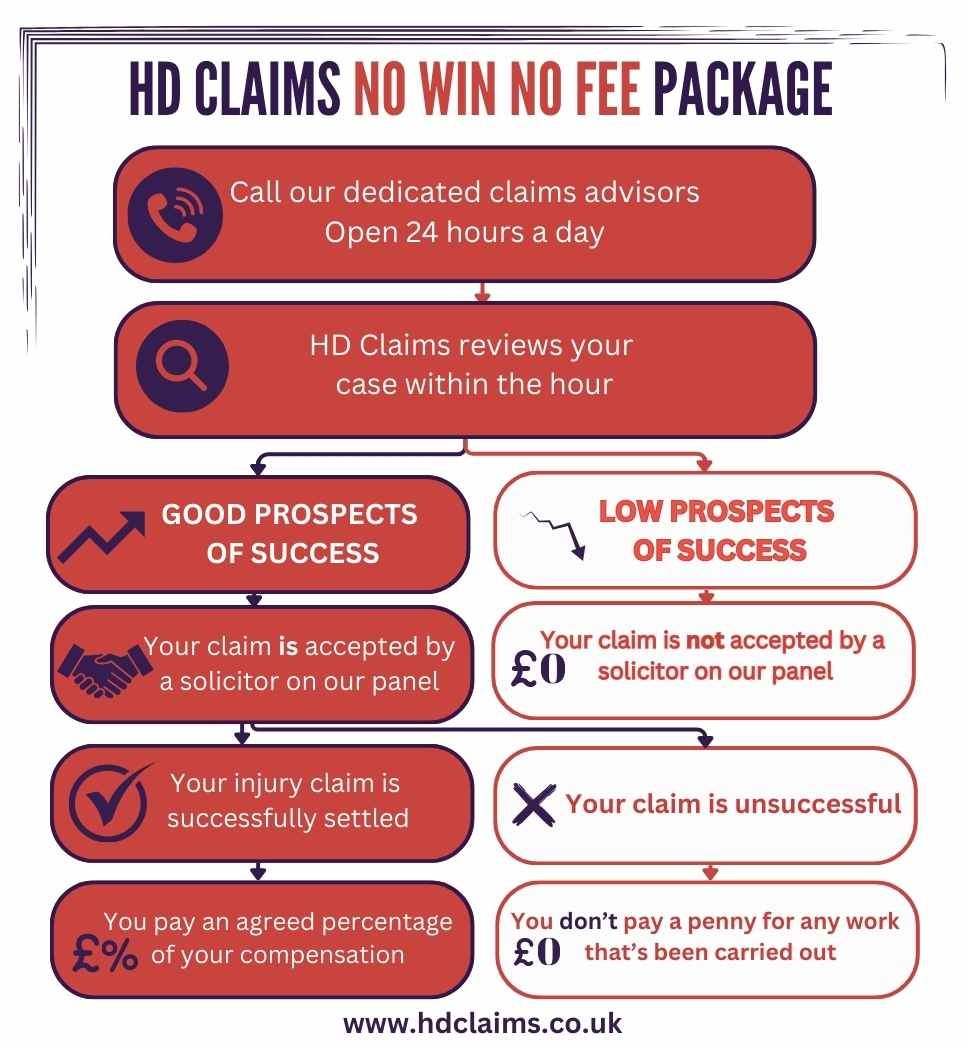
If your claim does not succeed, you will not usually pay the solicitor’s fee covered by the agreement. If the claim is successful, an agreed success fee may be deducted from the compensation recovered.

Before you sign, we will make sure the agreement clearly explains:

  • What outcome counts as a win?
  • What percentage may be deducted?
  • Who pays for medical reports and court fees?
  • Is an insurance policy required?
  • Could you face charges if you end the claim early?
  • What happens if you reject legal advice or a settlement offer?


Your solicitor will explain the possible deductions using a worked example, so you can see the estimated settlement, the charges that may apply and the amount you could receive.

Where a success fee arrangement is available, we will explain how it reduces your upfront financial risk and highlight any circumstances in which charges could still arise.

If court proceedings become necessary, Qualified One-way Costs Shifting (QOCS) protects you from paying the defender’s legal expenses if the claim is unsuccessful.

However, this protection may not apply if a claimant acts fraudulently, abuses the court process or behaves in a manifestly unreasonable way during the case.

If the defender lodges a formal settlement offer, known as a Minute of Tender, your solicitor will explain the financial risk before advising whether to accept or reject it. If the case continues and the final award does not beat the offer, you may become responsible for some of the defender’s post-tender expenses, subject to the applicable 75% cap.

Are Success Fees Capped Under the 2018 Civil Litigation Act?

Yes. Scottish regulations limit how much can be charged as a success fee in a personal injury case.

The Maximum Rates Are:

  • 20% of the first £100,000 recovered
  • 10% of the next £400,000
  • 2.5% of any amount above £500,000


VAT is included within the statutory limits, but this maximum rate is not automatically the percentage you will be charged. Before the claim begins, your solicitor will confirm the agreed rate in writing and explain how it will apply to your compensation.

For example, if £150,000 were recovered, the maximum would not be calculated by deducting 20% from the whole award. The first £100,000 would fall within the 20% band, while the remaining £50,000 would fall within the 10% band.

We will also make sure you understand whether expenses recovered from the defender affect the final deduction, so you know how your payment will be calculated before accepting a settlement.

INFO-GRAPHICS-HD-CLAIMS-NO-WIN-NO-FEE-SCOTLAND-PACKAGE

Road Traffic Accidents

We have personal injury solicitors to help you with you road traffic accident compensation claims.

Medical Negligence

Contact our expert medical negligence personal injury lawyers in Scotland.

Accidents at Work

With a large network of personal injury solicitors in Scotland we have helped numerous work accident cases.

Trip & Slip Accidents

Our personal injury lawyers are ever ready to help you out with slip trip injury accidents.

Speak to our compensation experts

It doesn't cost you anything to know where you stand.

Fill out the form, and we'll get back to you within one hour.

Need to speak to us sooner?

Call us on 0141 280 1112

Request a FREE call

Terms and conditions

How Are Outlays and Court Expenses Handled?

Outlays are costs paid to other organisations while your claim is being prepared. They can include medical-report fees, court dues, expert evidence and the cost of obtaining records.

Before work begins, your solicitor will explain how medical reports, court fees and other outlays will be funded. Where your claim proceeds under an eligible success fee agreement, you will not normally be asked to pay these costs upfront.

We will make sure your agreement identifies any other charges that could arise, including:

  • The agreed success fee
  • An After the Event insurance premium, where applicable
  • Charges that could follow if you end the agreement
  • The effect of rejecting professional advice
  • Any circumstances not covered by the funding arrangement


If After the Event insurance is relevant to your claim, your solicitor will explain what the policy covers, whether any exclusions apply and whether the premium will be deducted from your compensation.

Before you sign, we will explain what happens if the claim fails, what may be deducted if it succeeds and whether ending the agreement early could result in charges.

Satisfied Clients
0 K+
Dedicated Experts
0 +
Client Rating
0
Compensation Recovered
£ 0 + Million

Personal Injury Claims We Handle

We manage Scottish accident claims involving minor injuries, lengthy recoveries and life-changing harm. We work alongside a specialist solicitor whose experience matches the type of accident, the injuries involved and any dispute over responsibility.

Claims Can Arise From:

  • Road traffic collisions
  • Accidents at work
  • Slips, trips and falls
  • Defective products
  • Industrial disease, including asbestos-related illness and HAVS
  • Medical or clinical negligence
  • Brain, spinal and amputation injuries
  • Fatal accidents


During the initial assessment, we will look at whether another person or organisation owed you a duty of care, failed to meet that duty and caused your injury. Other legal tests may apply to claims involving defective products or statutory duties.

We review these points at the start. This helps us identify missing evidence early and avoids giving you unrealistic expectations about the likely outcome.

You can learn more about our team and read our case studies to see how we approach different injuries and liability disputes.

Road Traffic Collisions and Whiplash Claims

A road traffic accident claim may be possible if another road user caused all or part of the collision. We handle accidents on major routes such as the M8, M90 and A9, as well as crashes on local streets, junctions and rural roads.

Road claims may involve:

  • Whiplash and soft-tissue damage
  • Fractures and joint injuries
  • Passenger injuries
  • Cyclist and motorcyclist accidents
  • Pedestrian injuries
  • Commercial vehicle collisions
  • Uninsured or untraced drivers
  • Fatal injuries


Provisional Transport Scotland figures recorded 5,535 casualties in reported Scottish road collisions during 2025. Of those casualties, 1,906 were seriously injured.

After a collision, focus first on your safety and health.

Once you are able:

  • Seek medical attention and describe every symptom.
  • Exchange contact, vehicle and insurance details.
  • Report the accident to Police Scotland when required.
  • Photograph the vehicles, road conditions and visible injuries.
  • Keep witness details and dashcam footage.
  • Tell your insurer, but do not rush into an injury settlement.


If symptoms such as stiffness, headaches or back pain develop after the collision, tell us and seek medical attention. A medical assessment creates a record of the injury and helps distinguish accident-related symptoms from earlier health problems.

If you were hit by an uninsured driver, or if the driver fled the scene (a ‘hit and run’), you might still be able to claim compensation through the Motor Insurers’ Bureau (MIB). We can help you check if you meet their specific rules and gather the evidence they need.

Learn more about making a road accident claim with no upfront fees.

Workplace Accidents and Employer Negligence

You may have a claim after an accident at work where an employer, contractor or another responsible party failed to take reasonable care for your safety.

Common Examples Include:

  • Falls from ladders, scaffolding or platforms
  • Defective machinery
  • Poor training or supervision
  • Unsafe lifting tasks
  • Missing protective equipment
  • Exposure to harmful substances
  • Workplace vehicle accidents
  • Repetitive strain or industrial disease


These claims arise across construction, manufacturing, healthcare, hospitality, agriculture and North Sea offshore work.

According to the Health and Safety Executive, Scotland has an estimated 40,000 non-fatal workplace injuries each year.

Making an injury claim does not automatically mean that you will lose your job. Your employer must continue to follow employment law and fair procedures. Keep a written record if your hours, duties or treatment at work change after you report the accident or begin a claim.

Useful evidence can include:

  • The accident-book entry
  • Photographs of the area or equipment
  • Witness contact details
  • Training records
  • Payslips and absence records
  • Emails or messages about the accident
  • Medical notes and fit notes


You should not remove confidential workplace records without permission. Tell us what documents or records exist, and your solicitor can consider the proper way to obtain them.

We can assess eligible work injury claims.

Making A Personal Injury Claim In Scotland

Our panel of experienced personal injury lawyers excel in handling cases against well-funded insurance companies.

Our specialised injury lawyers will assist you with your claim, keep you informed throughout the whole process, and provide you with legal advice that is easy to understand.

01

Get In Touch.

Tell us your story, we're here to listen and provide you with an initial assessment based on your circumstances.

02

We’ll Prepare Your Claim.

We'll be by your side to take care of the legal process. We'll keep you informed of every step of the way.

03

Receive Compensation.

If your claim is successful, we'll ensure that you get your compensation as soon as possible.

efthymios-xylangouras

"A Student’s Journey from Trauma to Triumph: Efthymios’s Fight for Justice After a Devastating Car Accident"

When Efthymios was injured in a car accident, he was left with severe facial injuries. He didn’t know how he would manage his recovery and studies.

“When I got in contact with HD Legal, they made me feel supported. They were incredibly understanding and fought hard for me, ensuring I received the compensation I deserved.”

Read Efthymios’s story >

margaret-forbes

"Cracked Pavement, Broken Ankle: How HD Legal Helped Margaret Find Justice and Peace of Mind"

When Margaret tripped on a neglected crack in the pavement in Glasgow, she shattered her ankle and was forced to take months off work, unsure how she would manage.

“HD Legal were a lifeline for me. They took care of everything—from gathering crucial evidence to battling the council—and gave me the peace of mind I needed to focus on my recovery.”

Read Margaret’s story >

douglas-macgregor

"Blown Away: HD Legal Fights for Douglas After Faulty Washing Machine Explosion"

When Douglas’s new washing machine exploded, it caused a fire that damaged his kitchen and left him with painful burns.

“HD Legal fought relentlessly for me when it seemed like no one else would. They were thorough, professional, and supported me every step of the way, helping me recover both physically and financially.”

Read Douglas’s story >

smiling-women

"From Misdiagnosis to Recovery: How HD Legal Fought for Eilidh’s Justice and Secured the Care She Needed"

When Eilidh’s severe abdominal pain was repeatedly misdiagnosed, her condition worsened, leading to the need for urgent surgery.

“HD Legal stood by me when I felt lost. They were thorough, professional, and fought tirelessly to get me the care and compensation I needed to heal.”

Read Eilidh’s story >

smiling-man

"Falling from Heights, Rising with Justice: How HD Legal Secured Compensation for Alistair After a Workplace Accident Involving Faulty Scaffolding"

Alistair Campbell’s fall from faulty scaffolding left him with serious injuries and months of recovery.

“HD Legal’s panel of solicitors fought for me, ensuring I received the support needed to move forward.”

Read Alistair’s story >

Personal Injury Representation Across Major Scottish Cities

We assist people across Scotland, including Glasgow, Edinburgh, Aberdeen, Dundee, Inverness, Perth, Stirling, Paisley, Kirkcaldy and Dunfermline.

Most updates can be handled by phone, email or video call. Where an in-person appointment is needed, we will discuss the most suitable option with you.

Medical appointments are arranged with your condition and mobility in mind. Let us know early if travelling is painful for you, you depend on another person for transport, or you need accessibility support.

People in the west of Scotland can read more about our No Win No Fee solicitors serving Glasgow.

The Personal Injury Claims Process in Scotland: Step by Step

Every case develops differently, but most claims follow a recognisable path.

Free Initial Case Assessment

We start by listening to what happened and how the injury has affected your life. We will ask about the accident date, medical treatment, witnesses and the person or organisation you believe was responsible.

This first conversation also helps us check the relevant time limits and whether the case may qualify for No Win No Fee funding.

Do not wait until you have every document. Bring what you already have, and we can identify what still needs to be found.

Checking Responsibility

We look at who owed you a duty of care and what may have gone wrong. This could involve a driver, employer, property owner, local authority, healthcare provider or product manufacturer.

Responsibility for an accident is sometimes shared. For instance, two different organisations might both be at fault, or the opposing side might argue that your own actions contributed to the accident.

Collecting Evidence

The evidence depends on the type of claim. It may include photographs, CCTV, accident reports, witness accounts, wage information and medical records.

Road claims can also involve police information and vehicle evidence. Workplace cases may require training documents, risk assessments or maintenance records.

Keep receipts for treatment, medication, travel, care and replacement items. A small expense can be difficult to recover later if there is no record of it.

Medical Assessment

We will arrange the medical evidence needed for your claim. This may include an independent assessment covering your diagnosis, treatment, expected recovery and any symptoms likely to continue.

Give the medical expert an honest account of your symptoms and how they affect your daily life. Explain what you could do before the accident, what has changed and whether you need help with work, travel or daily tasks.

A final settlement should usually wait until the medical position is clear enough to value the claim properly. Once a full and final offer is accepted, you cannot normally return for more compensation if your condition later worsens.

Contacting the Responsible Party

We notify the responsible party or its insurer and explain what happened, why we believe they are liable and what injuries you suffered.

The insurer then investigates and responds. We handle these discussions and review any request for further evidence.

Send us any letter, message or settlement offer you receive from the insurer. Your solicitor will review it against the medical and financial evidence before advising whether it reflects the full value of your claim.

Valuing and Negotiating the Claim

The value of a claim is based on the injury and its wider effect on your life. The assessment can include lost income, treatment costs, travel, care, damaged belongings and future financial needs.

A quick offer is not automatically a fair offer. We compare it with the medical findings and documented financial losses before advising you.

Where liability has been admitted or established, your solicitor may seek an interim payment to help with immediate costs while the rest of the claim continues.

Settlement or Court Proceedings

If both sides agree on responsibility and value, the claim can settle without a court hearing. The agreement is recorded, and payment is arranged.

Where the insurer denies responsibility or disputes the amount, court proceedings may be needed. However, starting a court action does not mean the case will definitely go to trial. Negotiations often continue after proceedings begin.


DEDICATED CLAIMS ADVISORS

Our dedicated claims advisors are always available to offer free legal advice.

100% NO WIN NO FEE CLAIMS

All our claims are processed on a No Win No Fee basis; you pay nothing if you lose.

appear-logo-in-mobile

MILLIONS SECURED IN DAMAGES

To date, we have secured millions in damages.

THOUSANDS OF SATISFIED CLIENTS

To date, we have helped thousands of clients recover compensation and continue to do so.

The 3-Year Timebar: Prescription and Limitation (Scotland) Act 1973

Most personal injury court actions in Scotland must be started within three years.

The period usually runs from the accident date. It may also begin on a later “date of knowledge” if you did not immediately know that you had suffered a significant injury connected to another party’s act or omission.

Outlined in section 17 of the Prescription and Limitation (Scotland) Act 1973, the date-of-knowledge exception plays a vital role in industrial disease and delayed-diagnosis claims. For example, a worker exposed to asbestos may not develop symptoms until many years after the original exposure.

Different rules may apply to children, people who lack legal capacity and claims following a death. While a court can sometimes step in and allow a late claim, you should never count on getting an extension.

Speak to us as early as possible, even if you believe the deadline has passed. The dates and exceptions need to be checked against the facts rather than estimated from memory.

Will My Case Go to ASPIC or the Court of Session?

Most claims do not end up going all the way to a full trial. They are often resolved through negotiation once both sides have reviewed the medical and liability evidence.

When court proceedings are required, a Scottish personal injury case may be raised in a local sheriff court, the All-Scotland Sheriff Personal Injury Court or the Court of Session.

The All-Scotland Sheriff Personal Injury Court is based in Edinburgh and handles claims from across Scotland.

The Court of Session deals with high-value civil cases, including personal injury claims worth more than £100,000. We will make sure your case goes to the right court based on the value of your claim, how complicated the details are, and exactly what needs to be sorted out.

The Personal Injury Court recorded 6,893 registrations during 2024/25. A registered case may still settle before reaching trial.

If court action is needed, we will explain why, prepare you for each stage and oversee the process with the solicitor handling your case. Your solicitor will manage the court documents, deadlines and communication with the defender.

How Is Compensation Calculated Under the Judicial College Guidelines?

There is no single tariff for every Scottish injury claim. The amount depends on the medical evidence, recovery time, lasting symptoms and financial effect of the accident.

The Judicial College Guidelines may help when assessing the injury itself, alongside Scottish court decisions and the facts of the individual case. The guidelines help value an injury, but they do not guarantee a particular settlement.

Scottish claims commonly include two broad forms of compensation:

Solatium covers pain, suffering and loss of amenity. Loss of amenity refers to the effect of the injury on activities and parts of life you previously enjoyed. The Scottish judiciary uses solatium as the term for damages linked mainly to pain and suffering.

Patrimonial loss covers financial effects. It may include lost wages, treatment fees, travel costs, personal care, damaged property and future financial losses supported by evidence.

Suppose an injury stops you from working for twelve weeks. The claim may include compensation for the injury itself, but it can also include proven income loss, travel to hospital and help required at home.

Our personal injury compensation calculator for Scotland can give you an early estimate based on the injury category. It cannot assess every medical and financial detail, so it should not be treated as a final valuation.

FAQs

Can I Claim if the Accident Was Partly My Fault?

Yes. Sharing some responsibility does not always prevent you from making a claim.

Under contributory negligence, compensation may be reduced to reflect your share of the blame.

For example, imagine that a claim is valued at £30,000 and you are found to have been 25% responsible. The payment may be reduced by £7,500, leaving £22,500.

Partial fault can arise where:

  • A driver was speeding, but the injured passenger was not wearing a seat belt
  • A cyclist and motorist both failed to take reasonable care
  • An employer supplied unsafe equipment, but the worker ignored part of their training
  • A pedestrian crossed the road carelessly while a driver was travelling too fast


Do not decide for yourself that you have no claim. CCTV, vehicle data, photographs and witness accounts may present a different picture from what you remember in the immediate aftermath.

Start Your Free Initial Consultation Today

Tell us what happened, when it occurred and how the injury has affected you. We will review the basic facts, explain the next step and let you know whether No Win No Fee funding may be available.

Our role is to manage the legal strategy from beginning to end. We work alongside a specialist personal injury solicitor suited to your case, oversee progress and keep you informed while you concentrate on your recovery.

You can contact us by:


Read why people choose us for their injury claim, or contact us to arrange your free initial case assessment.

We’re Here To Help When You Need Us Most.

Call us on 0141 2801112, or leave us a message below to request a call back and one of our team will be in touch as soon as we can.

Terms and conditions