HD claims logo without B (2)
0%
Loading ...

Office Accident Claims in Scotland

As Featured In:

Check Out Our Awesome Reviews Below:

According to HSE, the total cost of workplace injury and ill health in Scotland was £1.6 billion in 2023/24, and 31% of Scotland’s work-related ill health cases are musculoskeletal disorders. Those are exactly the kinds of problems that often develop in office settings across Scotland, from city-centre offices near Buchanan Street and Glasgow Central to business districts around St Andrew Square and Edinburgh Park, through poor workstation setup, repetitive tasks, and avoidable strain.

An office injury is not something you just shake off. According to HSE, in 2024/25, each person suffering from a work-related musculoskeletal disorder took an average of 14.0 working days off in Great Britain, while Scotland sees an estimated 38,000 work-related musculoskeletal disorder cases each year.

We're Here To Help

Contact Us Today

At HD Claims, we work alongside a team of specialist personal injury solicitors best suited to your office injury claim, ensuring your representation is tailored to your needs. If your office accident claim is suitable, your solicitor can take your case on a Speculative Fee Agreement, which is the Scottish term for No Win, No Fee. This means you can move forward with your claim without paying legal fees up front.

If you want to understand the wider route for workplace cases, you can read our guide on accidents at work compensation claims. Talk to HD Claims today.

Speak to our compensation experts

It doesn't cost you anything to know where you stand.

Fill out the form, and we'll get back to you within one hour.

Need to speak to us sooner?

Call us on 0141 280 1112

Request a FREE call

Terms and conditions

What to Do Immediately After an Office Accident

What you do in the first few hours after an office accident can make a real difference to your recovery and to the strength of your claim. Try to act while the details are still fresh and before the danger or obstacles are removed, cleaned up, or repaired.

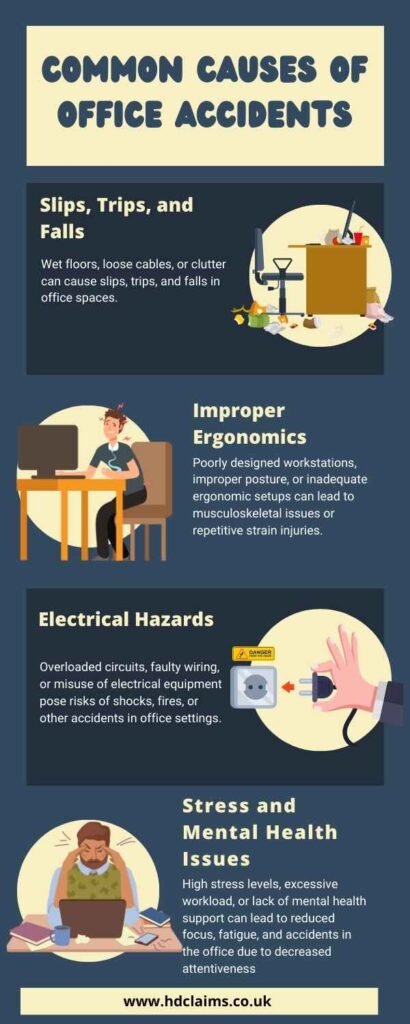
INFO-GRAPHICS-OF-OFFICE-ACCIDENT-CLAIMS-IN-SCOTLAND

These early steps can strengthen your claim and help show how the injury affected you from the start. They also help show what went wrong, how quickly you sought help, and how the injury began to affect your daily life.

Satisfied Clients
0 K+
Dedicated Experts
0 +
Client Rating
0
Compensation Recovered
£ 0 + Million

Employer Responsibilities: DSE Regulations and Workplace Safety

Under the Health and Safety at Work etc. Act 1974, employers must protect the health, safety, and welfare of their staff so far as is reasonably practicable. In office settings, that duty of care is backed up by more specific rules on the condition of the workplace, workstation setup, and day-to-day safety.

The Workplace (Health, Safety and Welfare) Regulations 1992 require employers to maintain the workplace and relevant equipment in an efficient state, keep floors and traffic routes free from obstructions or anything likely to cause a slip, trip, or fall, and provide suitable and sufficient lighting. That matters in ordinary work environments just as much as in higher-risk settings. A poorly lit stairwell, boxes left in a walkway, or cables stretched across the floor can all be signs of avoidable safety failures.

Display screen work brings its own legal responsibilities. Under the Health and Safety (Display Screen Equipment) Regulations 1992, employers must carry out a suitable and sufficient analysis of relevant workstations. HSE guidance also explains that where staff use DSE daily for an hour or more at a time, employers should assess the whole setup, including equipment, furniture, the working conditions, and any particular needs the worker may have.

That means an employer should not wait until someone is already in pain before taking action. They should carry out risk assessments, provide ergonomic workstations, give training on posture and workstation use, and deal with issues like screen height, chair support, keyboard position, glare, and lack of space. When those checks are overlooked, employees can end up dealing with injuries that could have been prevented by a safer workstation setup.

Common Types of Office Accidents and Injuries

Some people still assume office work accidents are minor by definition. They are not. An office injury caused by an unsafe environment, faulty furniture, or long-term strain from a poor workstation setup can have serious and lasting effects.

Repetitive Strain Injury (RSI) and Carpal Tunnel

Repetitive strain problems often build quietly. You may notice tingling in your fingers, weakness in your grip, pain in your wrist or forearm, or numbness that gets worse by the end of the day. What begins as discomfort at a keyboard or mouse can turn into long-term symptoms that affect typing, driving, sleeping, and basic tasks at home.

These are the kinds of issues that often lead to office injury claims in Scotland, especially where someone has worked for months without a proper workstation assessment. Carpal tunnel syndrome, tendon irritation, shoulder pain, and neck stiffness are common in workplaces where staff are expected to work through discomfort instead of having the setup fixed. According to HSE, poorly designed workstations and poor use of DSE can lead to pain in the neck, shoulders, back, arms, wrists, and hands, as well as fatigue and eye strain.

Slips, Trips, and Falls in the Office

A lot of office accidents happen away from the desk. Someone slips in the kitchen after a spill is left on the floor. Another trip over a loose computer cable under a shared workstation. A torn carpet edge in a corridor catches a shoe, or a recently mopped lobby has no warning sign in place.

These are not freak accidents. They are the sort of dangers and obstacles employers are expected to deal with before anyone gets hurt. The workplace regulations require floors and traffic routes to be kept free from obstructions and from anything likely to cause a slip, trip, or fall. When that does not happen, there may be grounds to claim compensation for the office injury and its wider impact.

If you are injured after a slip or trip in a workplace environment, the exact cause matters. A wet patch with no signage, uneven flooring, poor lighting near stairs, or wires left across a walkway can all become important evidence when liability is being assessed.

Back Pain and Muscle Strains from Poor Ergonomics

Back pain in an office is often brushed off as part of desk work, but that misses how these injuries actually happen. A chair with poor lumbar support, a screen set too low, a desk that forces someone to hunch forward, or a workstation with no room to sit properly can place strain on the neck, shoulders, and lower back day after day. Over time, that can lead to muscle strains, soft tissue injuries, or more serious spinal symptoms.

There is also the issue of manual handling. Office staff still lift and move things: boxes of printer paper, archive files, bottled water, and even furniture during office changes. HSE explains that employers must avoid dangerous manual handling where they can, assess the risks where it cannot be avoided, and reduce the risk of injury. When lifting tasks are ignored or treated casually, one awkward movement can lead to weeks of pain and significant time off work.

If your symptoms started after a poor workstation setup, you can read more about back or neck injuries caused by poor office ergonomics. If the injury happened while lifting or moving office items, our guide on manual handling claims may also help.


Making A Personal Injury Claim In Scotland

Our panel of experienced personal injury lawyers excel in handling cases against well-funded insurance companies.

Our specialised injury lawyers will assist you with your claim, keep you informed throughout the whole process, and provide you with legal advice that is easy to understand.

01

Get In Touch.

Tell us your story, we're here to listen and provide you with an initial assessment based on your circumstances.

02

We’ll Prepare Your Claim.

We'll be by your side to take care of the legal process. We'll keep you informed of every step of the way.

03

Receive Compensation.

If your claim is successful, we'll ensure that you get your compensation as soon as possible.

"A Student’s Journey from Trauma to Triumph: Efthymios’s Fight for Justice After a Devastating Car Accident"

When Efthymios was injured in a car accident, he was left with severe facial injuries. He didn’t know how he would manage his recovery and studies.

“When I got in contact with HD Legal, they made me feel supported. They were incredibly understanding and fought hard for me, ensuring I received the compensation I deserved.”

Read Efthymios’s story >

"Cracked Pavement, Broken Ankle: How HD Legal Helped Margaret Find Justice and Peace of Mind"

When Margaret tripped on a neglected crack in the pavement in Glasgow, she shattered her ankle and was forced to take months off work, unsure how she would manage.

“HD Legal were a lifeline for me. They took care of everything—from gathering crucial evidence to battling the council—and gave me the peace of mind I needed to focus on my recovery.”

Read Margaret’s story >

"Blown Away: HD Legal Fights for Douglas After Faulty Washing Machine Explosion"

When Douglas’s new washing machine exploded, it caused a fire that damaged his kitchen and left him with painful burns.

“HD Legal fought relentlessly for me when it seemed like no one else would. They were thorough, professional, and supported me every step of the way, helping me recover both physically and financially.”

Read Douglas’s story >

"From Misdiagnosis to Recovery: How HD Legal Fought for Eilidh’s Justice and Secured the Care She Needed"

When Eilidh’s severe abdominal pain was repeatedly misdiagnosed, her condition worsened, leading to the need for urgent surgery.

“HD Legal stood by me when I felt lost. They were thorough, professional, and fought tirelessly to get me the care and compensation I needed to heal.”

Read Eilidh’s story >

"Falling from Heights, Rising with Justice: How HD Legal Secured Compensation for Alistair After a Workplace Accident Involving Faulty Scaffolding"

Alistair Campbell’s fall from faulty scaffolding left him with serious injuries and months of recovery.

“HD Legal’s panel of solicitors fought for me, ensuring I received the support needed to move forward.”

Read Alistair’s story >

Calculating Compensation (Solatium & Patrimonial Loss) for an Office Injury

In Scotland, the value of an office accident claim is usually considered under two main categories: solatium and patrimonial loss. That reflects the distinct structure of Scottish personal injury law, which operates within a regulated legal framework that includes bodies such as the Law Society of Scotland.

Solatium covers the pain and suffering caused by the injury, including any psychological impact. In other words, it can include both the physical effects of the injury and related mental symptoms, such as anxiety.

Patrimonial loss deals with the financial impact of the injury. That can include past and future loss of earnings, missed overtime, treatment expenses, travel costs, private physiotherapy, and the cost of ergonomic equipment or workplace adjustments if you need support during recovery.

If you want a full breakdown of what financial losses you can recover after an injury, it helps to look at both the pain the injury caused and the money it has cost you.

Time Limits: The Prescription and Limitation (Scotland) Act 1973

In Scotland, office injury claims are usually governed by the Prescription and Limitation (Scotland) Act 1973. In most cases, you have three years from the date of the accident to raise a claim for personal injury. The legislation sets out that personal injury actions must normally be brought within three years of the injury, or, where the latter rule applies, the injured person’s date of knowledge.

That later rule matters in office cases involving conditions that develop over time, such as RSI or carpal tunnel syndrome. If your symptoms developed gradually, the three-year period may run from the point when you first became aware, or could reasonably have become aware, that your injury was linked to your working conditions rather than from the day the strain first began.

There are also exceptions. For example, different rules can apply where the injured person lacks the mental capacity to deal with the claim themselves.

Talk to HD Claims today on 01412801112 to find out where you stand and what you can do next, whether your office accident happened near Glasgow Central, St Andrew Square, Haymarket, or another workplace anywhere in Scotland.

DEDICATED CLAIMS ADVISORS

Our dedicated claims advisors are always available to offer free legal advice.

100% NO WIN NO FEE CLAIMS

All our claims are processed on a No Win No Fee basis; you pay nothing if you lose.

MILLIONS SECURED IN DAMAGES

To date, we have secured millions in damages.

THOUSANDS OF SATISFIED CLIENTS

To date, we have helped thousands of clients recover compensation and continue to do so.

Can I Make a No Win, No Fee Office Injury Claim in Scotland?

Yes, if your case is suitable, your solicitor can take it on a Speculative Fee Agreement, which is the Scottish term for No Win, No Fee. Scottish regulations treat speculative fee agreements as a type of no win, no fee funding arrangement, where there is a success fee if the case wins and no fee, or a lower one, if it does not.

That can make a real difference if you need legal advice after an accident at work but are worried about upfront costs. It gives many people a practical way to pursue office accident compensation claims in Scotland without having to fund the case themselves from the start.

There is also another layer of protection in Scotland called Qualified One-Way Costs Shifting (QOCS), which can be especially important if your case needs to be raised in a local Sheriff Court or in the Court of Session. For personal injury cases, QOCS generally means that if the claim is unsuccessful, you are not required to pay the employer’s or insurer’s legal expenses, subject to limited exceptions under the court rules.

FAQs

Will I be sacked or treated unfairly for making an office injury claim against my employer?

While fear of retaliation is common, UK employment law does provide important protection in health and safety cases. Under the Employment Rights Act 1996, certain dismissals linked to protected health and safety action can be automatically unfair, which means the usual two-year qualifying period for unfair dismissal claims may not apply. Protection from unfair treatment can also apply where an employee has raised genuine health and safety concerns or taken appropriate steps to protect themselves or others.

Yes, often you can. Agency workers still have health and safety protections; responsibility may fall on the business where you were working, the agency, or both, depending on who controlled the workplace, equipment, training, and supervision. Agency status does not stop you from claiming if your injury was caused by someone else’s negligence.

We’re Here To Help When You Need Us Most.

Call us on 0141 2801112, or leave us a message below to request a call back and one of our team will be in touch as soon as we can.

Terms and conditions