- Obligation-Free Consultation
- No Win, No Fee
- Award-Winning Lawyers
As Featured In:
Check Out Our Awesome Reviews Below:
EXCELLENT Based on 99 reviews Posted on Google Daniel MorosanuTrustindex verifies that the original source of the review is Google. I cannot thank the team at HD Claims enough for their help with my personal injury claim. From day one, their injury lawyers were incredibly professional, explaining the no win no fee process clearly without complex jargon. They took away all the stress of dealing with the insurance companies and secured the accident compensation I was entitled to. If you are looking for reliable personal injury solicitors who truly look out for your best interests, I highly recommend their services.Posted on Google Gigel stoicaTrustindex verifies that the original source of the review is Google. HD Claims made my personal injury claim simple and stress-free. The team was professional, responsive, and kept me updated throughout the process. I would recommend them to anyone needing help with an accident compensation claimPosted on Google Muhammed AhmedTrustindex verifies that the original source of the review is Google. I was involved in a car accident where my car was written off and my passengers were seriously injured. I contacted HD Claims and received an excellent service from start to finish. They were very understanding and took the time to explain the whole process clearly. In the end, I received a very favourable settlement. I would most definitely recommend this firm to anyone in a similar situation.Posted on Google Sarah TaylorTrustindex verifies that the original source of the review is Google. Excellent service from HD Claims! They completely managed my personal injury claim from start to finish and allocated me a fantastic specialist solicitor. The whole process was handled on a 'no win no fee' basis, making it entirely stress-free. Their communication was top-notch, and I am very happy with the final settlement I received. I highly recommend their team to anyone looking for reliable legal support.Posted on Google Nico SullivanTrustindex verifies that the original source of the review is Google. HD Claims were brilliant after my accident. They handled everything smoothly and kept me informed the whole time. If you need personal injury lawyers with car accident experience, they’re a great choice.Posted on Google faiq zebTrustindex verifies that the original source of the review is Google. I've used HD Claims for a few car accidents I've suffered over the years as a taxi driver. Always received a great experience and compensation - Asif Khan GlasgowPosted on Google picui bossTrustindex verifies that the original source of the review is Google. Hey my name is Andrei and I’m with John white my self and they are They are the best 100% in all Scotland you should try with them. They’re the best service and they provide with everything. What you want to know about and I give them out 10 out of 10.Posted on Google GAMERS ONLYTrustindex verifies that the original source of the review is Google. Was a very good service 👏Posted on Google Sunny InboxTrustindex verifies that the original source of the review is Google. I had a great experience with HD Claims. The injury lawyers were professional, responsive, and explained everything clearly. They handled my case with care and confidence, making the whole process stress-free. Highly recommended for injury claims.Posted on Google John SmithTrustindex verifies that the original source of the review is Google. My insurance company recommended a firm that charged 30% and had poor reviews. I went with Hamilton Douglas instead, who charged far less and were completely transparent. They were professional, communicative, and secured me an excellent settlement. Do your research and pick them.Verified by TrustindexTrustindex verified badge is the Universal Symbol of Trust. Only the greatest companies can get the verified badge who has a review score above 4.5, based on customer reviews over the past 12 months. Read more
Manufacturing is one of the higher-risk working environments in Scotland and the UK as a whole for non-fatal workplace injury. According to the Health and Safety Executive (HSE) annual statistics report for 2024/25, the sector records 2,110 non-fatal injuries per 100,000 workers, compared with 1,780 across all industries. That is roughly the equivalent of one reported non-fatal workplace injury for every 47 manufacturing workers over a 12-month period, against about one for every 56 workers across the wider workforce.
That increased risk is reflected in the number of people injured at work on factory floors, in plant rooms, on production lines, and in warehouse units across Scotland, from sites around Grangemouth and Rosyth to industrial estates such as Hillington Park and Eurocentral. These accidents often involve moving machinery, forklifts, heavy loads, poor guarding, unsafe working practices, or failures in supervision.
At HD Claims, we understand how disruptive a serious workplace injury can be, both physically and financially. Our role is to manage the legal strategy of your claim from start to finish, working alongside specialist factory accident lawyers best suited to the circumstances of your case. If you may have a factory accident claim in Scotland, we explain the process clearly and keep things straightforward while you focus on your treatment and recovery.
We also make sure cost concerns do not become another pressure point. If your case is suitable, your factory accident solicitor may be able to act under a Speculative Fee Agreement, which means you do not pay an upfront legal fee to start the claim. From the first conversation onward, we guide the claims process step by step, keep you informed, and help you move forward with confidence.
Speak to our compensation experts
It doesn't cost you anything to know where you stand.
Fill out the form, and we'll get back to you within one hour.
Need to speak to us sooner?
Call us on 0141 280 1112
- Over £3+ Million in Settlements
- No Win, No Fee
- Supporting Scots Since 2010
- 10 Offices Around Scotland
Request a FREE call
Employer Duty of Care in Scottish Factories and Manufacturing
In Scottish factories and manufacturing sites, employers owe a legal duty of care under the Health and Safety at Work etc. Act 1974, the main health and safety law in Great Britain. Employers are expected to identify dangers, control them properly, and keep the working environment as safe as reasonably practicable.
Whether the site is a large industrial unit at Hillington Park, a logistics base around Eurocentral, a manufacturing plant near Grangemouth, or a smaller workshop elsewhere in Scotland, that duty means more than a generic safety policy pinned to a wall. Machinery must be properly risk assessed, inspected, and maintained. Under PUWER (Provision and Use of Work Equipment Regulations) 1998, equipment has to be suitable for the job, safe to use, and fitted with the right guards and control measures, especially where workers may come into contact with moving parts, sharp cutting edges, or areas where they could be trapped or crushed.
Training is part of the legal duty too. If someone is asked to operate a press, conveyor, forklift, or other heavy machinery without proper instruction, supervision, or refresher training, the employer may be in breach of that duty. The same applies where production targets are pushed ahead of safety, and that causes preventable accidents at work.
PPE is not optional where the risk assessment shows it is needed. Employers must provide suitable protective equipment free of charge, which may include steel-toe boots, ear defenders, safety goggles, high-visibility clothing, or respiratory protection depending on the task and the environment. In many serious workplace injury claims, the root problem comes down to poor guarding, inadequate maintenance, lack of training, or unsuitable PPE.
Common Causes of Factory Accidents and Industrial Injuries
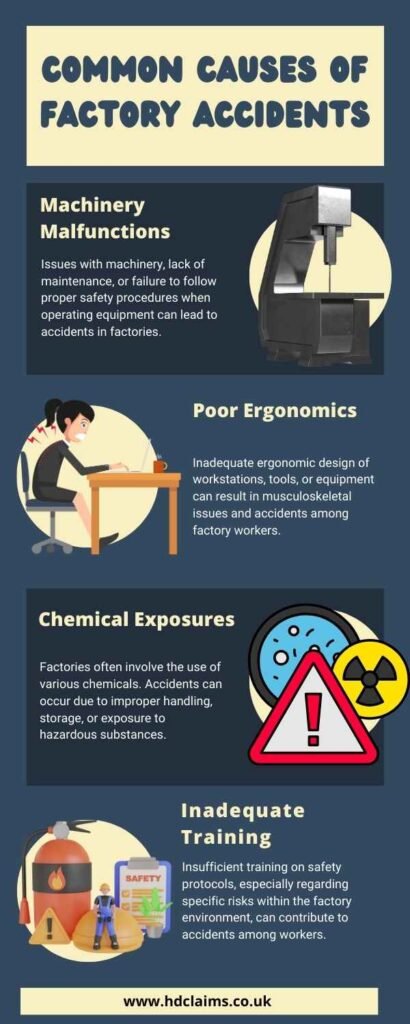
Factory accidents usually happen when known risks are allowed to build into serious dangers. On many sites, the danger is not the presence of machinery or chemicals on its own. It is the failure to control them properly.
We see these same patterns in large manufacturing and logistics locations across Scotland, including the Forth industrial corridor, the Glasgow region, and major warehouse and port-linked sites in Fife.
A dangerous machinery accident in a factory often starts with a shortcut that should never have been allowed. This can happen when safety guards are removed from conveyor belts, presses, or cutting equipment to speed up production, when maintenance is put off, or when a known fault is left unaddressed.

The injuries that can follow include:
- Crush injuries
- Amputations
- Severe hand trauma
- Deep lacerations
Forklift truck collisions are another common cause of serious injury in Scottish factories and warehouses. Where FLT routes cross pedestrian walkways, visibility is poor, loads are unstable, or traffic systems are poorly planned.
Workers can suffer:
- Impact injuries
- Crush injuries
- Fractures
- Head injuries
Manual handling injuries are also common where staff are expected to lift heavy pallets, awkward stock, or raw materials without mechanical aids or proper training.
These accidents often lead to:
- Back injuries
- Muscle tears
- Shoulder injuries
- Slipped or herniated discs
Exposure to hazardous chemicals or substances at work is another serious workplace risk. Under the Control of Substances Hazardous to Health Regulations, employers must store, handle, and control dangerous substances properly. When liquids leak, containers are mislabeled, ventilation is poor, or workers are sent in without the right protective equipment.
The injuries can include:
- Chemical burns
- Breathing injuries
- Eye injuries
- Lasting skin or lung damage
Common Types of Factory and Warehouse Injuries
Factory and warehouse accidents can leave workers with injuries that are immediately obvious, and others that develop over time. We often see people needing urgent hospital care after crush accidents or falls, while others only realise the full extent of the damage once pain, weakness, or restricted movement start affecting daily life.
Common injuries in these settings include:
- Fractures to the hands, wrists, arms, ankles, ribs, and legs
- Crush injuries involving fingers, feet, or limbs
- Deep cuts, lacerations, and degloving injuries caused by machinery or sharp materials
- Burns from heat, steam, chemicals, or faulty equipment
- Head injuries, including concussion and traumatic brain injury
- Back injuries from lifting, twisting, or carrying heavy stock
- Spinal injury cases linked to falls, collapsing loads, or vehicle impacts
- Shoulder, knee, and soft tissue injuries that can become long-term if not treated properly
- Hearing damage after repeated exposure to excessive industrial noise
- Breathing problems and skin conditions caused by dust, fumes, or chemical contact
Some workers also develop industrial disease after repeated exposure in the workplace. That can include noise-induced hearing loss, occupational asthma, or hand-arm vibration problems. Whether the harm was caused by one event or built up over months or years, the effect on work, income, and recovery can be just as serious.
What to Do Immediately After a Factory Workplace Accident
Your first step is to get medical treatment as soon as possible. That may mean going to the on-site first-aider, going to A&E, or calling an ambulance if the injury is serious. If you have hit your head, suffered a burn, broken a bone, or feel unsteady, do not try to finish your shift.
Once the immediate danger has passed, make sure the accident is formally recorded in the employer’s official Accident Book. Ask for the entry to be clear about where the accident happened, what equipment or substance was involved, and what injury you suffered. If possible, take a photo of the entry or ask for a copy.
Try to protect evidence while events are still fresh. Get the names and contact details of any coworkers who saw what happened. If there is CCTV in the area, ask for that footage to be preserved before it is overwritten.
Making A Personal Injury Claim In Scotland
Our panel of experienced personal injury lawyers excel in handling cases against well-funded insurance companies.
Our specialised injury lawyers will assist you with your claim, keep you informed throughout the whole process, and provide you with legal advice that is easy to understand.
01
Get In Touch.
Tell us your story, we're here to listen and provide you with an initial assessment based on your circumstances.
02
We’ll Prepare Your Claim.
We'll be by your side to take care of the legal process. We'll keep you informed of every step of the way.
03
Receive Compensation.
If your claim is successful, we'll ensure that you get your compensation as soon as possible.
"A Student’s Journey from Trauma to Triumph: Efthymios’s Fight for Justice After a Devastating Car Accident"
When Efthymios was injured in a car accident, he was left with severe facial injuries. He didn’t know how he would manage his recovery and studies.
“When I got in contact with HD Legal, they made me feel supported. They were incredibly understanding and fought hard for me, ensuring I received the compensation I deserved.”
"Cracked Pavement, Broken Ankle: How HD Legal Helped Margaret Find Justice and Peace of Mind"
When Margaret tripped on a neglected crack in the pavement in Glasgow, she shattered her ankle and was forced to take months off work, unsure how she would manage.
“HD Legal were a lifeline for me. They took care of everything—from gathering crucial evidence to battling the council—and gave me the peace of mind I needed to focus on my recovery.”
"Blown Away: HD Legal Fights for Douglas After Faulty Washing Machine Explosion"
When Douglas’s new washing machine exploded, it caused a fire that damaged his kitchen and left him with painful burns.
“HD Legal fought relentlessly for me when it seemed like no one else would. They were thorough, professional, and supported me every step of the way, helping me recover both physically and financially.”
"From Misdiagnosis to Recovery: How HD Legal Fought for Eilidh’s Justice and Secured the Care She Needed"
When Eilidh’s severe abdominal pain was repeatedly misdiagnosed, her condition worsened, leading to the need for urgent surgery.
“HD Legal stood by me when I felt lost. They were thorough, professional, and fought tirelessly to get me the care and compensation I needed to heal.”
"Falling from Heights, Rising with Justice: How HD Legal Secured Compensation for Alistair After a Workplace Accident Involving Faulty Scaffolding"
Alistair Campbell’s fall from faulty scaffolding left him with serious injuries and months of recovery.
“HD Legal’s panel of solicitors fought for me, ensuring I received the support needed to move forward.”
What Evidence is Needed to Support Your Scottish Claim?
The strongest claims are usually supported by simple, practical evidence gathered as early as possible. Before court proceedings are raised, Scottish personal injury claims often begin under the personal injury pre-action protocol, where information, evidence, and liability details are exchanged at an early stage. That is one reason why preserving records, witness details, CCTV footage, and medical evidence straight away can make such a difference.
Useful evidence can include:
- The Accident Book entry
- Photographs of the area, dangers, obstacles, machine, spill, or missing guard
- CCTV footage
- Witness names and statements
- Hospital, GP, physiotherapy, or other treatment records
- Wage slips or employer records showing loss of earnings
- Emails, messages, or internal reports showing that the danger had already been reported before the accident
If you are physically able, keep a short record of your symptoms and recovery in the days that follow. That can help show how the injury affected your work, sleep, mobility, and daily routine from the outset.
Will Making a Claim Affect My Employment or Job Security?
Making a factory accident compensation claim should not, in itself, put your job at risk. For many workers, this is the biggest concern after an accident, especially when they are still employed by the same company. In most cases, the claim is handled through the employer’s insurance, not paid directly from the factory owner’s bank account. By law, most employers in Great Britain must have Employers’ Liability Insurance in place to cover compensation if an employee is injured or becomes ill because of their work.
Time off after a serious accident is also far more common than many people realise. According to the HSE’s 2024/25 summary data, 40.1 million working days are lost each year due to work-related illness and workplace injury across Great Britain. That means factory employers, HR teams, and insurers are used to dealing with absence, recovery periods, and insurance procedures after workplace injuries.
Your employer should not dismiss you, demote you, or make your working life worse because you raised a health and safety issue or exercised your legal rights after being injured. Employees may be protected from dismissal and detriment in health and safety cases, and the Employment Rights Act 1996 provides protection where an employee is dismissed for asserting a statutory right.
If your treatment, hours, duties, or the way you are treated at work changes after the accident, keep a record of it. A sudden cut in hours, pressure to stay quiet, hostility from management, or threats about your job can all matter. Where those issues arise, we can help you understand the position clearly while overseeing the legal strategy of your claim from start to finish.
How Much Compensation Will I Get for a Factory Injury in Scotland?
Compensation for a factory injury in Scotland is worked out by considering two parts of the claim.
One part covers the injury itself. In Scottish cases, this is called solatium. It takes account of the pain you have been through, the effect on your movement, any scarring, and the emotional impact of the accident.
The other part covers the financial knock-on effects. This is known as patrimonial loss. It can include money you have already lost, along with costs you may continue to face while you recover or adapt to the injury.
For factory and warehouse workers, patrimonial loss can include:
- Lost basic wages
- Missed overtime and shift allowances
- Travel costs linked to treatment
- Private rehabilitation costs
- Future care and support needs
- Prosthetics or specialist equipment in severe injury cases
Where the injury is serious, the claim may also reflect future loss if returning to the same role is no longer possible or hours have to be reduced. In higher-value cases, the cost of ongoing rehabilitation, future treatment, and prosthetic support can form a major part of the overall compensation.
In the most serious and high-value cases, particularly where long-term disability, major future wage loss, or lifelong care needs are involved, the claim may be brought in the Court of Session instead of the sheriff court.
If you want a rough starting point before speaking to us, you can check your factory accident compensation value using our compensation calculator. A proper valuation depends on the medical evidence, your loss of earnings, and how the injury is likely to affect your life and work over time.
DEDICATED CLAIMS ADVISORS
Our dedicated claims advisors are always available to offer free legal advice.
100% NO WIN NO FEE CLAIMS
All our claims are processed on a No Win No Fee basis; you pay nothing if you lose.
MILLIONS SECURED IN DAMAGES
To date, we have secured millions in damages.
THOUSANDS OF SATISFIED CLIENTS
To date, we have helped thousands of clients recover compensation and continue to do so.
Time Limits for Scottish Factory Injury Claims
Most factory injury claims in Scotland are subject to a strict three-year court time limit under the Prescription and Limitation (Scotland) Act 1973. For a sudden accident, such as a crush injury, forklift collision, or fall at work, the clock will usually start running on the date of the accident itself.
Some industrial injury and occupational disease claims work differently because the harm does not always show up straight away. Noise-induced hearing loss, asbestos-related illness, occupational asthma, and similar conditions can take time to develop, and workers often do not realise at first that their health problem is linked to factory exposure.
That is where the date of knowledge rule becomes important. In broad terms, the three-year period may begin when you first knew, or could reasonably have known, that you had a significant injury and that it was connected to your work rather than some unrelated cause.
It is always better to get advice early. Even when the time limit has not expired, delays can make it harder to trace employers, preserve records, locate witnesses, and secure medical evidence that clearly links the injury to the work you were doing.
If court action becomes necessary, many Scottish personal injury cases are raised in the National Personal Injury Court, also known as the All-Scotland Sheriff Personal Injury Court. The rules governing this specialised court are continually refined based on feedback from across the civil justice sector, including consultative updates from the Law Society of Scotland.
No Win No Fee Factory Claims in Scotland
Money worries stop a lot of injured workers from taking the next step. According to the HSE’s 2024/25 findings, 1.9 million working people in Great Britain were suffering from a work-related illness. That scale is one of the reasons Scottish law now gives claimants more protection from the cost risks that used to deter people from bringing a case.
In Scotland, “No Win, No Fee” is commonly dealt with through a Speculative Fee Agreement. That means you do not pay an upfront legal fee to start the case, and the legal fee position depends on the outcome rather than landing on you at the beginning when you are already dealing with lost income and recovery.
There is another safeguard as well. Qualified One-Way Costs Shifting, usually shortened to QOCS, applies in Scottish personal injury cases raised on or after 30 June 2021. In most cases, it means the court should not make you pay the other side’s legal expenses if the claim does not succeed, as long as the case is pursued properly and honestly.
Taken together, these protections make a real difference. They give injured factory workers a route to justice without the fear that one unsuccessful case will leave them facing a second financial crisis.
Why Choose HD Claims for Your Scottish Factory Injury Case?
After a factory accident, most people are not thinking about legal terminology. They are thinking about pain, wages, hospital visits, and how they are supposed to get back on track. At that stage, having the right support can make a real difference.
That is where we come in. Our role is to manage the legal strategy of your claim from start to finish. We work alongside a team of specialist personal injury solicitors best suited to your specific case, including work-related injury compensation solicitors with experience in serious accidents at work, so your representation matches the facts of your injury and the way it happened.
We also keep the process practical. You are told what is happening, what evidence is needed, and what the next step looks like, without being left to chase updates or figure it out on your own. That matters even more in factory cases, where the evidence can involve machinery, workplace systems, training records, witness accounts, and medical support.
Most of all, we understand that recovery comes first. While you focus on treatment, appointments, and getting back some stability, we oversee the legal process and help move the claim forward in a clear, structured way.
If you want to talk through your options, call us on 01412801112.
FAQs
Can I claim if I am an agency worker or on a zero-hours contract?
Yes, you may still be able to claim. Health and safety protection does not disappear because your contract is temporary, through an agency, or based on irregular hours. According to HSE, agency and temporary workers are protected by law, with responsibility falling on the agency, the end user business, or both, depending on who controls the work and premises.
What if the accident was partly my fault?
A claim is not always ruled out just because you made a mistake as well. In some cases, fault is shared, and compensation can be reduced to reflect your part in what happened, rather than the claim failing altogether.
How long does a factory accident claim take?
There is no fixed timetable for every case. Claims usually move faster where fault is admitted early, and the medical picture is clear, while cases involving serious injuries, ongoing treatment, disputed liability, or complex wage loss usually take longer.
We’re Here To Help When You Need Us Most.
Call us on 0141 2801112, or leave us a message below to request a call back and one of our team will be in touch as soon as we can.